A flower is an angiosperm's reproductive structure. Stamens produce pollen; carpels enclose ovules. Petals and sepals surround these organs in a complete flower, but some flowers lack one or more groups, including either reproductive group.[ref]
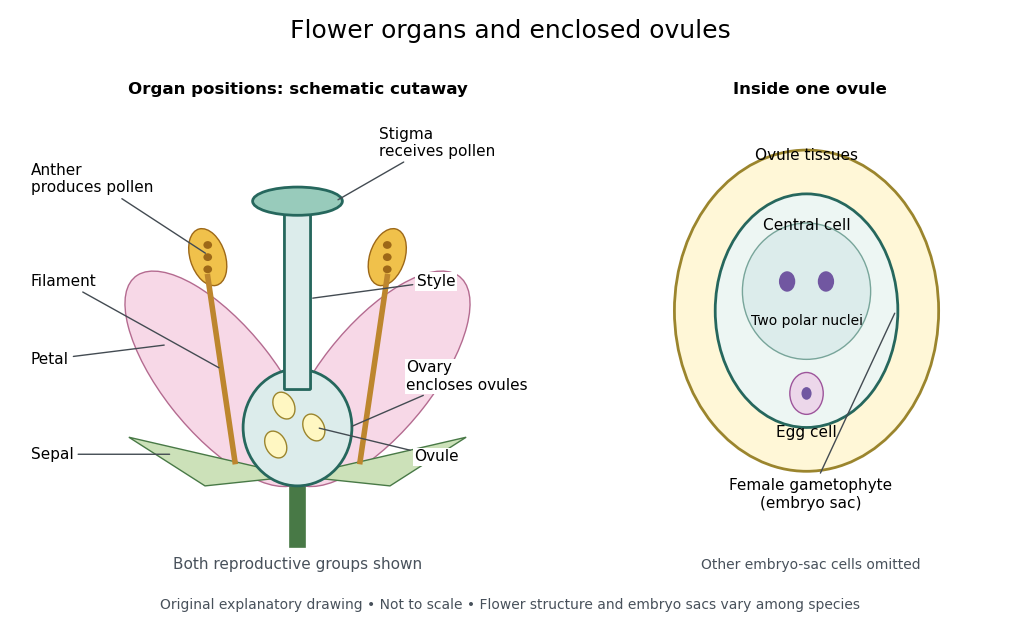

Read the drawing from outside inward, then trace two routes: where pollen is released, and where an ovule is enclosed. This reveals why catching pollen and forming a seed require different structures. A detached petal cannot substitute for a stigma simply because both belong to the same flower.
Temporal separation of male and female reproductive function. It can reduce self-fertilization without requiring separate male and female flowers.
Spatial separation of male and female reproductive organs that can reduce self-pollen transfer while retaining them within one flower.
The floral structures surrounding the reproductive organs, often differentiated into sepals and petals. Protection and pollinator attraction can be combined in a shared display.
A flower containing both male and female reproductive organs, stamens and carpels. It differs from monoecy, in which male and female structures occur separately on the same individual.
The organization of symmetry in a flower. Whole-flower symmetry, individual organ shape and developmental identity are distinct characters; similar outlines can arise through different molecular mechanisms.
A floral arrangement with one principal symmetry plane. Differential deployment of dorsal regulators can contribute, but a shared appearance does not establish one universal developmental mechanism.
A floral arrangement with multiple planes of symmetry around the reproductive axis. Its developmental basis can differ among lineages, so a derived radial flower need not restore the ancestral organ identities.
A stamen is a flower's male reproductive organ, typically an anther supported by a stamen filament. The anther produces and releases pollen.[ref]
Biology 2e by Mary Ann Clark and others. Biology 2e, §32.1 Flower Structure and Male Gametophyte (The Pollen Grain), Figures 32.3 and 32.6
The stalk supporting an anther.
The stigma is the carpel's pollen-receiving region. Compatible pollen may form a pollen tube that grows toward an ovule; arrival alone does not establish fertilization.[ref]
32.2 Pollination and Fertilization. Biology 2e, §32.2 Incompatibility Genes in Flowers and Double Fertilization
A useful diagnostic question is what was actually observed: pollen on a stigma, a growing pollen tube, or a new plant embryo? Each observation tests a different stage. A pollen tube germination assay isolates the middle process for direct viewing.
A female reproductive unit of a flower, comprising a stigma, a style and an ovary. A flower may have several carpels, including fused ones.[ref]
Biology 2e by Mary Ann Clark and others. Biology 2e, §32.1 Flower Structure: individual carpel and one or multiple carpels
The structure containing the angiosperm female gametophyte; a fertilized ovule can develop into a seed.
The gametophyte inside an angiosperm's ovule, containing an ovum and, in the common arrangement, a central biological cell with two polar cell nuclei.[ref]
Biology 2e by Mary Ann Clark and others. Biology 2e, §32.1 Female Gametophyte (The Embryo Sac), Figure 32.8; species variation is explicitly noted
An outer flower organ often protecting the unopened bud.
Articles by others on the same topic
There are currently no matching articles.