A eukaryote is an organism belonging to the lineage characterized by a membrane-bounded cell nucleus and extensive cellular compartmentalization. A nuclear envelope surrounds the nuclear genome; nuclear chromosomes are typically linear. Ribosomes perform biological translation outside the cell nucleus. See OpenStax Microbiology, 3.4: nuclear organization and protein synthesis. Specialized biological cells can lose their cell nucleus, as mature mammalian red blood cells do, while remaining parts of eukaryotic organisms; see OpenStax Biology 2e, 40.2: mature red blood cells.
Yeasts, plants and animals are all eukaryotes. Typical cells in these groups have mitochondria, but chloroplasts belong to photosynthetic plant and algae lineages, not to every eukaryote. A cell wall occurs in typical plant and fungus cells but is absent from animal cells. These are comparisons of representative cells, not a checklist every specialized cell must satisfy. See OpenStax Biology 2e, 4.3: nucleus, organelles and representative cells.
The interesting feature is controlled separation: cell membranes and organelle membranes let different cellular processes occupy distinct compartments while membrane transport connects them. The evolution of eukaryotes also involved partnership: mitochondria descend from a bacterial endosymbiosis. Modern phylogenetics supports an archaeal ancestry for the nuclear lineage, alongside this bacterial contribution; see two-domain system. Thus the history of a whole eukaryote cannot be read as the history of just one of its genes.
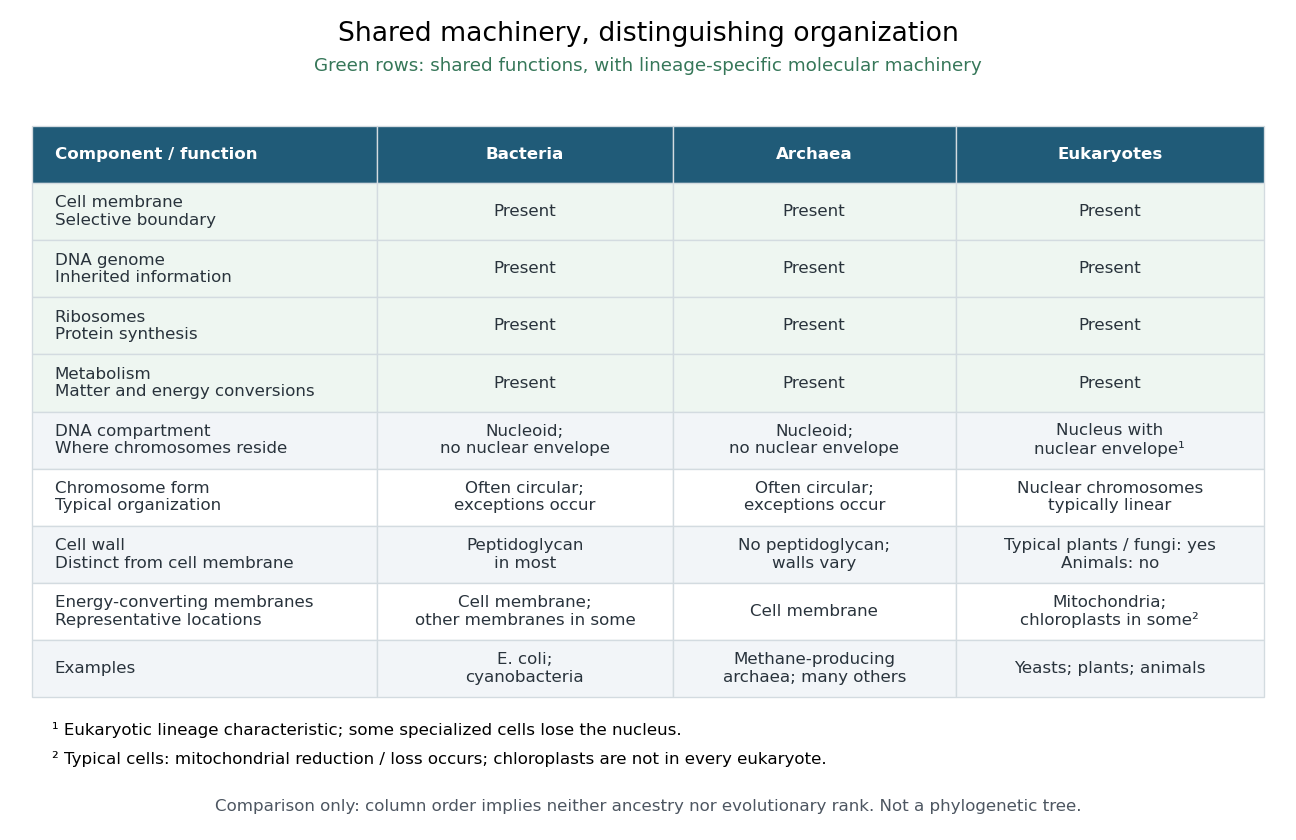
A fungus is a eukaryote that obtains nutrients by absorption rather than photosynthesis. Fungi include unicellular yeasts and multicellular forms. Their cell walls differ from bacterial peptidoglycan walls; having a cell wall does not make a fungus a plant. See OpenStax Biology 2e, 24.1: fungal nutrition and organization.
Yeasts are fungi whose growth is predominantly unicellular, commonly through budding or division into two cells. The word describes a growth form across different fungal lineages, rather than one species or an exclusive clade; some fungi can switch between unicellular and filamentous growth. Thus Saccharomyces cerevisiae is a yeast, but yeast is not another name for that one species. See Kurtzman, Fell and Boekhout, The Yeasts, chapter 1 (2011): definition and classification.
A yeast cell has eukaryotic organization, including a cell nucleus, mitochondria and a cell wall. Small size and a unicellular lifestyle do not make it a member of bacteria. These compartments let an experimentally accessible biological cell retain much of the organization shared with other eukaryotes. See Clark, Douglas and Choi, Biology 2e, 24.1: fungal cells and yeast growth.
A motivating experiment: can fermentation continue without intact yeast cells? In 1897, Eduard Buchner ground brewers' yeast with quartz sand and diatomite, added water, and pressed out a liquid extract. Adding concentrated cane sugar produced carbon dioxide after 15–60 minutes. A cell-retaining filter still yielded an active filtrate: with sterilized cane sugar in an icebox, fermentation began after about a day. Saturated lactose gave no observed fermentation. These are reported observations, not invented control results. See Buchner, Alcoholic fermentation without yeast cells (1897), translated excerpt hosted by Carmen Giunta.
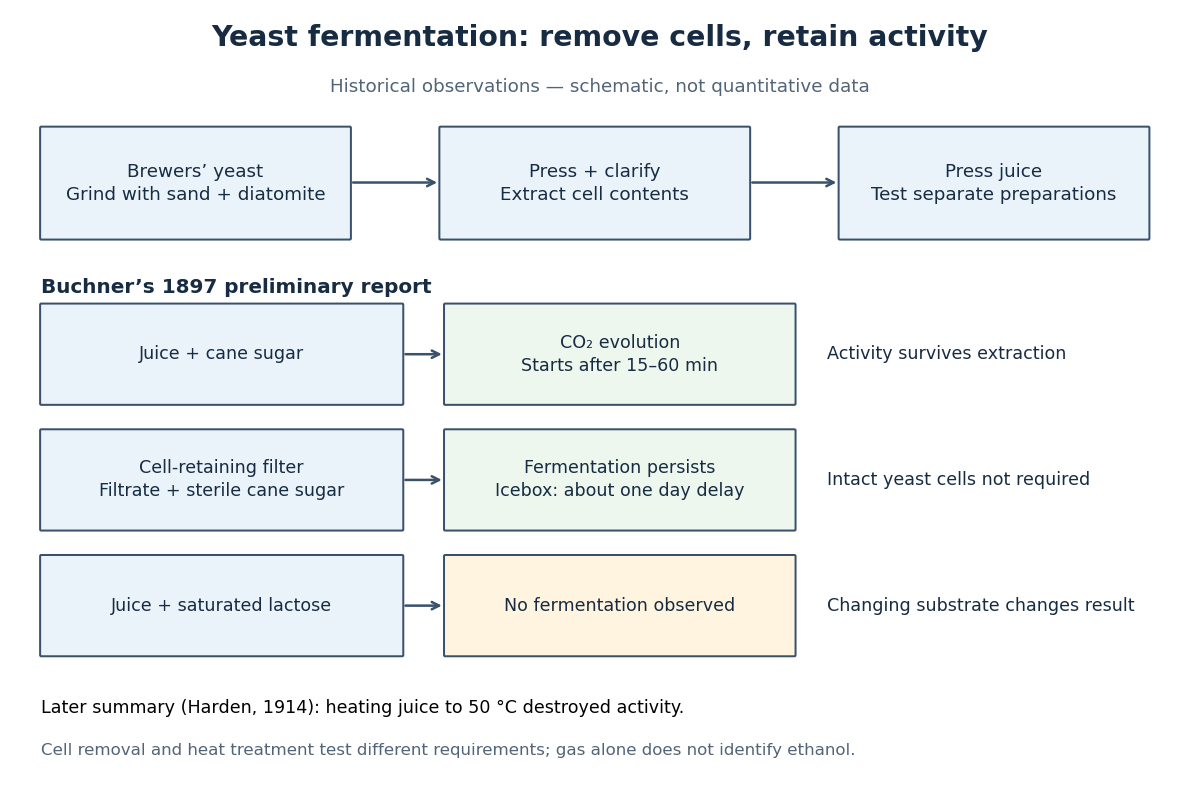
The filtration comparison addresses the objection that surviving intact yeast cells caused the activity. The lactose comparison tests substrate dependence; it is not a no-sugar blank, nor a comparison at matched sugar concentrations. A proposed modern follow-up would also compare the same extract with and without added sugar, accounting for material already in the extract. That is an experimental suggestion, not a result attributed to Buchner. His report specifies brewers' yeast; it does not identify the preparation here as a pure Saccharomyces cerevisiae strain.
Heat treatment asks a different question: does destroying activity in the extract stop fermentation? Buchner's preliminary report described weak or absent activity after heating and filtration, rather than one clean universal threshold. Harden's 1914 account of the subsequent work summarized loss of activity on heating the juice to . Harden also described requirements for both enzymes and coenzymes. Cell-free therefore means neither chemical-free nor a preparation containing one purified enzyme. See Arthur Harden, Alcoholic Fermentation (1914), chapters II and VI: cell-free activity and the fermenting complex.
The inference is that extracted cellular machinery can sustain these chemical reactions without an intact living biological cell. This does not show that the extract reproduces, grows or maintains itself like a yeast. Moreover, gas evolution alone does not identify ethanol: cellular respiration can also release carbon dioxide. Product identification is a separate measurement; Harden's account describes both ethanol and carbon dioxide as products of cell-free alcoholic fermentation. The beautiful separation is between the organism that produces and maintains the machinery and the machinery that catalyzes a particular transformation.
Schizosaccharomyces pombe is a yeast species used as a model organism. It supplies the candidate genes in the yeast cross-species complementation experiment; the recipient remains Saccharomyces cerevisiae.
Saccharomyces cerevisiae is a particular species of yeast, used in baking, brewing and laboratory research. During ordinary vegetative growth it reproduces by budding: a smaller daughter grows from the mother before separation. Laboratory strains can be maintained as either haploid or diploid biological cells. This makes it possible to investigate genes in a single eukaryote, then use controlled crosses and meiosis to connect a genotype to a phenotype. See Burgess, Powers and Mell, Budding Yeast Saccharomyces cerevisiae as a Model Genetic Organism (2017), pp. 1–2.
The practical value of Saccharomyces cerevisiae as a model organism is the combination of easy laboratory cultivation, accessible genetics, and cellular functions shared with other eukaryotes. A haploid strain has one set of chromosomes, so a changed allele is not accompanied by a second copy at that genetic locus. But a mutation need not produce an observable phenotype under every condition. The yeast is also a whole organism, not a miniature human: transferring a result requires evidence that the relevant function is shared in the target system. See Duina, Miller and Keeney, Budding Yeast for Budding Geneticists (2014): cultivation, genetic tools and conserved functions.
For a concrete example, Hartwell, Culotti and Reid's 1970 work followed temperature-sensitive Saccharomyces cerevisiae strains with successive microscope photographs. Failure to complete a particular part of the cell cycle helped identify required gene functions. Their distinction between when a function is required and where a cell finally stops is especially instructive: the visible endpoint need not be the time of the underlying defect. See Hartwell, Culotti and Reid, Genetic control of the cell-division cycle in yeast. I. Detection of mutants (1970): primary abstract. This is a useful way to turn an observable change in a biological cell into a question about genes and causal order.
In alcoholic fermentation, Saccharomyces cerevisiae converts sugars into ethanol and carbon dioxide. The carbon dioxide helps dough rise; the ethanol is useful in alcoholic drinks. The metabolism also supports production of ATP, a usable cellular energy carrier. This is one metabolic ability of one species, not the definition of every yeast. See Clark, Douglas and Choi, Biology 2e, 7.5: alcohol fermentation and the Burgess, Powers and Mell account above.
For glucose, the ideal net stoichiometry isOne molecule of glucose supplies six carbon chemical atoms: four end up in the two ethanol molecules and two in the two carbon dioxide molecules. The twelve hydrogen and six oxygen chemical atoms also balance. This is a net material balance across several enzyme-catalyzed steps, not a single chemical reaction step or the complete bookkeeping for cellular energy carriers. The standard pathway accounting yields a net two ATP per glucose: the initial breakdown produces the ATP, while the later conversion to ethanol regenerates a coenzyme needed to keep the breakdown going. See Clark, Douglas and Choi, Biology 2e, 7.2: net ATP accounting and the section 7.5 cited above.
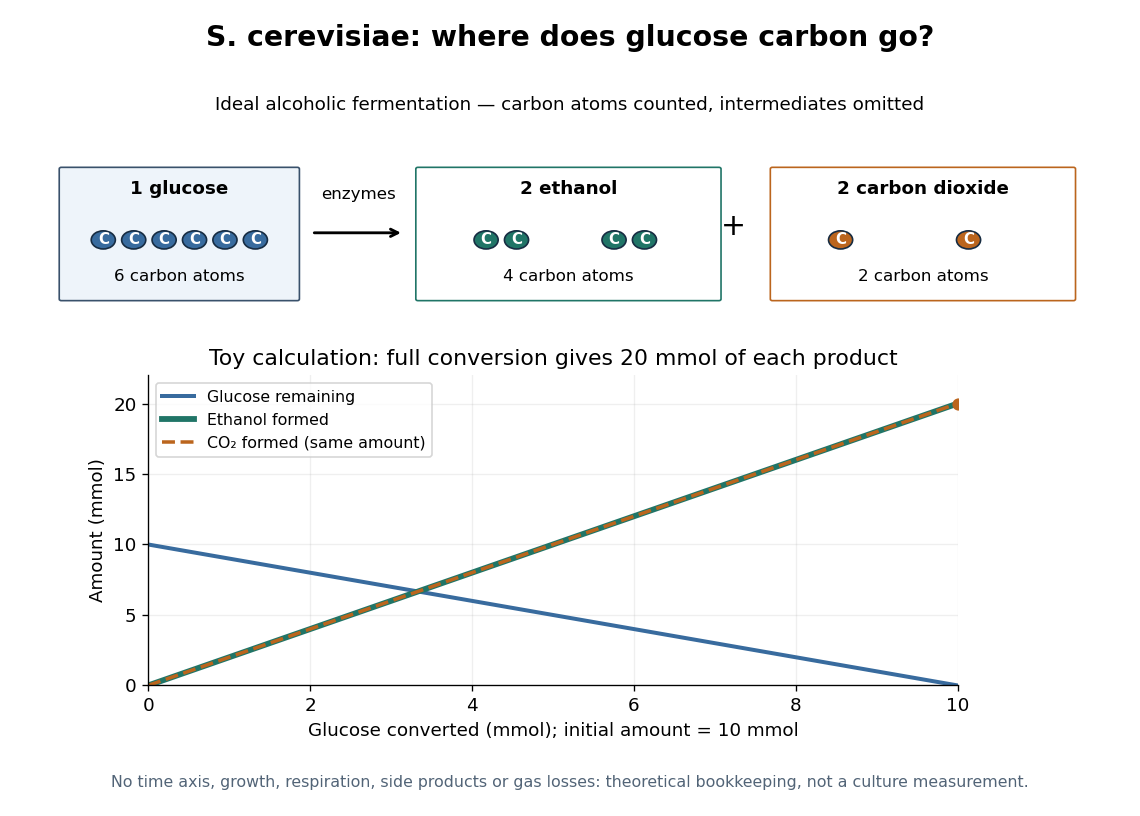
At complete conversion, this toy gives of ethanol and of carbon dioxide. The carbon balance is of carbon chemical atoms. A real culture also builds cellular material, can use other metabolic routes, and may retain dissolved carbon dioxide; the toy is a reference balance rather than a prediction of collected gas or beverage yield.
Although alcoholic fermentation does not require molecular oxygen as a reactant, the presence of molecular oxygen does not force Saccharomyces cerevisiae to stop fermenting. De Deken's 1966 experiments reported predominantly fermentative glucose use during exponential growth in air. Consequently, bubbles do not establish either absence of molecular oxygen or an exclusively fermentative metabolism. See De Deken, The Crabtree Effect: A Regulatory System in Yeast (1966): primary abstract.
Plants are eukaryotes. A typical photosynthetic leaf cell has a cell nucleus, mitochondria, chloroplasts, and a cell wall outside its cell membrane. A root cell need not have chloroplasts; the plant's parts specialize for different functions. Plants perform cellular respiration as well as photosynthesis. See OpenStax Biology 2e, 4.3: plant cell organization.
A flower is an angiosperm's reproductive structure. Stamens produce pollen; carpels enclose ovules. Petals and sepals surround these organs in a complete flower, but some flowers lack one or more groups, including either reproductive group.[ref]
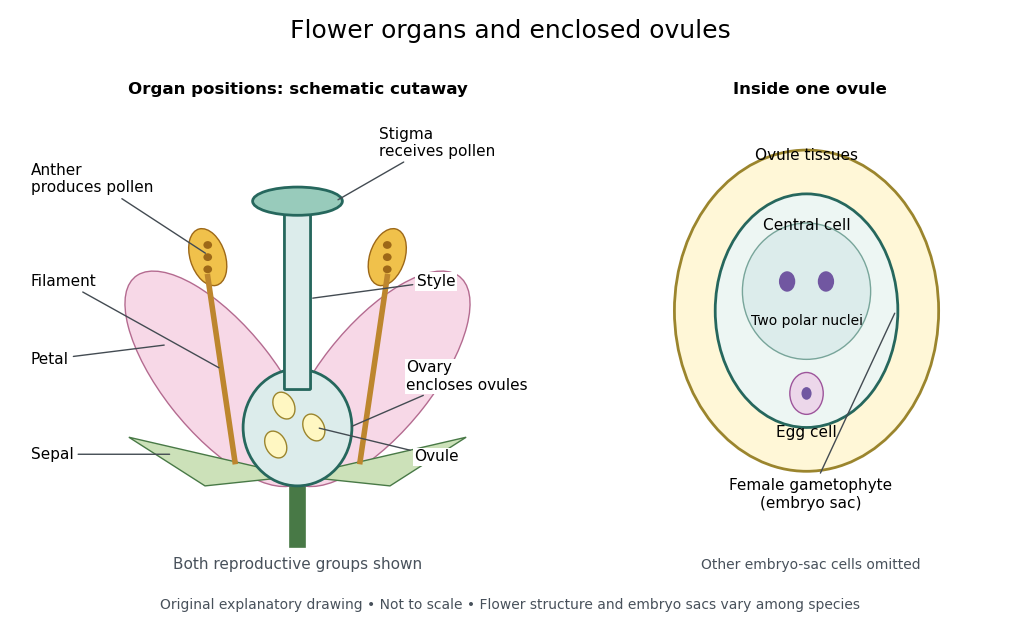
Read the drawing from outside inward, then trace two routes: where pollen is released, and where an ovule is enclosed. This reveals why catching pollen and forming a seed require different structures. A detached petal cannot substitute for a stigma simply because both belong to the same flower.
A stamen is a flower's male reproductive organ, typically an anther supported by a stamen filament. The anther produces and releases pollen.[ref]
Biology 2e by Mary Ann Clark and others. Biology 2e, §32.1 Flower Structure and Male Gametophyte (The Pollen Grain), Figures 32.3 and 32.6
The stalk supporting an anther.
The stigma is the carpel's pollen-receiving region. Compatible pollen may form a pollen tube that grows toward an ovule; arrival alone does not establish fertilization.[ref]
32.2 Pollination and Fertilization. Biology 2e, §32.2 Incompatibility Genes in Flowers and Double Fertilization
A useful diagnostic question is what was actually observed: pollen on a stigma, a growing pollen tube, or a new plant embryo? Each observation tests a different stage. A pollen tube germination assay isolates the middle process for direct viewing.
A female reproductive unit of a flower, comprising a stigma, a style and an ovary. A flower may have several carpels, including fused ones.[ref]
Biology 2e by Mary Ann Clark and others. Biology 2e, §32.1 Flower Structure: individual carpel and one or multiple carpels
The structure containing the angiosperm female gametophyte; a fertilized ovule can develop into a seed.
The gametophyte inside an angiosperm's ovule, containing an ovum and, in the common arrangement, a central biological cell with two polar cell nuclei.[ref]
Biology 2e by Mary Ann Clark and others. Biology 2e, §32.1 Female Gametophyte (The Embryo Sac), Figure 32.8; species variation is explicitly noted
An outer flower organ often protecting the unopened bud.
A seed packages a plant embryo, a seed food reserve and a protective seed coat. It is a living starting point for a new plant, not merely stored food. In a mature pea seed, the large cotyledons hold reserves; other seeds retain substantial endosperm. These are alternative arrangements, not successive germination stages.[ref]
Biology 2e by Mary Ann Clark and others. Biology 2e, §32.2 Development of the Seed, Figure 32.20 and the paragraph on pea cotyledons
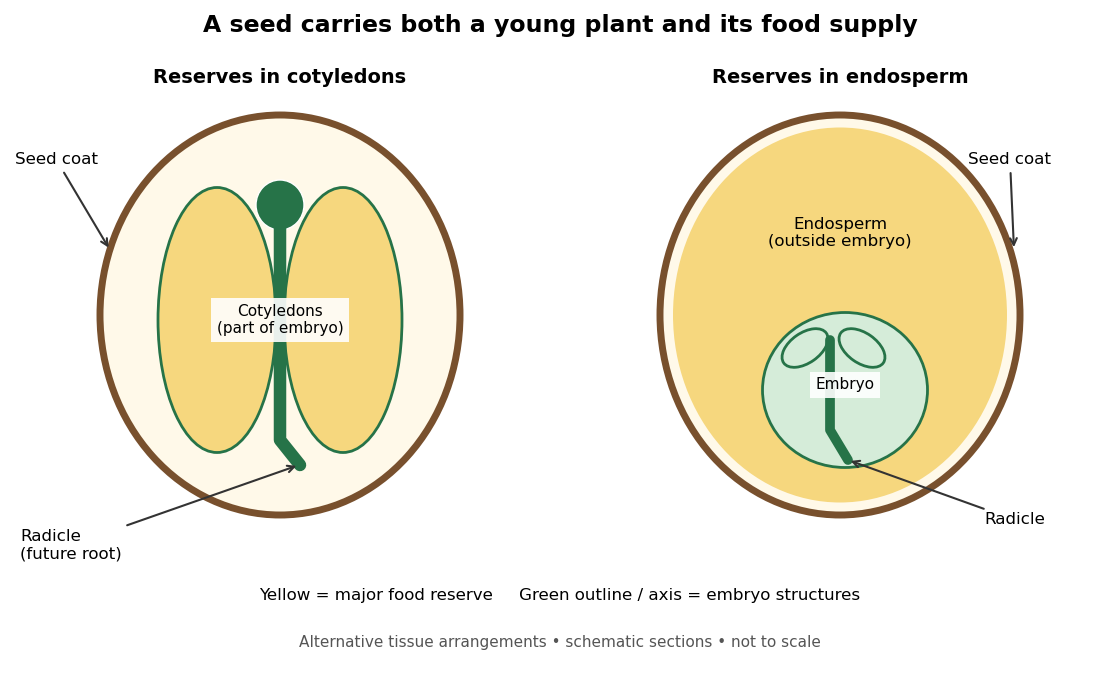
A useful reading exercise is to identify both the future plant and its initial food supply in each drawing. The large yellow area has the same role in both pictures, but it belongs to different plant tissues. Thus location and function alone do not establish tissue identity.
The protective covering of a seed, formed from maternal plant tissues surrounding the developing plant embryo.
Stored material supporting early seedling growth, located in cotyledons, endosperm or other plant tissues depending on the plant.
A nutritive plant tissue distinct from the plant embryo; it may remain in the mature seed or be depleted during development.[ref]
Biology 2e by Mary Ann Clark and others. Biology 2e, §32.2 Development of the Seed: endospermic and non-endospermic seeds
A young plant developing after germination. Early growth can use a seed food reserve before leaves support photosynthesis.[ref]
Biology 2e by Mary Ann Clark and others. Biology 2e, §32.2 Development of the Seed: reliance on cotyledon reserves before leaf photosynthesis
Seed germination is renewed plant embryo activity and growth. Many germination assays score completion as radicle emergence, before seedling establishment. Seed imbibition precedes that endpoint; swelling alone is insufficient.[ref]
Seed dormancy and the control of germination by William E. Finch-Savage and Gerhard Leubner-Metzger. Seed dormancy and the control of germination, §II.1, p. 502: water uptake, embryo expansion and radicle protrusion
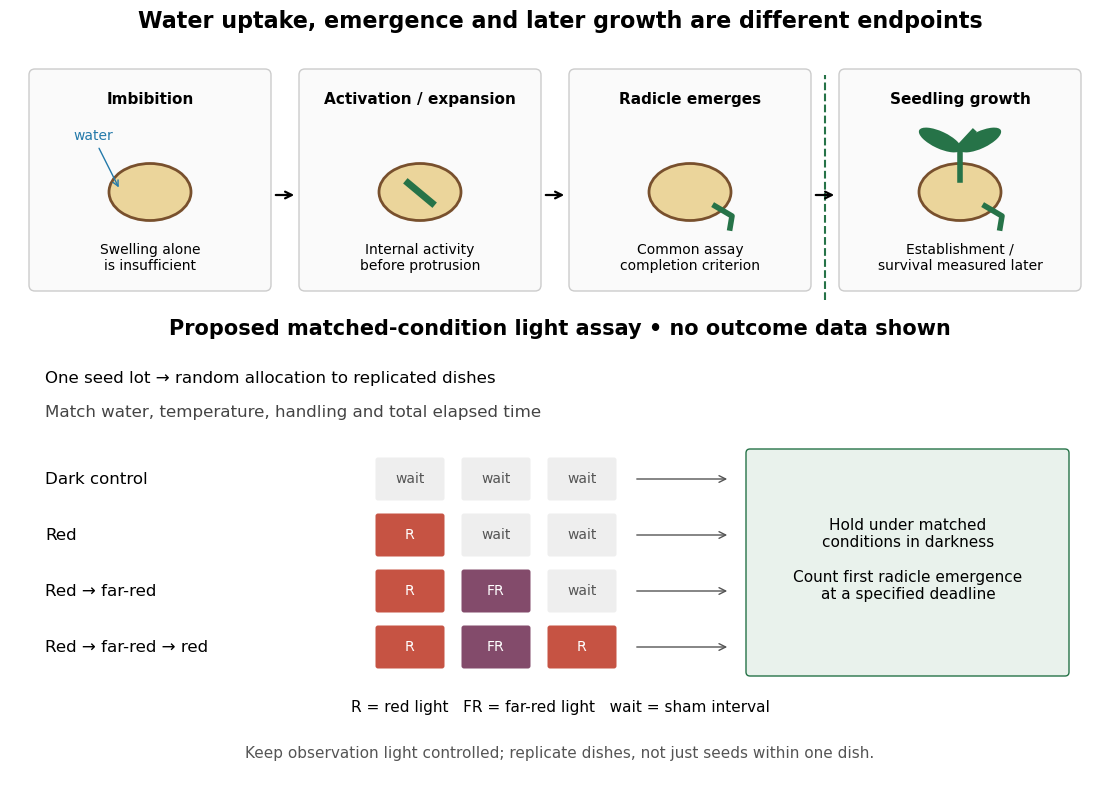
Water, molecular oxygen and suitable temperature support germination; light sensitivity depends on the species and seed state. Neither illumination nor one particular temperature is universally required. Seed dormancy connects germination timing to ecology by delaying seedling establishment.[ref]
Seed dormancy and the control of germination by William E. Finch-Savage and Gerhard Leubner-Metzger. Seed dormancy and the control of germination, Summary and §II.1–2, pp. 501–502: environmental requirements and timing
The distinction matters when comparing propagation experiments: a treatment that increases radicle emergence need not improve later seedling survival. Define the endpoint before comparing treatments, then measure the later outcome separately.
Initial seed water uptake, permitting renewed metabolism. Hydration does not prove seed viability or imply the idealized hydraulic law for capillary imbibition.[ref]
Seed dormancy and the control of germination by William E. Finch-Savage and Gerhard Leubner-Metzger. Seed dormancy and the control of germination, §II.1, p. 502: initial uptake and subsequent embryo expansion
A living seed's restriction on germination under otherwise favorable conditions, distinct from insufficient water, unsuitable temperature or lost seed viability. One failed test cannot diagnose seed dormancy.[ref]
Seed dormancy and the control of germination by William E. Finch-Savage and Gerhard Leubner-Metzger. Seed dormancy and the control of germination, §II.2, p. 502: operational definition and why absence of germination is insufficient
The capacity of a living seed to produce a developing plant under suitable conditions. A seed with seed dormancy can retain seed viability. In an ideal counting exercise, if of seeds complete germination, at least were living at the start. The other are unresolved: a failed germination assay alone cannot separate dead seeds, seed dormancy and unsuitable conditions.
The 1952 experiment used Grand Rapids lettuce seeds on wetted blotters in covered dishes. After 16 hours in darkness, seven lots of 200 received successive alternating exposures: one minute of red light at –, then four minutes above , with one lot removed after each exposure. Treated lots and a dark scientific control remained at for two days; germinated seeds were counted. Separate wavelength tests used a two-glass-prism spectrograph.[ref]
A Reversible Photoreaction Controlling Seed Germination by Harry Alfred Borthwick and others. A Reversible Photoreaction Controlling Seed Germination, pp. 662–664: preparation, spectrograph and alternating-exposure protocol
Table 1 shows alternating promotion and suppression according to the final exposure. Red light could restore promotion after far-red light; suppression was incomplete. This reversibility supports a reversible sensing state rather than simple cumulative illumination. The paper did not isolate or identify the pigment; the response concerns this lettuce preparation and timing. Its readout was a two-day germination count, not subsequent seedling performance.[ref]
A Reversible Photoreaction Controlling Seed Germination by Harry Alfred Borthwick and others. A Reversible Photoreaction Controlling Seed Germination, p. 663 pigment-identification limitation and p. 665 Table 1
The modern phytochrome description distinguishes forms and that interconvert under red and far-red light. This provides a concrete example of signal transduction: light changes a sensing state that affects development. The response should be distinguished from photosynthesis, which supplies chemical resources.[ref]
Biology 2e by Mary Ann Clark and others. Biology 2e, §30.6 The Phytochrome System and the Red/Far-Red Response, Figure 30.38: interconversion and cellular response
A specified test for germination, recording the endpoint, conditions and observation window. For a proposed red/far-red light test, use randomization to allocate one seed lot to darkness, red, red then far-red, and red then far-red then red. Match hydration, temperature, handling and elapsed time before counting; use sham waiting periods to equalize schedules. Use dish replication, retain the dark scientific control, and record radicle emergence using an observation procedure that does not itself provide an uncontrolled light treatment. This is a proposed design, not a claim about the 1952 paper's randomization or replication.
As an original hypothetical counting example, begin with seeds in one dish. Suppose 12 first meet the radicle endpoint by 24 hours, eight additional seeds by 48 hours, and four additional seeds by 72 hours. These invented event counts giveand cumulative sample proportions , and . The 48-hour increment is , not ; the latter includes earlier events. Counting the same emerged radicle again at each inspection would inflate the total. These numbers illustrate bookkeeping, not biological rates or treatment effects.
With a fixed denominator and irreversible classification of the first endpoint event, the set counted at an earlier inspection is a subset of the set counted later. Hence and cannot decrease. This short proof applies to cumulative germination counts even if a later seedling dies. A count of currently surviving seedlings has a different definition and can decrease.
For treatment comparisons, the dish may be the experimental unit: seeds in the same dish share conditions. Forty seeds in one dish do not supply forty independent dish replicates. Report the sample size, replication, endpoint time and denominator; a sample proportion by a deadline measures this assay's outcome, not an unconditional fraction with seed viability.
A grouping of biological cells in a plant with related functions. In a seed, plant embryo tissues and endosperm have distinct developmental identities.
Algae is a broad name for several photosynthetic eukaryotic groups, rather than one exclusive clade. The older name blue-green algae for cyanobacteria is misleading in a comparison of cellular organization: cyanobacteria are bacteria, with neither chloroplasts nor a cell nucleus.
Reclinomonas americana is a microbial eukaryote whose mitochondrial genome retains an unusually rich set of bacterial features. The 1997 sequence report provides a concrete observation under evidence for bacterial ancestry of organelles.
Animals are multicellular organisms with eukaryotic cellular organization. A representative animal cell has a cell membrane, cell nucleus and mitochondria, but no cell wall or chloroplasts. A neuron illustrates how this common plan can acquire a specialized shape and signaling function. See OpenStax Biology 2e, 4.3: animal cell organization.
Drosophila pseudoobscura is the species of insect used in the dietary divergence and mating isolation in Drosophila pseudoobscura experiment. The independently maintained experimental biological populations were not already different species.
Xenopus laevis is a frog used in developmental biology, including the intestinal nucleus transfer experiment and Xenopus laevis egg extract preparations.



