Plants are eukaryotes. A typical photosynthetic leaf cell has a cell nucleus, mitochondria, chloroplasts, and a cell wall outside its cell membrane. A root cell need not have chloroplasts; the plant's parts specialize for different functions. Plants perform cellular respiration as well as photosynthesis. See OpenStax Biology 2e, 4.3: plant cell organization.
A flower is an angiosperm's reproductive structure. Stamens produce pollen; carpels enclose ovules. Petals and sepals surround these organs in a complete flower, but some flowers lack one or more groups, including either reproductive group.[ref]
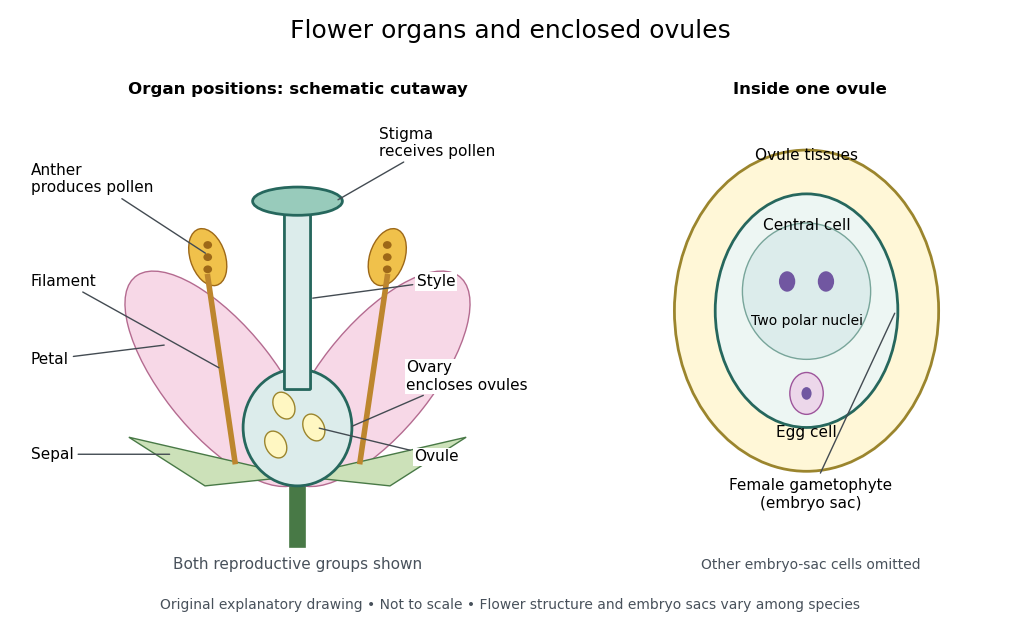
Read the drawing from outside inward, then trace two routes: where pollen is released, and where an ovule is enclosed. This reveals why catching pollen and forming a seed require different structures. A detached petal cannot substitute for a stigma simply because both belong to the same flower.
A stamen is a flower's male reproductive organ, typically an anther supported by a stamen filament. The anther produces and releases pollen.[ref]
Biology 2e by Mary Ann Clark and others. Biology 2e, §32.1 Flower Structure and Male Gametophyte (The Pollen Grain), Figures 32.3 and 32.6
The stalk supporting an anther.
The stigma is the carpel's pollen-receiving region. Compatible pollen may form a pollen tube that grows toward an ovule; arrival alone does not establish fertilization.[ref]
32.2 Pollination and Fertilization. Biology 2e, §32.2 Incompatibility Genes in Flowers and Double Fertilization
A useful diagnostic question is what was actually observed: pollen on a stigma, a growing pollen tube, or a new plant embryo? Each observation tests a different stage. A pollen tube germination assay isolates the middle process for direct viewing.
A female reproductive unit of a flower, comprising a stigma, a style and an ovary. A flower may have several carpels, including fused ones.[ref]
Biology 2e by Mary Ann Clark and others. Biology 2e, §32.1 Flower Structure: individual carpel and one or multiple carpels
The structure containing the angiosperm female gametophyte; a fertilized ovule can develop into a seed.
The gametophyte inside an angiosperm's ovule, containing an ovum and, in the common arrangement, a central biological cell with two polar cell nuclei.[ref]
Biology 2e by Mary Ann Clark and others. Biology 2e, §32.1 Female Gametophyte (The Embryo Sac), Figure 32.8; species variation is explicitly noted
An outer flower organ often protecting the unopened bud.
A seed packages a plant embryo, a seed food reserve and a protective seed coat. It is a living starting point for a new plant, not merely stored food. In a mature pea seed, the large cotyledons hold reserves; other seeds retain substantial endosperm. These are alternative arrangements, not successive germination stages.[ref]
Biology 2e by Mary Ann Clark and others. Biology 2e, §32.2 Development of the Seed, Figure 32.20 and the paragraph on pea cotyledons
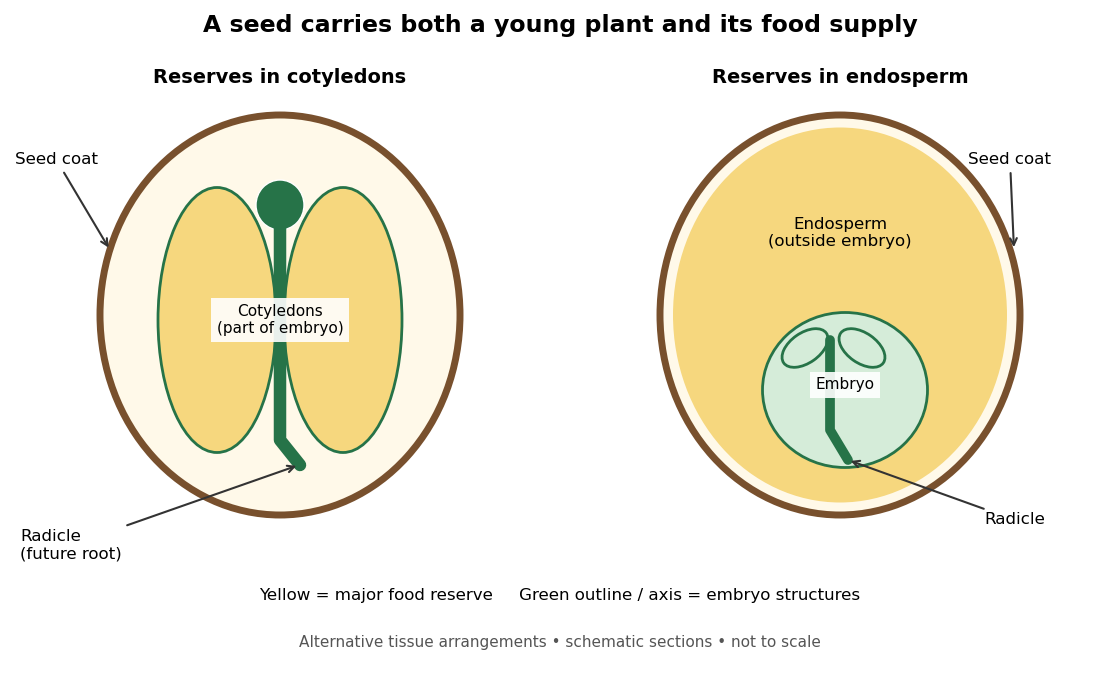
A useful reading exercise is to identify both the future plant and its initial food supply in each drawing. The large yellow area has the same role in both pictures, but it belongs to different plant tissues. Thus location and function alone do not establish tissue identity.
The protective covering of a seed, formed from maternal plant tissues surrounding the developing plant embryo.
Stored material supporting early seedling growth, located in cotyledons, endosperm or other plant tissues depending on the plant.
A nutritive plant tissue distinct from the plant embryo; it may remain in the mature seed or be depleted during development.[ref]
Biology 2e by Mary Ann Clark and others. Biology 2e, §32.2 Development of the Seed: endospermic and non-endospermic seeds
A young plant developing after germination. Early growth can use a seed food reserve before leaves support photosynthesis.[ref]
Biology 2e by Mary Ann Clark and others. Biology 2e, §32.2 Development of the Seed: reliance on cotyledon reserves before leaf photosynthesis
Seed germination is renewed plant embryo activity and growth. Many germination assays score completion as radicle emergence, before seedling establishment. Seed imbibition precedes that endpoint; swelling alone is insufficient.[ref]
Seed dormancy and the control of germination by William E. Finch-Savage and Gerhard Leubner-Metzger. Seed dormancy and the control of germination, §II.1, p. 502: water uptake, embryo expansion and radicle protrusion
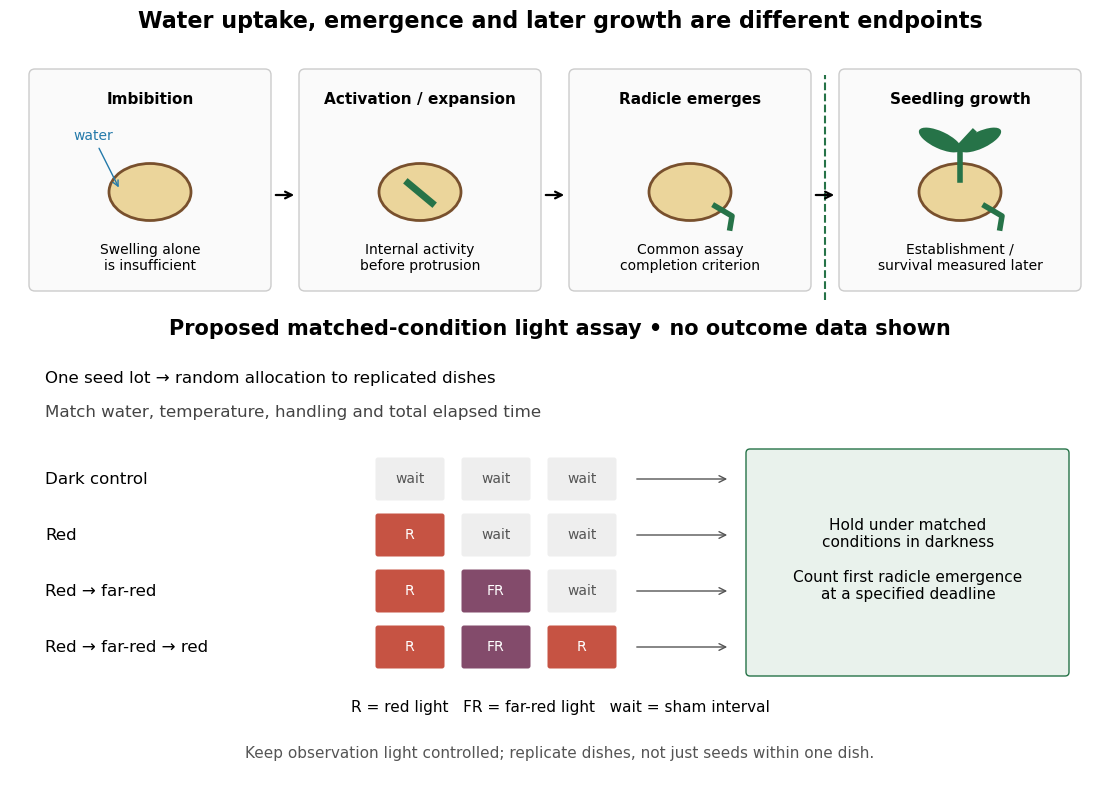
Water, molecular oxygen and suitable temperature support germination; light sensitivity depends on the species and seed state. Neither illumination nor one particular temperature is universally required. Seed dormancy connects germination timing to ecology by delaying seedling establishment.[ref]
Seed dormancy and the control of germination by William E. Finch-Savage and Gerhard Leubner-Metzger. Seed dormancy and the control of germination, Summary and §II.1–2, pp. 501–502: environmental requirements and timing
The distinction matters when comparing propagation experiments: a treatment that increases radicle emergence need not improve later seedling survival. Define the endpoint before comparing treatments, then measure the later outcome separately.
Initial seed water uptake, permitting renewed metabolism. Hydration does not prove seed viability or imply the idealized hydraulic law for capillary imbibition.[ref]
Seed dormancy and the control of germination by William E. Finch-Savage and Gerhard Leubner-Metzger. Seed dormancy and the control of germination, §II.1, p. 502: initial uptake and subsequent embryo expansion
A living seed's restriction on germination under otherwise favorable conditions, distinct from insufficient water, unsuitable temperature or lost seed viability. One failed test cannot diagnose seed dormancy.[ref]
Seed dormancy and the control of germination by William E. Finch-Savage and Gerhard Leubner-Metzger. Seed dormancy and the control of germination, §II.2, p. 502: operational definition and why absence of germination is insufficient
The capacity of a living seed to produce a developing plant under suitable conditions. A seed with seed dormancy can retain seed viability. In an ideal counting exercise, if of seeds complete germination, at least were living at the start. The other are unresolved: a failed germination assay alone cannot separate dead seeds, seed dormancy and unsuitable conditions.
The 1952 experiment used Grand Rapids lettuce seeds on wetted blotters in covered dishes. After 16 hours in darkness, seven lots of 200 received successive alternating exposures: one minute of red light at –, then four minutes above , with one lot removed after each exposure. Treated lots and a dark scientific control remained at for two days; germinated seeds were counted. Separate wavelength tests used a two-glass-prism spectrograph.[ref]
A Reversible Photoreaction Controlling Seed Germination by Harry Alfred Borthwick and others. A Reversible Photoreaction Controlling Seed Germination, pp. 662–664: preparation, spectrograph and alternating-exposure protocol
Table 1 shows alternating promotion and suppression according to the final exposure. Red light could restore promotion after far-red light; suppression was incomplete. This reversibility supports a reversible sensing state rather than simple cumulative illumination. The paper did not isolate or identify the pigment; the response concerns this lettuce preparation and timing. Its readout was a two-day germination count, not subsequent seedling performance.[ref]
A Reversible Photoreaction Controlling Seed Germination by Harry Alfred Borthwick and others. A Reversible Photoreaction Controlling Seed Germination, p. 663 pigment-identification limitation and p. 665 Table 1
The modern phytochrome description distinguishes forms and that interconvert under red and far-red light. This provides a concrete example of signal transduction: light changes a sensing state that affects development. The response should be distinguished from photosynthesis, which supplies chemical resources.[ref]
Biology 2e by Mary Ann Clark and others. Biology 2e, §30.6 The Phytochrome System and the Red/Far-Red Response, Figure 30.38: interconversion and cellular response
A specified test for germination, recording the endpoint, conditions and observation window. For a proposed red/far-red light test, use randomization to allocate one seed lot to darkness, red, red then far-red, and red then far-red then red. Match hydration, temperature, handling and elapsed time before counting; use sham waiting periods to equalize schedules. Use dish replication, retain the dark scientific control, and record radicle emergence using an observation procedure that does not itself provide an uncontrolled light treatment. This is a proposed design, not a claim about the 1952 paper's randomization or replication.
As an original hypothetical counting example, begin with seeds in one dish. Suppose 12 first meet the radicle endpoint by 24 hours, eight additional seeds by 48 hours, and four additional seeds by 72 hours. These invented event counts giveand cumulative sample proportions , and . The 48-hour increment is , not ; the latter includes earlier events. Counting the same emerged radicle again at each inspection would inflate the total. These numbers illustrate bookkeeping, not biological rates or treatment effects.
With a fixed denominator and irreversible classification of the first endpoint event, the set counted at an earlier inspection is a subset of the set counted later. Hence and cannot decrease. This short proof applies to cumulative germination counts even if a later seedling dies. A count of currently surviving seedlings has a different definition and can decrease.
For treatment comparisons, the dish may be the experimental unit: seeds in the same dish share conditions. Forty seeds in one dish do not supply forty independent dish replicates. Report the sample size, replication, endpoint time and denominator; a sample proportion by a deadline measures this assay's outcome, not an unconditional fraction with seed viability.
A grouping of biological cells in a plant with related functions. In a seed, plant embryo tissues and endosperm have distinct developmental identities.
Articles by others on the same topic



Formal name: "plantae".