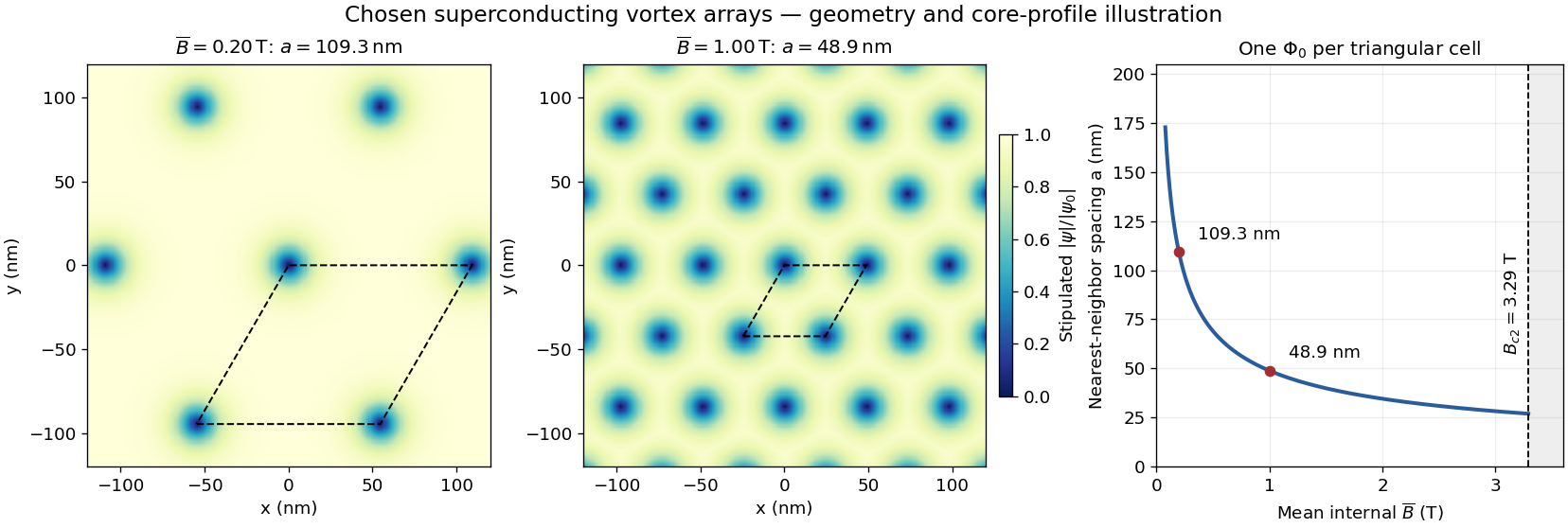
Assume a triangular array of straight, singly quantized Abrikosov vortices with nearest-neighbor distance . Here is the magnitude of the spatially averaged internal magnetic field, and is the superconducting flux quantum; is the elementary charge. Two lattice vectors of length meeting at span area . One flux quantum per cell givesThus multiplying by five decreases by ; it does not multiply the flux of each vortex by five. Using the exact SI Planck constant and elementary charge, .[ref]
For chosen internal fields and , the spacings are approximately and . These are geometric model calculations, not measurements from a particular sample. The local magnetic field varies within a cell; replacing by the field at a core would not give this counting relation.

Articles by others on the same topic
There are currently no matching articles.