The superconducting mixed state is the equilibrium vortex regime of a type-II superconductor, between its lower critical magnetic field and upper critical magnetic field in the ideal bulk description. Magnetic flux enters through Abrikosov vortices, while the surrounding material retains a nonzero superconducting order parameter.
Each vortex has a suppressed-order core and circulating electric currents; in the appropriate bulk limit, a singly wound vortex carries one superconducting flux quantum. Their mutual interactions can produce an Abrikosov vortex lattice. Increasing the field increases the vortex density until superconductivity is destroyed at the upper critical field. Defects can immobilize vortices through flux pinning, so a prepared sample's magnetization need not coincide with the equilibrium curve. Spatial coexistence here means vortex cores within superconducting matter, rather than arbitrary macroscopic patches of two phases.[ref]
Nobel Lecture: Type-II superconductors and the vortex lattice by Alexei Alexeyevich Abrikosov. discussion of the vortex solution and triangular lattice
An Abrikosov vortex has a core where the superconducting order parameter is suppressed, surrounding circulating electric currents, and a winding of its quantum phase. A singly wound vortex carries one superconducting flux quantum in the appropriate bulk flux-quantization limit. The exact contour statement is fluxoid and flux quantization in a superconductor; the enclosed magnetic flux alone need not equal a flux quantum on a contour with appreciable electric current.
A periodic array of Abrikosov vortices. In the isotropic local theory near the upper critical magnetic field, the triangular array has a lower Helmholtz free energy than the square array.[ref]
Nobel Lecture: Type-II superconductors and the vortex lattice by Alexei Alexeyevich Abrikosov. p.976, equations3–4 and the two lattice geometries
The useful distinction is between vortex existence, array geometry, and vortex mobility. Quantized winding does not force every array to be triangular or defect-free. A stationary array and vortices moving under an applied electric current also have different transport consequences; flux pinning matters for carrying useful electric currents.
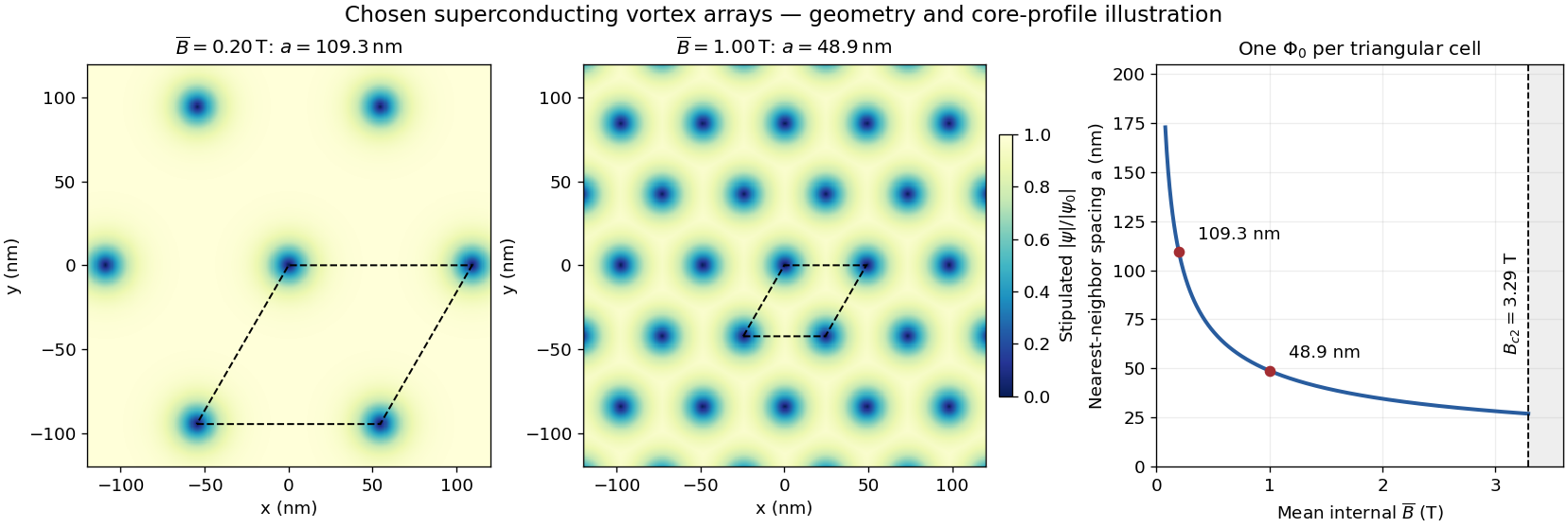
Assume a triangular array of straight, singly quantized Abrikosov vortices with nearest-neighbor distance . Here is the magnitude of the spatially averaged internal magnetic field, and is the superconducting flux quantum; is the elementary charge. Two lattice vectors of length meeting at span area . One flux quantum per cell givesThus multiplying by five decreases by ; it does not multiply the flux of each vortex by five. Using the exact SI Planck constant and elementary charge, .[ref]
For chosen internal fields and , the spacings are approximately and . These are geometric model calculations, not measurements from a particular sample. The local magnetic field varies within a cell; replacing by the field at a core would not give this counting relation.

A measure of spatial nonuniformity in the order parameter, with averages taken over one lattice cell. Set . ThenEquality requires uniform , so a nonconstant core pattern costs more in the quartic term than a uniform amplitude with the same mean squared amplitude. This identity alone does not compare two different vortex arrays: their admissible profiles must also satisfy the field equations.
U. Essmann and H. Träuble reported triangular vortex arrays, including defects, using electron microscopy on lead-indium and niobium samples in the remanent state.[ref]
The direct observation of individual flux lines in type II superconductors by U. Essmann and H. Träuble. Publisher abstract, materials, electron microscopy and remanent-state lattices
Such a prepared state need not display the equilibrium array at a uniform applied field. Images of regular positions and a proof of unrestricted vortex motion would answer different questions.Flux pinning is the trapping of Abrikosov vortices by spatial variations in a superconductor, such as defects or regions where superconductivity is already weakened. A vortex can lower its energy by placing its suppressed-order core in such a region, producing a barrier to displacement.
This matters for transport because an electric current exerts a force on vortices. Moving vortices produce an electric field and hence dissipative electrical response; pinning resists that motion and supports useful superconducting critical current density. Pinning also explains magnetic hysteresis and trapped magnetic flux. Thermal activation can still permit slow motion through flux creep, while stronger drive can produce vortex depinning. Thus pinning improves practical current carrying capacity without making every finite-temperature relaxation rate exactly zero.
Slow motion of pinned superconducting vortices, commonly through thermally activated escape over energy barriers. It permits magnetic relaxation and a small dissipative voltage even below an ideal static depinning force. The barrier depends on current and pinning structure; a universal sharp transport threshold should not be assumed.
Motion of a previously pinned Abrikosov vortex when drive, thermal activation or other fluctuations overcome its trapping. The resulting flux motion can generate an electric field, so a transport critical current depends on the measurement's voltage and time criteria.
Articles by others on the same topic
There are currently no matching articles.