An Abrikosov vortex has a core where the superconducting order parameter is suppressed, surrounding circulating electric currents, and a winding of its quantum phase. A singly wound vortex carries one superconducting flux quantum in the appropriate bulk flux-quantization limit. The exact contour statement is fluxoid and flux quantization in a superconductor; the enclosed magnetic flux alone need not equal a flux quantum on a contour with appreciable electric current.
A periodic array of Abrikosov vortices. In the isotropic local theory near the upper critical magnetic field, the triangular array has a lower Helmholtz free energy than the square array.[ref]
Nobel Lecture: Type-II superconductors and the vortex lattice by Alexei Alexeyevich Abrikosov. p.976, equations3–4 and the two lattice geometries
The useful distinction is between vortex existence, array geometry, and vortex mobility. Quantized winding does not force every array to be triangular or defect-free. A stationary array and vortices moving under an applied electric current also have different transport consequences; flux pinning matters for carrying useful electric currents.
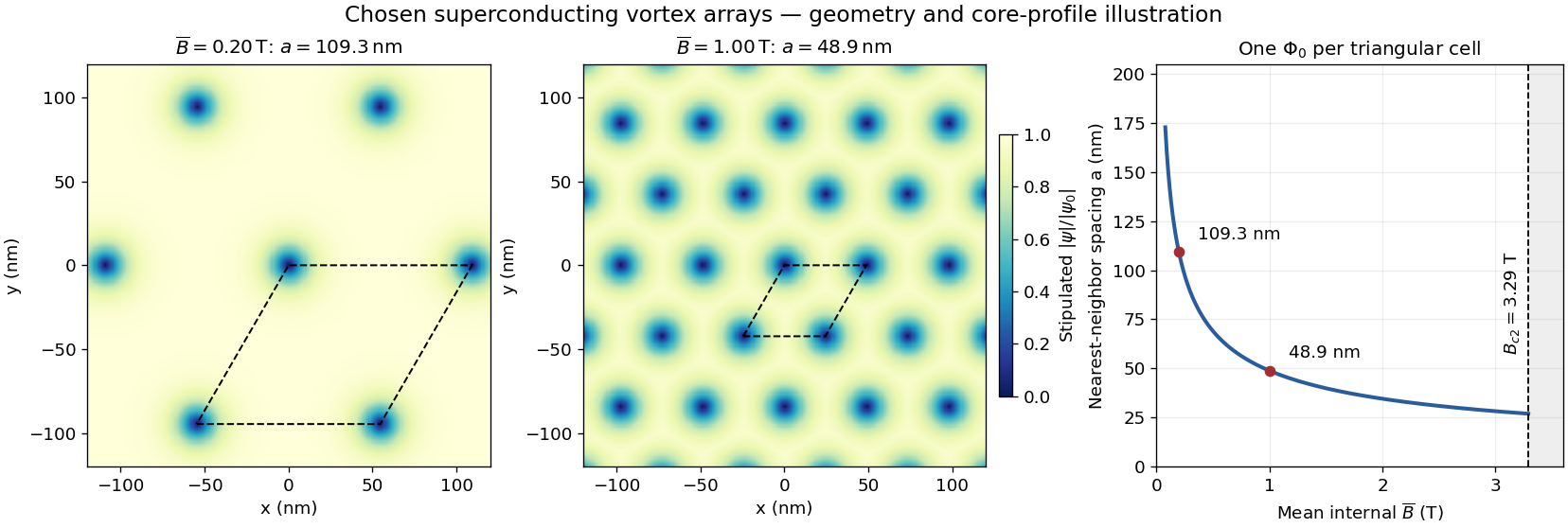
Assume a triangular array of straight, singly quantized Abrikosov vortices with nearest-neighbor distance . Here is the magnitude of the spatially averaged internal magnetic field, and is the superconducting flux quantum; is the elementary charge. Two lattice vectors of length meeting at span area . One flux quantum per cell givesThus multiplying by five decreases by ; it does not multiply the flux of each vortex by five. Using the exact SI Planck constant and elementary charge, .[ref]
For chosen internal fields and , the spacings are approximately and . These are geometric model calculations, not measurements from a particular sample. The local magnetic field varies within a cell; replacing by the field at a core would not give this counting relation.
A measure of spatial nonuniformity in the order parameter, with averages taken over one lattice cell. Set . ThenEquality requires uniform , so a nonconstant core pattern costs more in the quartic term than a uniform amplitude with the same mean squared amplitude. This identity alone does not compare two different vortex arrays: their admissible profiles must also satisfy the field equations.
U. Essmann and H. Träuble reported triangular vortex arrays, including defects, using electron microscopy on lead-indium and niobium samples in the remanent state.[ref]
The direct observation of individual flux lines in type II superconductors by U. Essmann and H. Träuble. Publisher abstract, materials, electron microscopy and remanent-state lattices
Such a prepared state need not display the equilibrium array at a uniform applied field. Images of regular positions and a proof of unrestricted vortex motion would answer different questions. Articles by others on the same topic


The Abrikosov vortex, named after the Soviet physicist Alexei Abrikosov who first described it in 1957, is a fundamental concept in the study of type-II superconductors. In these materials, when subjected to a magnetic field beyond a certain critical threshold, they can exhibit quantized magnetic flux lines known as vortices.