Consider a uniform plane wave of unit complex amplitude transmitted by an ideal optical slit of full width . Treat the field as invariant along the optical slit height: this is one-dimensional transverse Fresnel propagation, so the prefactor is , rather than the two-dimensional prefactor . Removing the carrier givesHere is incident irradiance. This infinitely long slit model describes a transverse cut away from the ends of a sufficiently long physical slit; its finite conserved quantity is transmitted power per unit optical slit height.
Put and . Substitution reduces the integral toThis form separates the pattern's shape from its physical scale. Reflection proves , so the light intensity is an even function of . At , direct integration gives , with limit one at . Hence the Fraunhofer diffraction comparison is the squared sinc function. In this paragraph the unnormalized sinc function takes argument .
For an original example, choose wavelength and full width . At , , and the edge-to-centre wave phase change is radians. At , , and that wave phase change is only radians. Even the nearer screen is fifty slit widths away; that geometric comparison alone misses its strong Fresnel diffraction.
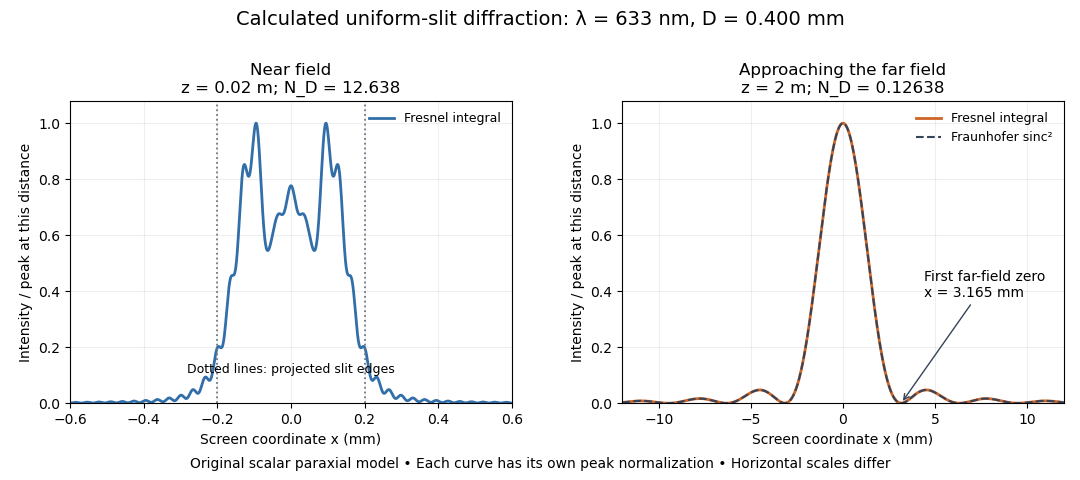
Original calculated Fresnel diffraction profiles of a 0.400 mm slit at 633 nm, compared with the Fraunhofer diffraction shape
. Details. 
These are numerical predictions from the displayed scalar integral, using the composite trapezoidal rule, rather than measured profiles. Each curve is divided by its own peak light intensity; the two horizontal scales differ. At 2 cm the computed central irradiance is about , with brighter off-axis maxima. At 2 m it is about and is the peak. The dashed Fraunhofer diffraction curve has its own central normalization; its first zeros are at . The finite-distance Fresnel diffraction curve remains slightly nonzero there.
Normalization hides the brightness change, but not the change in shape. The Fourier transform propagation multiplier has unit complex modulus, so Plancherel theorem givesThis is conservation of transmitted power per unit height in the ideal scalar model. An integral over only the displayed screen interval misses the tails; a peak-normalized profile is not a unit-integral probability density. Spreading and decreasing brightness together preserve the transmitted power.
Articles by others on the same topic
There are currently no matching articles.