Phase-contrast imaging converts spatial phase changes of light into intensity differences by interference with a reference field. In an off-resonant atomic cloud, the optical phase carries information about column density. Weak probing can support repeated measurements with reduced absorption, although destructiveness still depends on detuning and probe strength.
The Huygens-Fresnel principle describes propagation by coherent addition of secondary-wave contributions from a wavefront or aperture. Their complex amplitudes, including relative wave phases, must be summed before calculating light intensity. The Fresnel propagator follows by retaining quadratic propagation wave phase in the paraxial approximation.
Each point on a wavefront acts as a source of secondary wavelets, whose envelope gives the next wavefront. The geometric construction gives refraction from secondary wavelets. The Huygens-Fresnel principle additionally keeps the amplitudes and phases needed to calculate interference and diffraction.
Let a plane incident wavefront first meet a flat interface at , and let another point on that front reach on the interface after . Its path has length . The secondary wavelet from has radius in the second medium; the new wavefront through is tangent to it at . Right triangles with common hypotenuse give and , where both ray angles are measured from the interface normal. Consequently , which is Snell's law. The construction uses phase velocities in homogeneous isotropic media.
Scalar diffraction theory approximates light by one complex field satisfying a scalar wave equation. Aperture propagation is represented by an integral of secondary contributions, with vector polarization of waves and detailed electromagnetic edge conditions suppressed. The approximation is useful for many apertures large compared with wavelength, but is not an exact substitute for Maxwell equations at arbitrary apertures.
In linear scalar diffraction theory, complementary aperture transmissions and give complex fields , where is the unobstructed field under identical illumination. Away from the direct beam in Fraunhofer diffraction, their diffracted fields differ by a sign and have equal intensity. Intensities do not generally add: in particular, complementary on-axis Fresnel diffraction patterns need not have equal intensity. The ideal scalar statement does not incorporate vector boundary details at a real conducting edge.
A Rayleigh interferometer compares optical paths through a sample and a reference. A path-length difference shifts the interference phase by . In analytical ultracentrifugation, sample and reference sectors produce concentration-dependent fringe shifts, allowing radial concentration scans without requiring the solute to absorb at the probe wavelength.[ref]
Optical Systems Used for AUC by Beckman Coulter Life Sciences. Rayleigh interference optics: reference sector, refractive-index difference and fringe displacement
In division of wavefront, different spatial portions of an incident wavefront are selected and propagated so that their fields overlap. Double-slit interference is an example. The selected portions need sufficient spatial optical coherence for stable interference fringes.
In division of amplitude, a partially reflecting interface sends parts of the same incident wavefront into separate paths that are later recombined. A Michelson interferometer is an example. The resulting interference visibility depends on relative optical path length, polarization of waves, intensity balance and optical coherence.
An interferogram records detected light intensity produced by interference as a controlled position, phase or delay is varied. In Fourier transform spectroscopy, the variable is the delay between two copies of the same field. Removing the constant background gives a correlation signal whose Fourier transform determines the source's spectral power density, subject to the measured delay window and instrumental response.
An astronomical interferometer combines observations from separated collecting locations to infer angular source structure. Its projected interferometric baseline determines the angular spatial frequency sampled. Amplitude and intensity interferometers measure different coherence observables; a Michelson stellar interferometer combines optical field amplitudes.
A two-element radio interferometer coherently combines signals from two receiving antennas. With equal single-arm wave intensity , projected baseline , free-space wavelength and imposed phase difference , its directional response is the displayed formula. It follows by adding the two complex amplitudes and taking the squared modulus. Near the normal to the baseline, the first null is from a maximum. This narrow response repeats in interference fringes, so a long baseline alone does not give an unambiguous image.
For three collectors whose measured pair phases are , the oriented sum around the triangle cancels the collector-based errors. closure phase retains source phase information, including asymmetry, but does not cancel arbitrary baseline-dependent errors or fill missing spatial-frequency coverage.
The Michelson stellar interferometer, associated with Albert Abraham Michelson, uses separated collectors and beam-redirection optics to produce interference fringes. The collector spacing determines sensitivity to a stellar angular diameter, independently of the final beam spacing at the combiner. The first null for a uniform disk is , where is the full angular diameter. Different surface-brightness laws, including limb darkening, change the null.
Let identical spatially incoherent stellar brightness profiles of equal integrated flux be displaced by projected angles along an interferometer baseline. The Fourier shift property makes their normalized signed coherence . The observed visibility is its absolute value. The slow single-star envelope depends on each star's brightness profile, while the oscillatory factor records projected separation. Unequal flux prevents complete cancellation at the binary minima.
For two identical equally bright stars, zeros of the binary factor occur at , where is separation projected along the baseline. Their repeated spacing is . Multiple samples separate these rapid zeros from zeros of a resolved stellar envelope. Baseline rotation is needed to recover an unknown two-dimensional separation direction; the first zero alone does not determine both diameter and separation.
Two identical uniform circular discs of angular diameter and equal flux have , , with limiting value one at . Multiplication by gives their signed binary coherence. Its first single-disc envelope zero is , while the binary modulation has a separate scale . Limb darkening and other nonuniform profiles change the envelope, not the elementary Fourier shift factor.
Fresnel diffraction describes diffraction when the quadratic propagation wave phase across an aperture must be retained. Its Fresnel propagator becomes the Fraunhofer diffraction description when that curvature is negligible.
A Fresnel diffraction pattern is a map of how propagation changes the wave interference of light from an aperture. It can resemble the opening, develop bright and dark structure near its edges, and eventually approach a Fraunhofer diffraction pattern. The controlling comparison involves wavelength, opening size and propagation distance together; a distance large compared with the opening need not give the far field.
For a monochromatic wave, use time dependence , wavenumber and complex amplitude . Let be the transmitted field immediately behind an aperture in the plane . In a homogeneous medium, the scalar paraxial approximation givesThis is the two-transverse-coordinate Fresnel propagator, with its carrier restored. It adds complex amplitudes before taking their squared complex modulus to obtain light intensity. It is a scalar paraxial approximation, rather than a full vector solution of Maxwell equations.[ref]
Scalar Diffraction Optics. Interactive Optics by Sander Konijnenberg, Aurèle J.L. Adam and H. Paul Urbach; Fresnel Approximation, equations (381)–(385), and the following paraxial-wave-equation remark
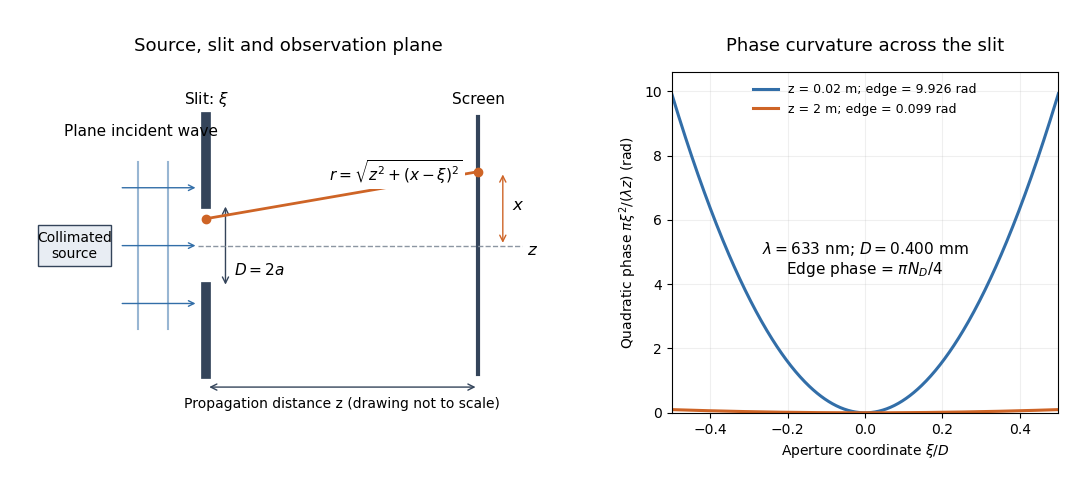
The source in this constructed geometry supplies a plane wave; the observation screen is a plane perpendicular to the optical axis. The right panel isolates the aperture-dependent wave phase that distinguishes Fresnel diffraction from Fraunhofer diffraction. Its vertical scale is in radians, and the drawing's lengths are schematic.
Keeping this wave phase is useful when transporting a field between nearby optical components: both the shape and the complex amplitude matter for subsequent wave interference. A particularly striking feature is that propagation can create a dark centre even from a uniformly illuminated symmetric aperture; the incident wave amplitudes need not be unequal for their outgoing contributions to cancel.
For normalized Fresnel integrals , an interval aperture contributes the chord between its two limiting points on the Cornu spiral. The full unobstructed field is , so its squared magnitude is2. Comparing to only the half-plane limit instead of this full chord introduces a factor-of-four normalization error. The formula compares power at one observation point under the same illumination and propagation factors.
The largest radius of the normalized Cornu spiral occurs on its first outer turn at , where . Oddness makes the chord from to attain twice that radius, while the triangle inequality bounds every other chord by the same length. The interval is therefore the strongest freely selectable connected aperture at that observation point, with normalized point power about1.80142. Signed physical limits follow from . Existing openings can constrain this optimization.
If a screen already has an interval hole, additional removal cannot reduce that hole. A connected final aperture must contain it, imposing lower/upper endpoint constraints on its Cornu spiral chord. The unrestricted longest chord need not be feasible. For an existing interval , constrained chord maximization gives approximately , , with point-power ratio1.60257. The two aperture endpoints, rather than just a nominal Fresnel-zone width, determine the received field.
For an opaque half-plane whose edge lies height above the direct source–receiver ray, the paraxial parameter is . The unobstructed half-aperture supplies the Cornu spiral chord from to infinity. Division by the full-aperture chord gives the displayed intensity transmission. It is at grazing incidence, approaches one well into the illuminated region and tends to zero deep in shadow.[ref]
A diffraction-loss ratio is normalized to the unobstructed intensity at the same receiver position. With a point source that unobstructed intensity changes as inverse source–receiver distance squared. Moving the receiver can therefore decrease the transmission ratio while increasing its absolute received intensity. The two curves require separate normalization; a Cornu-chord plot alone omits geometric spreading.
A scalar aperture approximation that sums the secondary waves reaching an observation point. For a point source with incident spherical amplitude , one common forward-normal convention isHere and are source-to-aperture and aperture-to-observer distances and is an obliquity factor. The Fresnel diffraction approximation retains quadratic path phase; Fraunhofer diffraction additionally neglects the quadratic phase across the aperture. Kirchhoff boundary assumptions do not give an exact electromagnetic solution at a sharp edge.
A concentric diffractive focusing element with successive zone boundaries chosen to differ by half a wavelength of optical path to a focus. Alternating transmitting and absorbing zones suppress cancellation between neighboring half-period zones. For an incident plane wave, the paraxial boundaries satisfy . The outermost zone width controls the finest transverse scale, and the focal length varies with wavelength.
For a plane wave incident on a flat zone plate, the path difference from radius to axial focal distance is . Setting it equal to gives the title relation. The paraxial limit is , and the fine outer-zone width is approximately . Alternately removing half-period annuli makes the remaining contributions reinforce at the principal focus. Choosing the number of zones sets the aperture and fabrication scale, not the principal focal distance independently of these radii.
For uniform coherent plane-wave illumination, an ideal binary amplitude zone plate transmits alternate Fresnel half-period zones. If complete odd zones are open, every one contributes approximately twice the unobstructed axial complex amplitude, in the same phase, and . This is a local light intensity gain relative to removing the plate and outer stop. It differs from comparison with a finite clear aperture: an aperture containing an odd integer number of half-period zones has axial intensity , giving plate-to-aperture ratio . Neither gain is a total power efficiency.
At the geometric shadow boundary of a straight opaque half-plane, the transmitted Fresnel integral is exactly half the unobstructed complex amplitude for ideal point illumination. The Cornu spiral chord is from its origin to one limiting endpoint, rather than between both limiting endpoints. Therefore and . Half the unobstructed intensity would confuse a field fraction with its square. Edge thickness, source extent and alignment can modify the ideal result.
The Arago spot is the bright axial point in the shadow of a circular obstruction under suitably coherent illumination. In ideal scalar diffraction theory, secondary fields from the circular edge arrive in phase on axis. Fresnel diffraction by an opaque disk gives an axial intensity equal to the unobstructed intensity in its paraxial model; this is not a claim that the whole geometric shadow is bright.
Under the same scalar paraxial assumptions as Fresnel diffraction by a circular aperture, Babinet's principle gives the complementary opaque-disk field on axis. Its axial intensity equals the unobstructed intensity, producing the Arago spot inside the geometric shadow. The off-axis pattern depends on the full Fresnel integral; it is not obtained by subtracting aperture intensities from the incident intensity. Finite source size, misalignment and imperfect circular edges reduce the ideal spot contrast.
For a circular aperture of radius , paraxial plane-wave illumination and propagation distance , define . On axis, the radial Fresnel diffraction integral normalized by the unobstructed field givesFor a finite axial point source a distance before the aperture and detector a distance after it, replace by in the phase. The formula assumes illumination amplitudes and obliquity factors approximately constant across the aperture. Odd and even numbers of Fresnel half-period zones give bright and dark axial extrema; large local intensity is compatible with global conservation of energy.
A Fresnel half-period zone is a region of an aperture whose optical path to an observation point differs from the axial path by an interval of half a wavelength. For an axial optical point source a distance before the aperture and an axial observer a distance beyond it, the paraxial path excess at aperture radius is . The outer radius of zone is thereforeSuccessive zones contribute approximately opposite phases to the Huygens-Fresnel principle integral. The finite source distance matters: using the plane-wave formula requires .
For an axial point source a distance before a square aperture and an observer a distance beyond it, source and observation wave phase curvatures add: . With aperture side , put . Separation into two one-dimensional Fresnel integrals gives the field normalized to its unobscured value,At an off-axis observer , centre the dimensionless coordinates on and . If are the directed Cornu spiral chords between the corresponding aperture-edge parameters, . This is a product of complex interval factors, rather than a sum of two intensities. The unobscured field is evaluated at the same observation point and includes its common propagation wave phase.
The quadratic wave phase follows from an ordinary distance calculation. Write . The Taylor expansion of the distance to a screen point isIn the slowly varying propagation prefactor, suffices. In the complex exponential , however, a small distance error is multiplied by the large wavenumber . Retaining the quadratic term while dropping the quartic term requires both and over the contributing aperture and the screen region being considered. The second condition is a wave phase accuracy requirement; the first is the geometric paraxial approximation.
Expanding the retained quadratic term separates three effects:The outside quadratic factor changes the wave phase at each screen point but has unit complex modulus, so it leaves that screen's light intensity unchanged. The quadratic factor inside the integral changes relative wave phases between contributions from different aperture points, so it changes their wave interference. The remaining linear factor supplies a Fourier transform. Fraunhofer diffraction drops the aperture quadratic factor when it is nearly constant; it does not require dropping the screen quadratic factor when predicting a later coherent field.
There is also a useful proof from the Helmholtz equation. Substituting gives . Neglecting yields the parabolic wave equation. A transverse Fourier transform evolves each spatial frequency by , using the transform kernel . Its inverse Fourier transform is the quadratic Fresnel propagator kernel above. Thus quadratic wave phase in space and quadratic wave phase in spatial frequency are two views of the same propagation.
A Fresnel number compares squared aperture size with the product of wavelength and propagation distance. For an optical slit of full width , explicitly distinguish the full-width and half-width conventions:The full-width convention is used throughout the Fresnel slit propagation example below. The definition also appears in the Delft treatment.[ref]
Scalar Diffraction Optics. Interactive Optics by Sander Konijnenberg, Aurèle J.L. Adam and H. Paul Urbach; Fresnel and Fraunhofer Approximations, equations (390)–(392): aperture diameter convention
For uniform incident wave phase, makes the omitted aperture wave phase small and gives the Fraunhofer diffraction regime. When is of order one or larger, retain it and use Fresnel diffraction, provided the paraxial approximation still holds. These are continuous changes in accuracy, rather than a physical boundary at one selected number. For a rectangular aperture, check both transverse dimensions. Incident wavefront curvature contributes its own wave phase through ; the aperture-to-screen Fresnel number alone does not describe a spherical source's illumination.
The scaling is revealing: doubling the optical slit width at fixed wavelength and distance multiplies the Fresnel number by four. Maintaining the same Fresnel number then requires four times the distance. Two systems can consequently have the same dimensionless pattern despite very different physical lengths.
Consider a uniform plane wave of unit complex amplitude transmitted by an ideal optical slit of full width . Treat the field as invariant along the optical slit height: this is one-dimensional transverse Fresnel propagation, so the prefactor is , rather than the two-dimensional prefactor . Removing the carrier givesHere is incident irradiance. This infinitely long slit model describes a transverse cut away from the ends of a sufficiently long physical slit; its finite conserved quantity is transmitted power per unit optical slit height.
Put and . Substitution reduces the integral toThis form separates the pattern's shape from its physical scale. Reflection proves , so the light intensity is an even function of . At , direct integration gives , with limit one at . Hence the Fraunhofer diffraction comparison is the squared sinc function. In this paragraph the unnormalized sinc function takes argument .
For an original example, choose wavelength and full width . At , , and the edge-to-centre wave phase change is radians. At , , and that wave phase change is only radians. Even the nearer screen is fifty slit widths away; that geometric comparison alone misses its strong Fresnel diffraction.
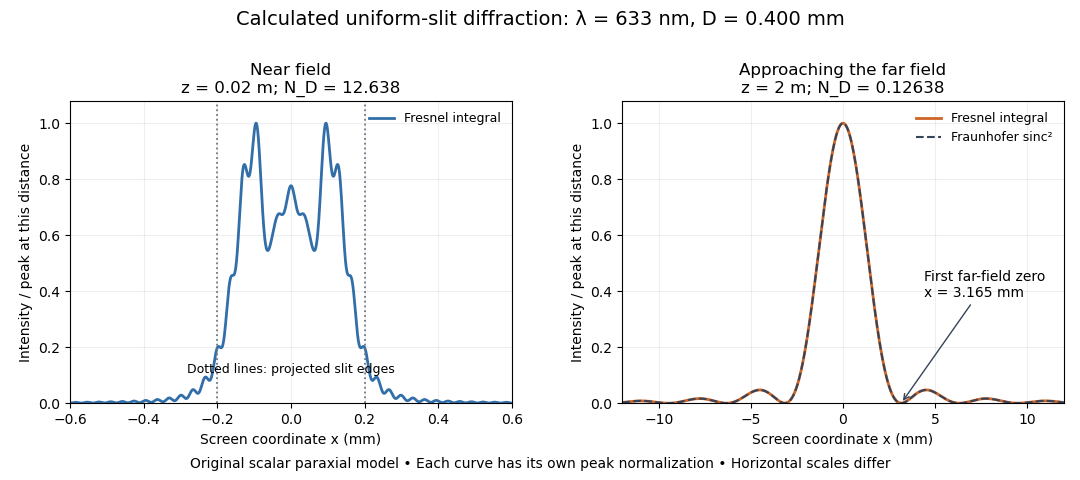
Original calculated Fresnel diffraction profiles of a 0.400 mm slit at 633 nm, compared with the Fraunhofer diffraction shape
. Details. These are numerical predictions from the displayed scalar integral, using the composite trapezoidal rule, rather than measured profiles. Each curve is divided by its own peak light intensity; the two horizontal scales differ. At 2 cm the computed central irradiance is about , with brighter off-axis maxima. At 2 m it is about and is the peak. The dashed Fraunhofer diffraction curve has its own central normalization; its first zeros are at . The finite-distance Fresnel diffraction curve remains slightly nonzero there.
Normalization hides the brightness change, but not the change in shape. The Fourier transform propagation multiplier has unit complex modulus, so Plancherel theorem givesThis is conservation of transmitted power per unit height in the ideal scalar model. An integral over only the displayed screen interval misses the tails; a peak-normalized profile is not a unit-integral probability density. Spreading and decreasing brightness together preserve the transmitted power.
A documented experiment uses curved illumination rather than the uniform Fresnel slit propagation model. Laboratory Exercise No. 4: Diffraction, MIT 6.237, Fall 2024, printed pp. 5–6, gives a helium–neon laser at , a microscope objective optical lens, a circular aperture and a screen 5–40 cm from the object. Preparation includes comparing central brightness in Fresnel diffraction and Fraunhofer diffraction. A 40× objective produces a nonplanar incident wavefront; the opening is placed less than 1 cm from it. With objective-to-screen distance fixed, students move the opening, sketch patterns, and record positions of consecutive central nulls to estimate aperture size. The Fraunhofer diffraction pattern supplies a regime comparison. A separate spherical-obstacle task observes a bright centre inside the shadow. The handout supplies procedures, rather than measured distances or profiles.[ref]
The circular-opening test probes cancellation of complex amplitudes at the centre while the source wavefront curvature changes. To interpret it, include that curvature in the aperture field and use a circular aperture, rather than substituting the plane-illuminated Fresnel slit propagation profile. Useful additional controls are to retain the same laser and opening, centre the illumination, repeat position readings and check background with the beam blocked. If a camera replaces the visual screen readout, avoid saturation and calibrate its position scale. Alignment, imperfect aperture edges, illumination variation and limited contrast near a null constrain the inferred size. A bright central obstacle spot illustrates why the sharp shadows of geometrical optics can fail; it does not imply that every Fresnel diffraction pattern has a bright centre.
A fundamental Gaussian beam is an ideal beam of light whose transverse wave amplitude has a Gaussian function profile. Here consider a circularly symmetric beam in vacuum, with propagation along , two transverse coordinates , and radius from the optical axis. With the beam waist at , total power , and vacuum wavelength , its time-averaged light intensity, meaning irradiance in , isHere is the minimum beam radius, and is the Rayleigh range. Far from the beam waist, with beam divergence half-angle . These are the fundamental circular Gaussian beam laws within the scalar paraxial approximation, appropriate when and the beam divergence is small. The underlying envelope solves the parabolic wave equation exactly; this does not make it an exact vector solution of Maxwell equations. [ref].
The radius convention matters. Writing for the complex wave amplitude envelope, the same is the wave amplitude radius and the light intensity radius:At these ratios are and , respectively. The light intensity radius is instead . None of these radii is a sharp edge: the ideal Gaussian function has nonzero tails at every finite radius. Kogelnik and Li explicitly use the wave amplitude radius in their fundamental-mode treatment. [ref]
https://dielslab.unm.edu/sites/default/files/Kogelnik66_0.pdf. Herwig Kogelnik and Tingye Li, Laser Beams and Resonators, Applied Optics 5, 1550–1567, 1966, §3.2
.For a numerical example, take vacuum wavelength and beam waist radius . Substitution gives Rayleigh range and far-field beam divergence half-angle . At , the beam radius is and the on-axis irradiance is half its waist value. At the same wavelength, halving the beam waist radius to quarters the Rayleigh range to and doubles the beam divergence half-angle to . At fixed power, that smaller beam waist also quadruples the peak irradiance.
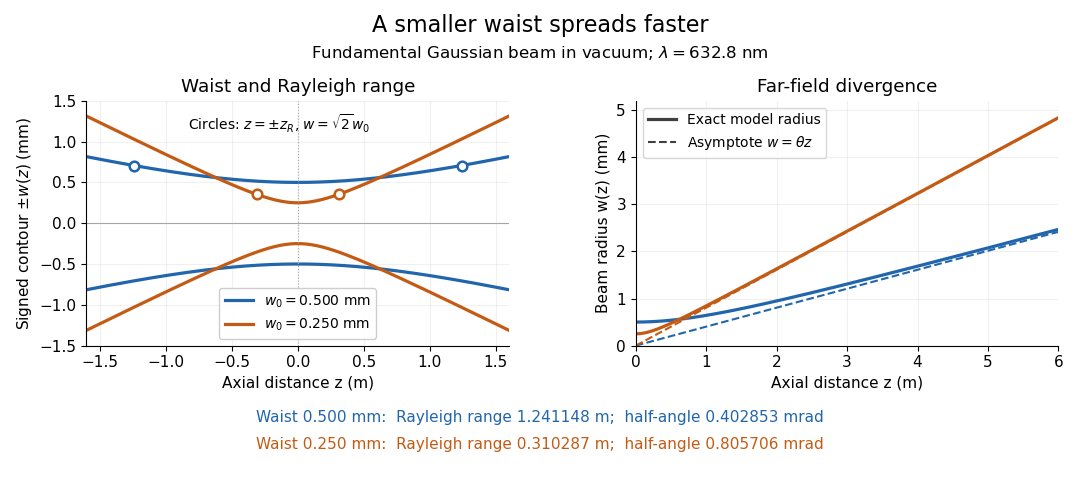
Gaussian beam radii at 632.8 nm: a smaller beam waist gives a shorter Rayleigh range and greater beam divergence
. Details. The contours in the left panel are in a plane through the optical axis; they mark an light intensity level, not an outer boundary. The right panel compares the exact model radii with the far-field asymptotes . The horizontal and vertical axes use different length units, so the drawn slopes are not physical angles.
The normalization expresses conserved power during free propagation. In transverse polar coordinates, an annulus has area , soA proof outline is the substitution in this integral. Spreading reduces peak irradiance as while increasing transverse area as , leaving power unchanged. In particular, the disk of radius contains , or , of the total power; the local light intensity at its rim is only of the on-axis light intensity. These are different quantities.
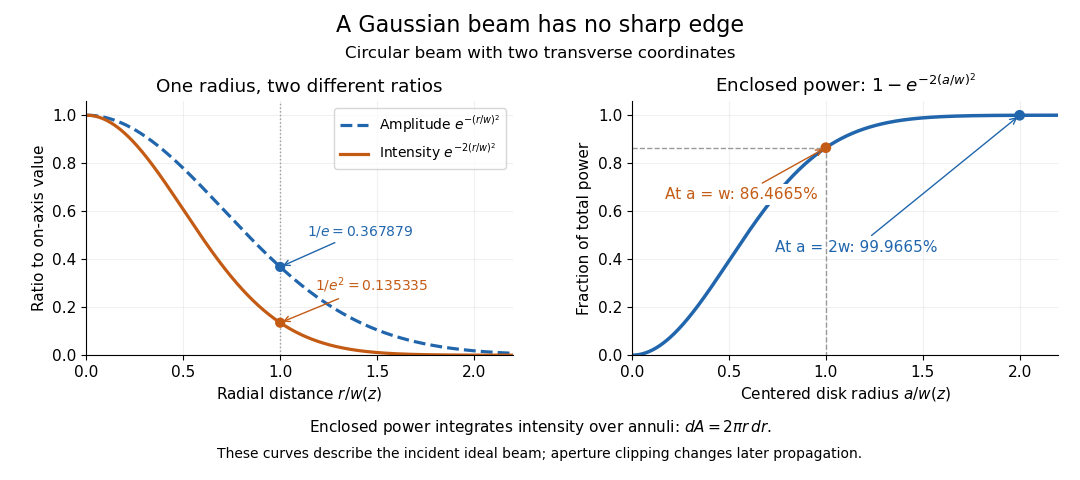
The left panel compares normalized wave amplitude magnitude and irradiance; the right panel integrates the transverse area to show enclosed power. For an ideal absorbing circular aperture of radius centered on the optical axis, the same fraction gives the power passing the aperture at that plane. An aperture of radius clips about of the incident power; radius clips only , or . After clipping, extra diffraction means the transmitted field no longer obeys the unmodified ideal Gaussian beam law. Every finite aperture cuts some ideal tail. Kogelnik and Li distinguish their large-aperture beam analysis from their finite-aperture diffraction analysis. [ref]
https://dielslab.unm.edu/sites/default/files/Kogelnik66_0.pdf. Kogelnik and Li, 1966, §§3–4
.The useful tradeoff is that a small bright spot cannot remain narrow indefinitely. An optical lens can create a smaller beam waist, but diffraction then makes the beam spread faster. The particularly simple relation ties localization directly to beam divergence. A proof outline for the propagation law starts with . The parabolic wave equation separates into two transverse factors, and a Gaussian integral in each coordinate givesHere is dimensionless and is the wavenumber; the carrier convention is , with angular frequency . Taking the squared complex modulus gives the stated and its light intensity scaling. Each transverse factor contributes , explaining the prefactor here and the different prefactor in the preserved Gaussian beam with one transverse coordinate.
Historically, Gaussian beam theory developed alongside early laser resonator theory and lens-guided transmission. In their 1966 review, Kogelnik and Li credit Boyd and Gordon, and Goubau and Schwering, with early beam treatments; they summarize earlier work rather than claim the whole construction as a new discovery. Their paper brings beam propagation, focusing and finite-aperture diffraction into a common practical account. [ref]
https://dielslab.unm.edu/sites/default/files/Kogelnik66_0.pdf. Kogelnik and Li, 1966, introduction and §3
.For a circular Gaussian beam with intensity proportional to , the displayed is the intensity radius. Its minimum is the beam waist radius, while the larger radius at a cavity mirror is not itself a waist. The Rayleigh range is .
The complex beam parameter combines a Gaussian beam's wavefront curvature and spot radius : . With , the beam waist is . A real paraxial ray transfer matrix maps it by . Positive imaginary part selects the physical finite-width branch in this convention.
A real paraxial ray matrix transforms a Gaussian beam parameter by the displayed fractional-linear map. For a lossless round trip with determinant one, a fixed point with positive imaginary part generically requires . Scalar matrices are degenerate exceptions: their fractional-linear map fixes every physical beam parameter even at the boundary. Finite apertures and resonance phases impose additional physical constraints.
The beam waist is the narrowest cross-section of a freely propagating Gaussian beam. Its radius uses the wave amplitude , or light intensity , convention; its diameter is . Specifying a “spot size” without saying radius or diameter can introduce a factor-of-two error. Within the scalar paraxial approximation, the wavefront at the beam waist is planar. The minimum radius sets both the Rayleigh range and the far-field beam divergence.
The Rayleigh range of a fundamental Gaussian beam in vacuum is the positive axial distance from the beam waist at which its radius grows from to . Thus its contour area doubles and its peak irradiance halves. Within , the radius stays at most ; for , beam divergence dominates. At fixed vacuum wavelength, the Rayleigh range scales quadratically with the beam waist radius. The formula here uses the vacuum wavelength, not an unlabelled wavelength in a material.
For the free parabolic wave equation , input with propagates asThe branch is continuous from . One-dimensional transverse Fresnel propagation or two Gaussian integrals prove the formula. With , the squared envelope is . The amplitude power is because there is only one transverse coordinate. A two-transverse-coordinate Gaussian beam instead has power when both coordinates share the same .
Beam divergence describes the angular spread of a beam away from its optical axis; specify the radius convention and whether the quoted angle is a half-angle or full angle. For the fundamental Gaussian beam in vacuum, the far-field light intensity radius obeysHere is the small-angle half-angle in radians under the paraxial approximation; the full angle is . The geometric asymptote has angle , approximated by in this regime. Other beam profiles need their own beam divergence definitions and propagation laws.
Phase conjugation creates a returning monochromatic wave whose spatial complex amplitude is proportional to the complex conjugate of the incident field. Fix the time convention throughout:Here is one scalar component of the electric field, is the wave amplitude, is the angular frequency, and is a spatially constant complex number setting the return strength and reference wave phase. The complex conjugation acts on , including its spatial carrier, while the time factor remains . Conjugating both factors would merely give another representation of the same real field. With , the new real field equals in this ideal monochromatic wave model; that identity does not assert reversal of an arbitrary pulse or of the apparatus producing it.
The spatial wave phase becomes , so the local wavevector changes from to . For example, with becomes : both components of the wavevector reverse. In a transparent stationary medium with isotropy and positive refractive index, light rays follow the wavevector, giving counterpropagation. The same wavefronts now have opposite propagation normals. This is why phase conjugation can return a distorted beam toward its origin: it reverses the detailed spatial wave phase, rather than requiring that wave phase to be flat.
The attractive application is correction of optical aberrations accumulated on an outward trip. The return uses the distortion itself as the prescription for correction, as the original thin phase-plate cancellation by phase conjugation example makes explicit. An experimentally accessible implementation measures the spatial wave phase and uses a spatial light modulator to generate its negative; digital optical phase conjugation describes an inspected 2010 demonstration of recovery through multiple scattering.
A phase-conjugate mirror is an optical device that implements phase conjugation at its return surface. It may generate the return using an independently supplied beam, as in digital optical phase conjugation; its name specifies the field transformation, rather than a particular reflecting material. Conjugating the transverse complex amplitude and launching the returning longitudinal carrier produces the complete reversed wavevector. A spatially constant leaves the shape of the wavefront unchanged; a spatially varying would add its own wavefront error.
An ordinary flat mirror obeys the law of reflection. At a surface , its reflected plane wave has wavevector , whereas a phase-conjugate mirror returns . Ordinary specular reflection preserves the tangential wavevector. At normal incidence a single plane wave can therefore look identical in the two cases, apart from an overall wave phase and strength; oblique incidence or a curved wavefront reveals the distinction. In boundary-envelope notation an ideal ordinary mirror multiplies the incident complex amplitude by a constant reflection factor , while an ideal phase-conjugate mirror returns its complex conjugate times .
Consider an optical point source at , a uniform transparent medium, and a flat return surface . A light ray with slope reaches . A phase-conjugate mirror reverses its full direction and returns it to . An ordinary mirror reverses only its normal direction; its returning light ray reaches at . Thus rays with at return to with ordinary specular reflection, but all return to under ideal phase conjugation. These are stipulated geometric coordinates, not laboratory measurements.
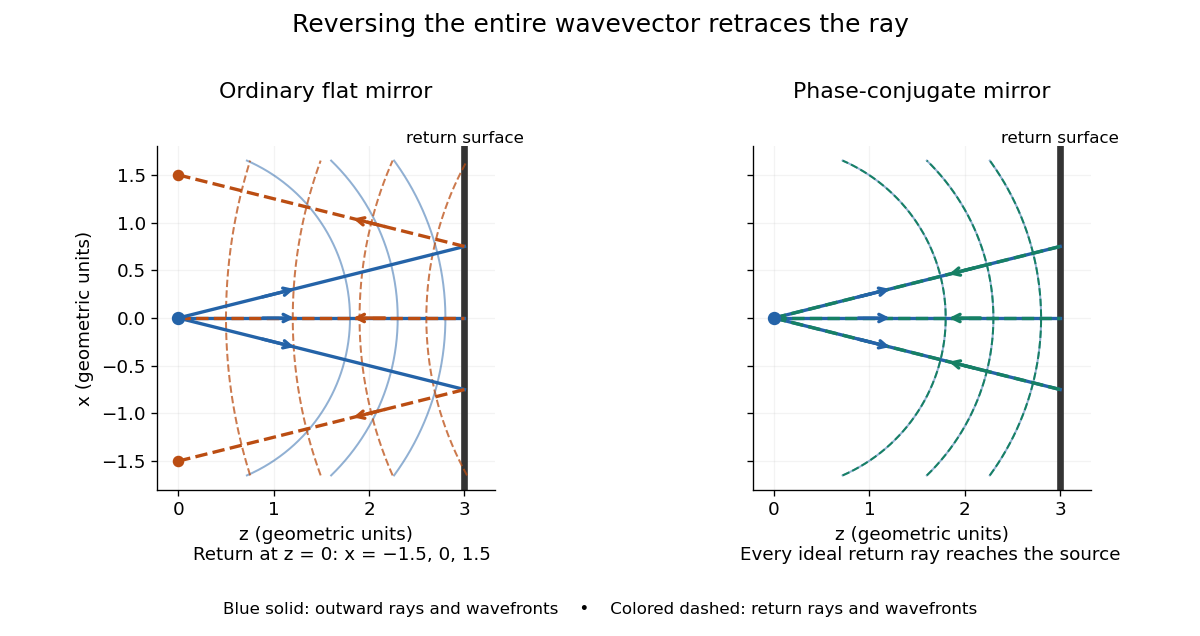
Solid blue curves mark outward wavefronts; dashed curves mark returning wavefronts. In the phase-conjugate mirror panel the returning curves coincide with the outward ones, and the arrows reverse on the same light rays. The diagram uses equal spatial scales. In geometrical optics, reversing each light ray in an unchanged medium with wave reciprocity retraces its route. At the optical point source itself, the ray construction becomes singular and diffraction sets the physical focal size.
A wave-level proof outline applies to a stationary scalar medium with real refractive index and no wave absorption. Writing for the vacuum speed of light, its Helmholtz equation isAll coefficients are real, so complex conjugation gives the same Helmholtz equation for . The conjugated outgoing boundary data select the incoming solution. This explains the connection between phase conjugation and retracing, provided the required incoming field is supplied over the necessary aperture. It also exposes the limits: wave reciprocity alone does not imply absence of wave absorption; conjugation of complex material coefficients would describe a different medium. Loss, an incomplete aperture, a changing medium or failure of wave reciprocity can prevent exact reconstruction. Intensity-dependent material changes need a separate analysis and are not covered by this linear proof.
Model a thin transparent plate by a lossless reciprocal phase screen with transmission at the chosen angular frequency. Both passages multiply the local field by the same : reversing travel does not by itself change the sign of an accumulated optical path length. Assume the plate is stationary, the two passages use corresponding transverse positions, and the plate is adjacent to the return surface or perfectly reimaged onto it. Ignore propagation between these reference surfaces, wave absorption, clipping and intensity-dependent changes. Take the incident boundary envelope to be . Outward transmission gives . Ideal phase conjugation and the second transmission then giveThis is a complete short proof of cancellation in the specified phase screen model. For an ideal ordinary mirror with constant reflection factor , the corresponding envelope is : the extra wave phase is , rather than zero. A constant reflection wave phase changes neither conclusion.
For an original toy optical aberration, let on , take , and chooseThe even term adds symmetric curvature and the odd term makes the two sides unequal. The outward wave phase is ; immediately after ideal phase conjugation it is ; after the second passage it is zero. At , the outward values are , while an ordinary mirror's completed return has values . All wave phases here are unwrapped relative to the central ray and are otherwise equivalent modulo . At a stipulated vacuum wavelength , these outward errors correspond to optical path length errors of . These are chosen values; they are not observations or physical plate thicknesses.
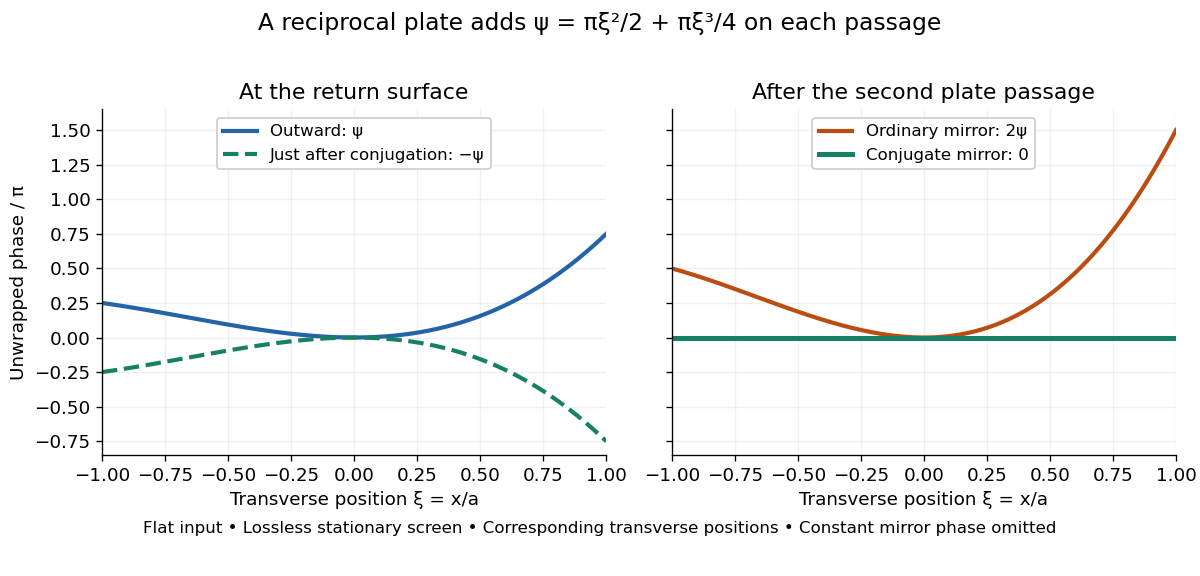
Original thin phase screen example: sign reversal at conjugation and cancellation after the second passage
. Details. The wave phase plots make a subtle distinction visible: the field is still curved immediately after phase conjugation, and becomes flat only after crossing the same plate again. More generally, conjugation restores , not a universally flat wavefront. If the plate instead has transmission with real , the return is . Its plate-induced wave phase cancels but its lost wave amplitude does not recover. If the return plate has changed to wave phase , the residual factor is . Those two variations distinguish correction of a stationary optical aberration from universal reversal of loss or material evolution.
Digital optical phase conjugation uses a wavefront sensor and a spatial light modulator to measure an incident field and launch a beam with the opposite spatial wave phase. A phase-only spatial light modulator illuminated uniformly generally does not reproduce the incident wave amplitude as well; exact requires the appropriate wave amplitude and polarization of an electromagnetic wave too. The experimentally useful question is how much of the original optical mode can be recovered with the measured and controlled field components.
In 2010, Meng Cui and Changhuei Yang demonstrated digital optical phase conjugation through a prepared multiple scattering sample. They dried mixed-size polystyrene microspheres on cover glass, added immersion oil, and sealed them with another cover glass. A 532 nm laser supplied signal and reference beams. The signal crossed the sample between two objectives; the reference interfered with it on a charge-coupled device. Phase-stepped wave interference recovered the spatial wave phase; a calibrated spatial light modulator imposed its negative on the reference-derived return beam. The reference supplied playback power, without nonlinear mixing pumps. An optical camera read out the recovered signal. With the same sample and a zero-phase spatial light modulator control, the return instead produced a scattering of light pattern. This comparison supports mode recovery by spatial wave phase control, not merely increased illumination. A separate ordinary-mirror control tested source displacements. Finite sampling and collection limited recovery; the system controlled wave phase rather than the complete vector field. These restrictions distinguish demonstrated reconstruction from exact reversal of every scattered component.[ref]
A wavefront connects points with the same wave phase at one specified time. It is a surface, rather than the trajectory of a particular piece of light. For a scalar monochromatic wave written as , a wavefront is a connected level set of the phase function ; different surfaces can share the same wave phase modulo . A plane wave has planar wavefronts. An outward wave from an ideal point source in a uniform medium has spheres as wavefronts, while an optical lens can turn nearly planar wavefronts into converging ones. The wavefront describes wave phase, not wave amplitude: drawing it does not say how bright the beam is. [ref]
The relation to light rays becomes precise in a stationary medium with isotropy, negligible loss and a real positive scalar refractive index . In the geometrical optics limit, spatial changes in the refractive index and wave amplitude are slow on the local wavelength scale. For a single smooth propagation branch, writeHere is the angular frequency, is the vacuum speed of light, has units of length, and the last relation is the optical eikonal equation. The local wavevector is . Its direction is normal to a smooth wavefront, since a gradient is normal to its level sets. A forward light ray has unit tangent vector , so it follows this normal under the stated assumptions. Along that light ray, : the change in is the optical path length. This is the short geometric argument linking wavefronts, light rays and optical path length. [ref]
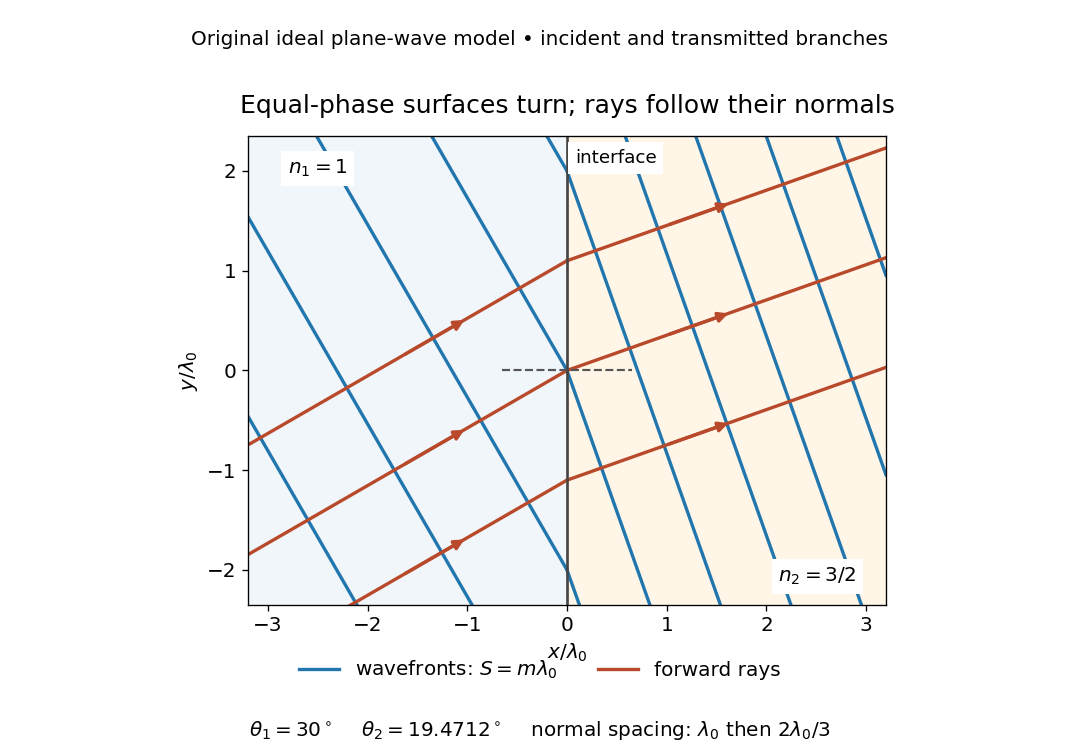
The diagram shows incident and transmitted branches separately, with the reflected branch omitted. Its stipulated refractive indices are and , and its incident angle is to the interface normal. At a stationary interface, the frequency and tangential wavevector agree on the two sides: Snell's law gives , hence . The wavefronts turn while their normal spacing decreases from to , where is the vacuum wavelength. More explicitly, with normal to the interface and tangential, take for and for . These functions agree at ; the drawn wavefronts are at with . This is an exact piecewise plane wave phase construction for the stipulated transparent media, not measured material data. [ref]
The normal-to-wavefront rule requires its assumptions. In a medium with anisotropy, the wavevector remains normal to a smooth wavefront, but the group velocity and energy flux need not follow it. [ref] Near a wave caustic, where multiple light rays meet, one smooth phase function may no longer describe the field; diffraction and the full wave amplitude matter. A wavefront is also not generally a surface of equal pulse arrival time. In a medium with optical dispersion, a monochromatic wave phase moves with the phase velocity, while a sufficiently narrow wave packet follows the group velocity. Even identical optical path lengths at one frequency can give different group delays. The usual equal-travel-time picture needs a common launch reference and a nondispersive ray model; an arbitrary broadband disturbance has no single monochromatic wavefront.[ref]
An optical path length measures how much propagation wave phase a path accumulates, expressed as the distance that would accumulate the same wave phase in vacuum. A centimetre in a uniform medium with refractive index has optical path length , although its geometric length remains . This makes optical path length useful whenever two contributions must arrive with matching wave phases, from an optical lens to a Michelson interferometer. [ref]
For a specified path at fixed angular frequency , the optical path length is the line integralHere is geometric arc length, and is the phase refractive index, evaluated at the same frequency everywhere. The propagation interpretation assumes a stationary linear medium with isotropy, a real positive scalar refractive index and negligible loss, on a valid geometrical optics branch. The path can curve; at sharp interfaces apply the appropriate matching conditions to each segment. A prescribed curve has a mathematical line integral, but it predicts a propagation wave phase only when it represents the physical branch. [ref] Optical fibers can require a mode wavenumber rather than the bulk refractive index along a guessed light ray. [ref]
Fix the vacuum wavelength , with frequency and vacuum wavenumber . In a locally uniform medium the wavelength is , while the frequency stays unchanged at a stationary interface. With the convention , propagation from a specified starting wave phase contributesThe relative reference includes launch wave phases and any extra wave phase from mirrors, beam splitters or coatings. Thus is a propagation contribution, not an absolute detector wave phase independent of the apparatus. If the reference contributions stay fixed, a change in optical path difference changes the phase difference by . Using the material wavelength again in this formula would count the refractive index twice. [ref]
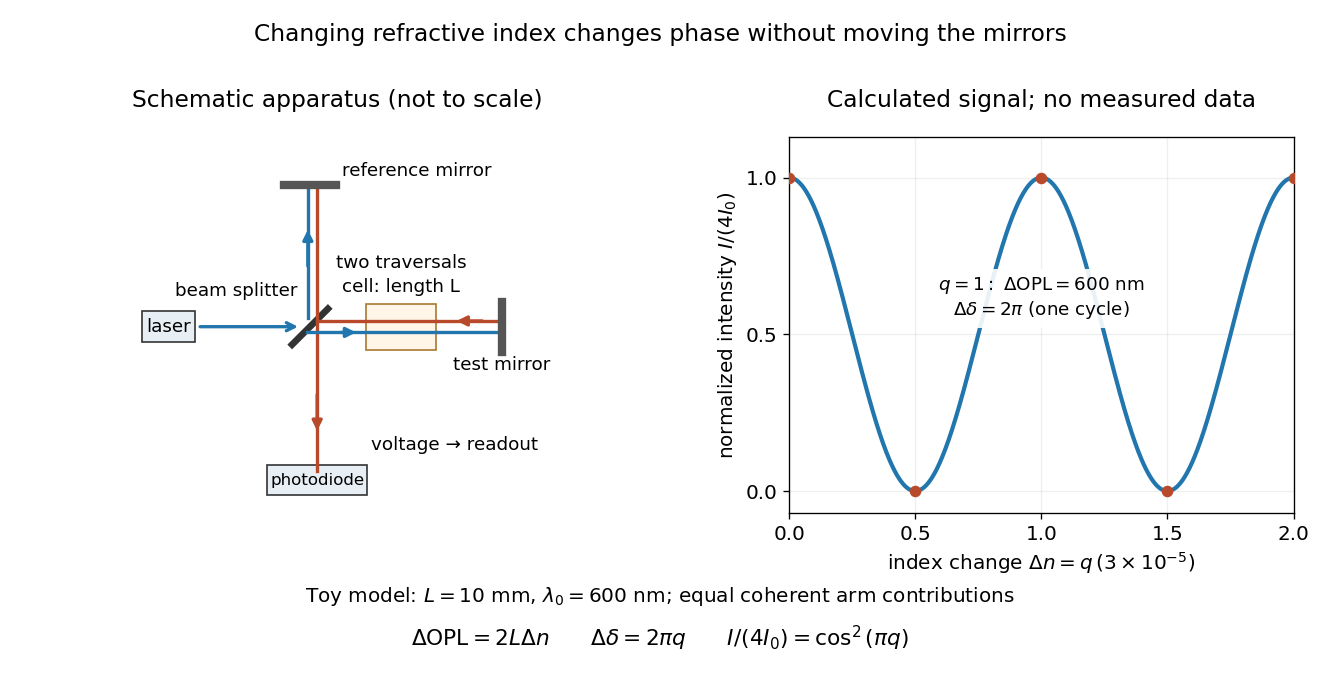
Optical path difference in a Michelson interferometer: apparatus schematic and a calculated phase difference readout
. Details. A motivating measurement turns invisible optical oscillations into a slowly changing electrical signal. MIT's teaching experiment uses a laser, a beam splitter, two returning mirrors, an amplified photodiode, an oscilloscope and a calibrated mirror actuator driven by a function generator. The returning beams overlap on the photodiode; one channel records detector voltage and another the actuator drive. The measured observable is the changing light intensity, including its maxima and minima, rather than direct timing of an optical cycle. A calibrated displacement per drive voltage and the spacing of the extrema relate geometric motion to the phase difference. The guide infers the laser wavelength from known actuator calibration; conversely, with independently known vacuum wavelength and ambient refractive index, the same relation calibrates mirror motion. These two unknowns cannot both be inferred from fringe spacing alone. [ref]
For a proposed change-of-medium measurement, keep the mirrors fixed and put a transparent cell of internal length in one arm. Compare its contents at refractive indices and , leaving its windows in place. At normal incidence the two traversals giveHere is the signed number of whole interference fringe cycles plus any resolved fractional cycle, counted continuously. A mirror displacement instead gives ; distinguish this double-pass factor from a single pass in a Mach-Zehnder interferometer. OpenStax's gas-cell worked example provides the same double-pass reasoning; it is a teaching calculation rather than a published measurement dataset.[ref]
An exact toy calculation makes the sensitivity visible. Stipulate , and . Then and : a full interference fringe cycle, despite unchanged geometric lengths. For a continuous change , let and choose the initial detector phase difference to be zero. Equal coherent detected arm contributions of light intensity predictThe plot is this stipulated model: gives a minimum, restores a maximum, and the reference level is chosen by adjustment of the apparatus. It contains no measured values or assigned properties of a real gas. The equivalent mirror travel in vacuum is per cycle. A single endpoint light intensity cannot distinguish from ; the continuous fringe count carries the missing information.
For an interpretable cell measurement, establish the initial phase difference with a small calibrated mirror scan, then track slow changes through successive interference fringes. Measure the dark signal and each arm separately, keep photodiode gain within its linear range, align both beams on the same region and match their linear polarizations. Monitor interferometric visibility and keep arm delays within the useful optical coherence time. Record cell length, contents, pressure and temperature; return to the starting condition to check drift. Changes in window deformation, cell length, external air or mirror position also change optical path length, so a reference cell or an independently monitored mechanical path is needed to isolate the contents' refractive index. These controls are deductions from the model, not a claim that the illustrated apparatus was operated. Loss of fringe count leaves a whole-cycle ambiguity; at an intensity extremum the first derivative with respect to phase difference vanishes, so a scan around phase quadrature is more sensitive to small changes. Broadband illumination, unstable optical coherence, vibration and strong loss can invalidate a simple one-frequency inference.
An optical path difference subtracts two optical path lengths at the same frequency and with specified endpoints and sign. Its phase difference contribution is , in addition to any apparatus reference wave phase. For wavefront error, the comparison is usually between an actual wavefront and an ideal reference wavefront.
In a monochromatic two-path interferometer, an ideal phase plate of thickness and refractive index adds phase at normal incidence. The interference pattern is unchanged when for integer , provided transmitted amplitudes and alignment are unchanged. Calling the smallest index requires specifying the admissible range; excludes the optically null solution.
The group refractive index is for a transparent isotropic propagation branch with forward group velocity . Differentiating the local wavenumber givesThe last formula gives the propagation group delay along a path whose geometry is fixed as frequency varies; additional apparatus wave phases require their own frequency derivatives. For a narrow wave packet with little loss and negligible reshaping, it approximates the transit of its wave envelope. In the nondispersive case , it reduces to . An optical path length at one frequency contains no information about , so in a medium with optical dispersion it cannot by itself determine the group delay. [ref]
For an original local model near , choose two equal geometric paths of length , with and . At both optical path lengths equal , and matched launch and interface references give equal carrier wave phases. But and , so their group delays differ by . This local stipulated model is a counterexample to identifying equal wave phase with equal pulse arrival; it asserts no material response outside the narrow band considered. Strong loss or pulse reshaping requires a fuller propagation model, and group delay need not time the earliest causal response.
For vacuum incidence at fixed angle into a transparent isotropic medium, Snell's law gives . Thus , andAngles must be differentiated in radians. This determines the local group velocity from a first derivative of measured refraction angles; pulse broadening needs further information about group velocity dispersion and absorption.
The group delay is the frequency derivative of an unwrapped transfer wave phase, using the convention. It predicts the leading delay of a narrow wave envelope when the transfer wave amplitude and the delay vary little across its band; it is not generally a signal-front arrival time.
The second derivative of spectral phase with respect to angular frequency; it measures variation of group delay with angular frequency.
The cubic term in a component's spectral phase, conventionally written , where is an angular frequency offset.
A wavefront error is the difference in optical path length from a reference wavefront, often an ideal plane or sphere. Its root mean square should specify the illuminated pupil and which modes, such as constant phase or image displacement, have been removed.
For a real wavefront error , its squared spatial root mean square is . Orthogonal unit-peak sine modes have mean square , so , whereas the coefficient norm is . On a finite optical pupil orthogonality needs checking; independent uniform random wave phases give the same diagonal after wave phase averaging. This normalization matters when a speckle contrast of a sinusoidal wavefront error is specified by peak wave amplitude.
Wave interference is the reinforcement or cancellation that occurs when overlapping wave amplitudes add by the superposition principle. For two monochromatic waves of the same frequency, mutual optical coherence means that their relative wave phase is stable during the observation. Equal wave phases give constructive interference; a half-cycle phase difference gives the destructive interference intensity minimum. Wave amplitudes add before their squares determine wave intensity. [ref]
https://openstax.org/books/university-physics-volume-3/pages/3-1-youngs-double-slit-interference. Ling, Sanny and Moebs, University Physics Volume 3, §3.1: coherent waves and interference
.Consider two overlapping beams in a homogeneous medium, with the same polarization of an electromagnetic wave and individual local time-averaged light intensities . Their phase difference is measured in radians. In the scalar detection convention, the combined local time-averaged wave intensity isThe last term records wave interference; adding alone misses it. The formula describes irradiance when both fields propagate along the same direction, or when the same detector geometry factor is included in all three intensities. For crossing beams it describes the squared electric field response, proportional to scalar wave intensity; a specified component of the Poynting vector also requires the propagation geometry. The ideal crossing plane waves below make that distinction explicit.
For equal individual light intensities , the cosine half-angle identity givesThe constructive interference intensity is at modulo , and the destructive interference intensity is zero at modulo . At phase quadrature, , it is . With and in the same arbitrary wave intensity unit, the maximum is , the minimum is , and the phase quadrature value is : unequal wave amplitudes cannot cancel completely.
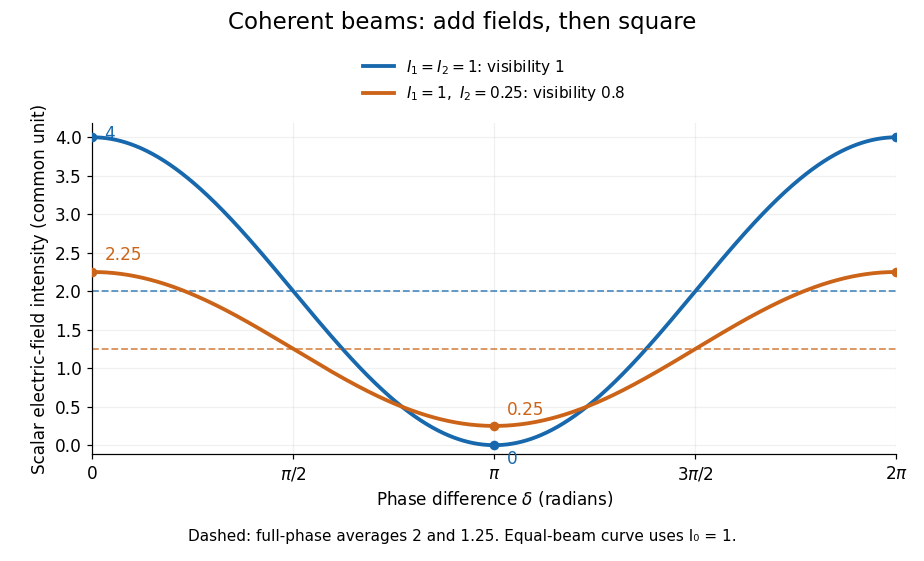
Two-beam wave intensity versus phase difference: equal beams reach 4 and 0; unequal beams reach 2.25 and 0.25
. Details. Both curves use the same wave intensity unit and a horizontal angle in radians. The dashed levels are the averages over a full phase difference cycle. Equal beams have interferometric visibility one; the unequal example has interferometric visibility .
A spatially varying phase difference turns the same law into interference fringes. Take two ideal plane electromagnetic waves with common wavelength , equal individual light intensities , and propagation directions at angles and from the axis in the plane, with . Both have linear polarization along , perpendicular to both propagation directions. Choose equal initial wave phases; their wavevectors and phase difference areHere is the wavenumber and the angular frequency. The common and time terms cancel, so the interference fringes stay at fixed for every . Their interference fringe spacing isSet the length unit to , so that , and take : then . The constructive interference intensity bands lie at integer ; the destructive interference intensity bands lie at half-integer .
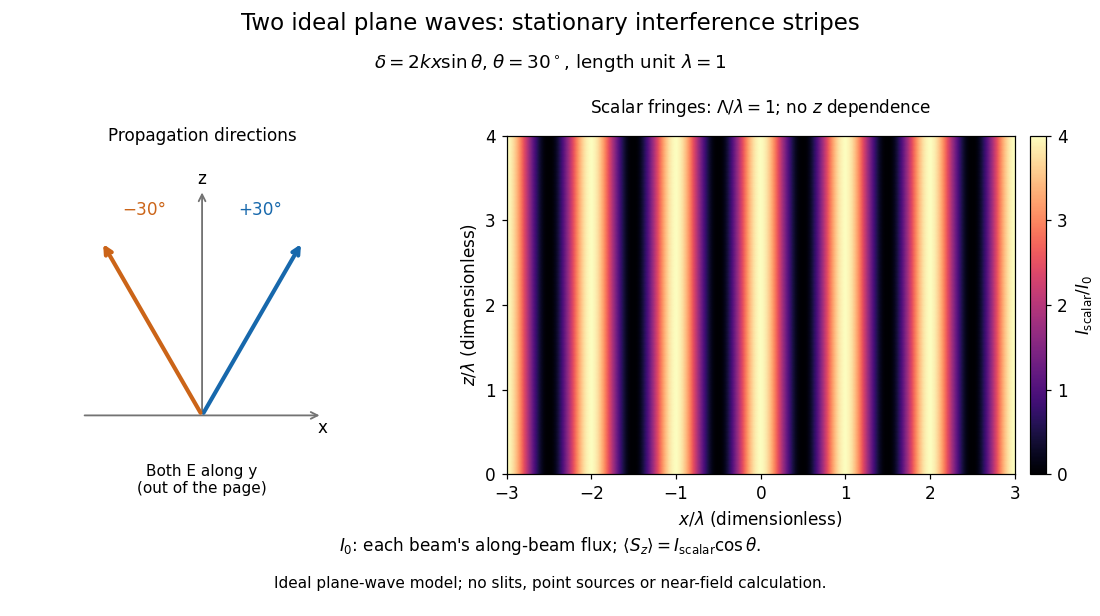
The grid covers and ; both axes are dimensionless lengths in wavelength units. The colour scale is from zero to four, using the same single-beam normalization as the equal-beam curve above. This is an ideal plane wave superposition, with no slits or point sources and no near-field approximation. For these -polarized plane electromagnetic waves in vacuum, the longitudinal time-averaged Poynting vector obeys ; the plotted scalar therefore differs from the irradiance through a plane normal to by that common factor. This relation follows by adding the magnetic fields as well as the electric fields.
The bright peaks do not create energy. Averaging over one interference fringe spacing, or equivalently over one full phase difference cycle, givesbecause the integral of the cosine is zero, with sine as its antiderivative. Equal beams thus average to , despite bright bands at . For the crossing-wave geometry, the average longitudinal energy flux is correspondingly . Bright and dark regions redistribute the incoming energy; conservation of energy concerns the full energy flux, rather than the height of one peak.
Wave interference is useful because phase differences convert small changes in optical path length into measurable changes of wave intensity, as in a Mach-Zehnder interferometer. Its beauty is that the same superposition principle produces both complete cancellation and fourfold brightening; adding more coherent contributions also produces the narrow peaks of a diffraction grating. Feynman's treatment connects this many-source pattern directly to addition of complex amplitudes. [ref].
A short proof outline uses local real fields with parallel linear polarizations. Write and for the same positive conversion factor . Averaging over many wave periods while the phase difference stays fixed uses and , giving the stated law. Equivalently, add the complex amplitudes and take the squared complex modulus. [ref]
https://www.feynmanlectures.caltech.edu/I_29.html#Ch29-S5. Feynman, Leighton and Sands, The Feynman Lectures on Physics, I §29–5: the mathematics of interference
.For different fixed linear polarizations in a common transverse plane, the cross term acquires the dot product of their real unit vectors, equal to for relative angle . Orthogonal linear polarizations remove the cross term in polarization-insensitive scalar detection; different orientations generally only reduce it. A common polarizer can select overlapping components and recover wave interference. Likewise, rapid random variation of the phase difference removes the observed cross term only when the detector's time average has . Slowly varying wave phases can instead move resolved interference fringes, and biased or incompletely sampled wave phases can leave residual contrast. Finite optical coherence therefore depends on the observation time as well as the fields.
Lloyd's mirror produces interference between light arriving directly from a narrow source and light reflected by a plane mirror, which appears to originate at the source's virtual image. With source distance from the mirror, the effective source separation is . A reflection phase shift close to reverses the bright/dark condition relative to two equally phased sources. Spatial filtering, suitable temporal coherence, and direct/reflected beam overlap remain necessary.
Measurement using wave interference: relative path or phase changes are inferred from the resulting signal. The interacting fields must have sufficient optical coherence in the measured modes for the intended interference signal.
Measurement using interfering light fields. A phase difference changes the detected intensity, allowing measurements of displacement, optical path length or a spectrum. The round-trip phase in a Michelson interferometer gives one explicit path-to-phase calibration; Fourier transform spectroscopy recovers spectral information from an interferogram.
A nearly uniform wavefront phase over one collector is called its piston. Differential atmospheric piston changes the pairwise optical phase without requiring a change in the source. Delay tracking and closure phase address different consequences of this phase error; intensity correlations are unchanged by an ideal pure phase multiplication at either detector.
fringe tracking estimates changing optical delay or phase and adjusts delay compensation to keep an astronomical interferometer near a useful interference condition. The delay must first lie inside the finite-bandwidth coherence envelope; rapid tracking then controls atmospheric piston. This is optical-path stabilization, with sensitivity and reference-source limitations.
A Moiré pattern is a large-scale modulation produced by superposing similar periodic structures. Two identical two-dimensional lattices rotated by a small angle have geometric period in the usual matching geometry. In layered crystals this modulation can act as an electronic superlattice; the actual bands additionally depend on interlayer coupling and orbital structure.
A slow spatial modulation produced by overlapping periodic structures with different projected spatial frequencies or orientations. Its spacing need not equal an atomic lattice spacing.
Subtract the phases and of two projected periodic structures. Their relative phase repeats along the difference vector after distance . For magnitudes and separated by angle , this gives . At zero rotation it reduces to ; equal spacings give . Finite specimen extent limits how many periods can be observed.
Destructive interference occurs when coherent contributions partially or completely cancel their complex amplitudes. For two equal contributions, a phase difference of modulo gives zero resultant wave amplitude. The missing local light intensity is consistent with conservation of energy because the full spatial interference pattern redistributes power.
Thin-film interference combines coherent light contributions reflected or transmitted at the two surfaces of a layer. For a film of refractive index , thickness and internal angle , the round-trip optical path difference is . The relative reflection phase shift must also be included. For a nonabsorbing higher-index film surrounded by air, one of the two leading reflected contributions has a phase shift and the other does not. Reflection maxima therefore satisfy . A smooth reflection spectrum filters many visible wavelengths at once; varying thickness and angle produce spatially varying mixed colours.
With one reflection phase reversal and near-normal incidence, reflected minima satisfy . Subtracting the reciprocal-wavelength conditions for consecutive minima gives the displayed thickness relation. A single maximum between two stated minima identifies the consecutive-order case. Wavelength-dependent refractive index or non-air surroundings can change the inference.
An optical coating designed to reduce reflection through refractive-index choice and thin-film interference. A quarter-wave design is a single-wavelength approximation, not broadband perfection.
A thin-film design that suppresses reflected green light more strongly than red and blue can leave a purple residual reflection. A single quarter-wave layer cancels reflections exactly only at its design wavelength and angle under the ideal index-matching condition. reflection colour should be distinguished from the much smaller colour change of the transmitted beam; multilayer designs can broaden the low-reflectance band.
For a film of refractive index and thickness in air, its round-trip propagation phase is . Two neighbouring same-type interference fringes differ by . At small angular spacing in radians,The relation assumes slowly varying interface reflection coefficients and no rapidly varying reflection phase. At normal incidence the first derivative vanishes, so a local linear angular-spacing formula must be replaced by a quadratic expansion.
A curved transparent surface resting on a plane traps a thin film whose thickness increases radially, producing circular interference fringes. For near-normal reflected light and one relative reflection wave phase change, contact is dark and bright rings obey for . Here is the film's refractive index and the vacuum wavelength. For spherical curvature radius , gives . Consequently for ring diameters . A contact gap, altered reflection phase, or significant oblique incidence changes the formula.
The double-slit experiment compares propagation through two openings. Coherent illumination gives double-slit interference; independent incoherent source patches contribute light intensities whose displaced patterns can reduce the observed interferometric visibility.
Evacuating a transparent cell of optical length in one coherent beam changes its optical path by relative to an unchanged cell in the other beam. With vacuum wavelength , the number of completed fringe periods is . The initial maximum is not an additional completed period. Counting only integer fringes leaves a phase uncertainty of order one fringe unless the final fractional phase is measured; the corresponding index scale is . Fixed equal window contributions cancel in the path difference.
In oblique-incidence two-slit interference, the incident wave contributes a constant phase offset while changing observation angle changes the outgoing optical path difference by . Subtracting the phase conditions of an adjacent minimum and maximum cancels the unknown incidence angle and order and gives the displayed wavelength. Nonadjacent extrema need their intervening phase-order difference; angular spacing should not be replaced by a small-angle formula unless justified.
A sequence of individual localized electron detections can accumulate a two-path interference distribution when the apparatus maintains coherence. The 1989 experiment led by Akira Tonomura used a field-emission source, an electron biprism, electron lenses and a position-sensitive electron counter. It realized two coherent paths without literal machined double slits. Low occupation of the instrument excludes interactions between different electrons as the origin of the fringes.[ref]
Double-slit interference depends on the relative wave phase and first-order optical coherence of two collected fields. For equal separately measured intensities, the interferometric visibility is . A small source direction change introduces phase difference for projected interferometric baseline .
Two equally illuminated slits of different widths have field amplitudes . Their interference intensity is . Near the centre, , so the local maximum-to-minimum ratio is . At one slit envelope's zero the interference visibility vanishes even if the other slit still transmits.
The ratio of an envelope width to a fringe period counts spatial intervals. It need not equal the number of bright fringe centres strictly inside the envelope's zeros. For a symmetric overlap from phase index to , the width spans 50 periods, but the strictly interior integer centres are through , totaling 49. Endpoints where one aperture amplitude vanishes have no two-beam contrast. State the count convention rather than treating these as inconsistent answers.
Two equal rectangular apertures of width , centre spacing , and relative phase have Fraunhofer diffraction amplitude proportional to , with and . HenceThe interference zeros satisfy , including the central dark fringe. The single-aperture envelope vanishes at for nonzero integer . A uniform phase reversal translates the narrow-slit fringes by half a fringe without changing their spacing.
Two adjacent half-slits of width h with opposite field transmission have centres separated by h. The aperture transform is . Thus the phase-reversed pair factor multiplies the finite-half-slit envelope, giving the displayed normalized intensity with and . The on-axis field cancels. Positive side maxima satisfy , and total integrated transmission is unchanged by a lossless phase plate even though the angular distribution changes.
A relation between wave phases that lets contributions from successive interaction regions add coherently. In Cherenkov radiation, the condition along the particle trajectory is , relating angular frequency, wave vector and particle velocity.
The daughter photons occupy orthogonal ordinary and extraordinary polarization classes. Alternative assignments to two collected paths can interfere if timing, spectrum and spatial mode do not distinguish them. spatial walk-off and unequal group delays often require compensation.
In a common birefringent down-conversion arrangement, the two daughter photons have the same polarization class, ordinarily both ordinary or both extraordinary relative to the crystal. The pump has a suitable different index for phase matching. This classification alone does not establish polarization entanglement.
Compensation of phase mismatch by a spatial modulation of the coupling coefficient. Write . The driven amplitude contains , so the selected Fourier component accumulates coherently when . For first-order compensation the full spatial period is , twice the nonlinear optical coherence length.
An ideal equal-duty pattern alternating and has first Fourier coefficient of magnitude . Hence its conversion intensity is of a uniformly phase-matched crystal using that same coefficient, under the same undepleted plane-wave assumptions. The modulation can nevertheless allow a larger tensor coefficient or an otherwise inaccessible wavelength. Periodically poled lithium niobate implements such sign reversals using ferroelectric domains.
The residual wave vector difference in a wave-conversion process. For collinear sum-frequency generation, choose . Contributions separated by then differ by wave phase . At phase matching this residual is zero. The sign convention changes some amplitude phases but not the unseeded conversion factor .
The distance over which a constant phase mismatch accumulates phase difference . In unseeded, undepleted sum-frequency generation, the generated intensity first reaches a maximum at this length and returns to zero at . This length concerns relative phases of interacting waves, rather than the temporal optical coherence length of one source.
The slow change in the resultant amplitude when two nearby frequencies interfere. Two steady sinusoidal components at and produce successive amplitude maxima separated by .
A linear time-invariant circuit sends each sinusoidal input to an output at the same frequency, multiplied by its complex transfer function. Two inputs therefore give the sum of two phase-shifted sinusoids. If their output amplitudes are equal, the sum factors into a carrier at the mean frequency and a signed cosine envelope at half the frequency difference. The envelope magnitude repeats at the full difference frequency. Unequal amplitudes give a nonzero minimum; a nonlinear detector is needed to generate a separate difference-frequency signal.
For mutually coherent monochromatic waves with the same polarization of waves in the scalar convention of wave interference, constructive interference reaches its maximum at phase difference , with integer . The wave amplitudes add, giving . Equal individual wave intensities give ; individual wave intensities and give in their common unit. This maximum assumes the optical coherence and detection conditions stated in wave interference.
Articles were limited to the first 100 out of 254 total.
Articles by others on the same topic



Physical optics is a branch of optics that focuses on the wave nature of light and its interactions with matter. Unlike geometrical optics, which primarily deals with the propagation of light in terms of rays and prisms, physical optics examines phenomena such as interference, diffraction, and polarization, which cannot be adequately explained by ray optics alone. Key concepts in physical optics include: 1. **Wave Nature of Light**: Light is treated as a wave, which means it is subject to wave phenomena.