Take the Gaussian function with . Every derivative is a polynomial times the same Gaussian function, so is a Schwartz function. The Fourier transform of a Gaussian gives, in the cycles convention,Thus the Poisson summation formula gives the exact identityThe Gaussian Fourier transform is given in scaled form in Exercise 41 of Terence Tao's 245C, Notes 2: The Fourier transform.[ref]
245C, Notes 2: The Fourier transform by Terence Tao. §3, Exercise 41: transform of a scaled Gaussian; put r=1/sqrt(a) and adjust its prefactor
The identity is also the imaginary-axis transformation of the Jacobi theta function. At the Gaussian function is its own Fourier transform; at reciprocal values of its spatial and spectral widths exchange.For a short derivation of the Gaussian Fourier transform, write . Differentiation under the integral and integration by parts, using , giveThe Gaussian integral gives , so this ordinary differential equation yields the claimed formula. The decay of the Gaussian function justifies these steps and removes the boundary term.[ref]
Lecture 17: The functional equation. Lecture 17, §17.1, Lemma 17.9 and proof, printed p. 3: differential-equation proof for the unit Gaussian; scaled here to a>0
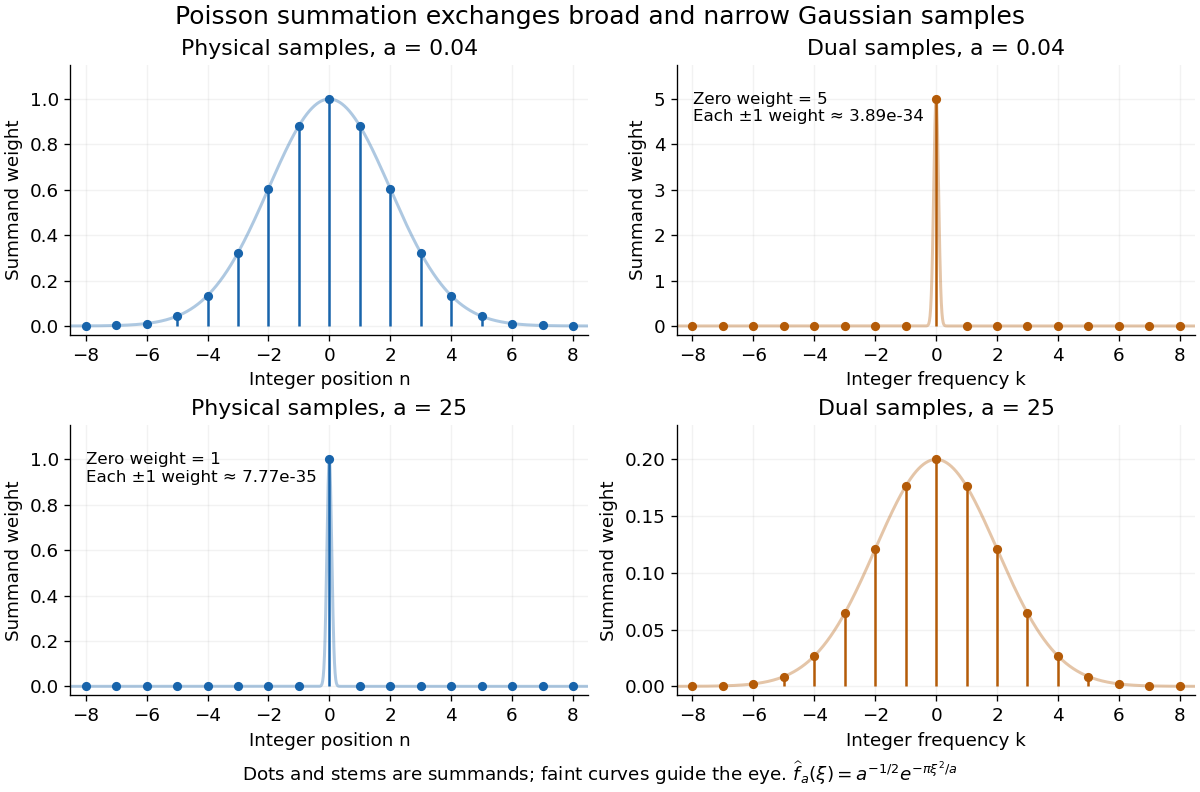

For , the physical Gaussian function has width parameter , while its Fourier transform has width parameter . Many physical samples matter, but the dual zero sample already givesFor , use the physical side instead:These are bounds on the full positive tails, obtained below, rather than estimates based only on the first omitted term. Ordinary floating-point arithmetic rounds these sums to and ; the exact real numbers are slightly larger. A Gaussian sum truncation bound lets us choose the cheaper side and certify its truncation error before evaluating it.
For and a nonnegative integer , define the symmetric partial sum and its positive remainder bySuccessive omitted terms have ratio for . Bounding them by a geometric series givesConsequently the physical approximation to has error at most , while the dual approximation has error at most . The prefactor must be included when setting an absolute error tolerance.
For a truncation error below , at the physical side first passes this bound with : lattice points give , whereas gives . The dual side needs only . At the physical side needs only , whereas the dual side first passes the bound with : lattice points give . These counts measure symmetric lattice terms; using the even function symmetry reduces the distinct exponential function evaluations to . Truncation bounds do not include rounding error in a numerical implementation.
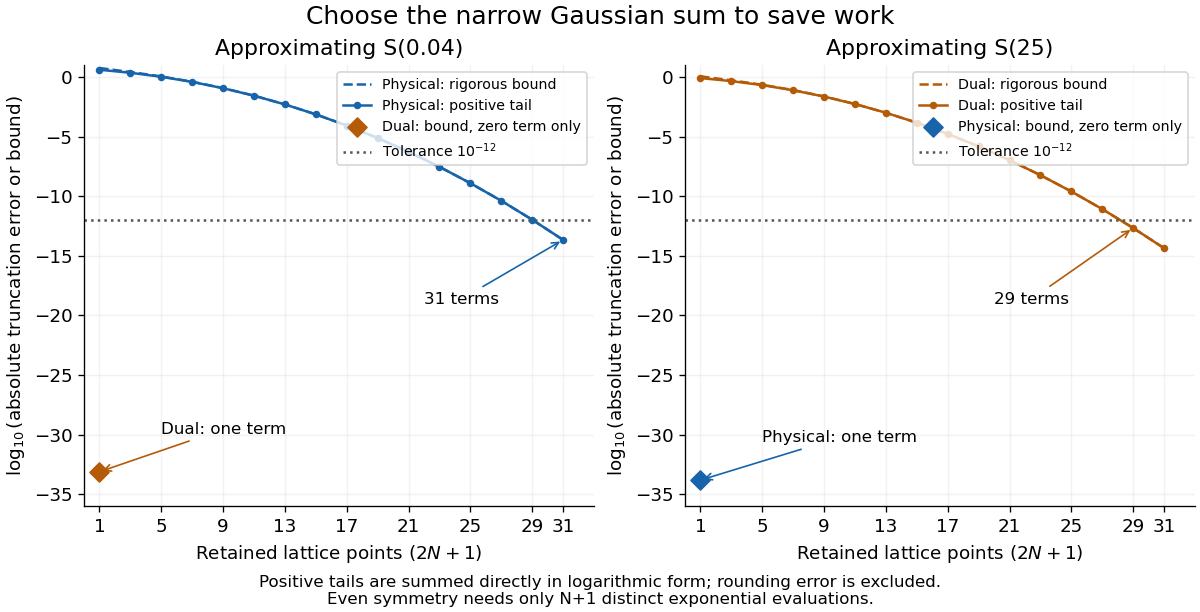
Positive Gaussian tails and rigorous bounds versus retained lattice points, showing the efficient side at reciprocal scales
. Details. 
Articles by others on the same topic
There are currently no matching articles.