Gross mass is the mass of the complete specified load, including its contents and the packaging counted as tare mass. For that same boundary,The gross indication in OIML's weighing terminology is obtained with neither a tare device nor a preset tare device operating, after an initial zero indication.[ref] A full crate's gross mass consequently differs from an individual jar's gross mass, because the specified loads differ.
Consider four jars, each containing of material and having an empty-container tare mass of . An outer crate adds . For the complete load, the net mass of the contents, composite tare mass, and gross mass are respectivelyThese are chosen bookkeeping values, assuming the listed components exhaust the load and each component is counted once.
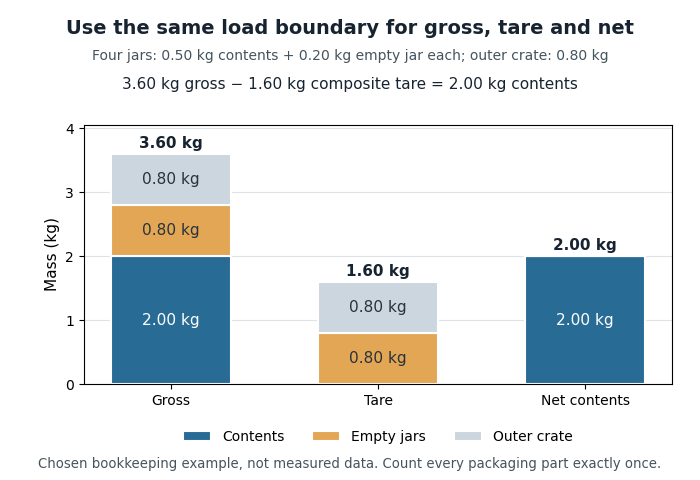
Gross, composite tare and net mass of four jars in one outer crate
. Original chosen example: 2.00 kg of contents, 0.80 kg of empty jars and 0.80 kg of outer crate. The colored parts represent disjoint portions of the complete load. Details.
Subtracting the full composite tare mass from the complete gross mass gives of contents. If the jars' has already been removed from an intermediate total, subtracting the same full composite tare mass again gives . The missing is precisely the duplicated deduction. Use one load boundary and subtract each packaging component once.
The gross mass also remains relevant to maximum weighing capacity when a subtractive tare device reduces the available net-load range.[ref] For an illustrative instrument modeled with a gross-load limit, a container leaves for contents. At that limit the complete load still has gross mass , even though the tared display reports only its contents.
For a stationary ideal weighing scale, the normal contact force associated with a complete load is related to its gravitational weight. A displayed net mass is a processed indication of that load; it is not the full supported mass. Changes in the gravitational field, measurement calibration, or the load boundary must therefore be distinguished when interpreting a reading.
Articles by others on the same topic
There are currently no matching articles.