The Haldane mapping function connects additive genetic map distance to endpoint recombination fraction in a toy model with no crossover interference. Specify the model directly along a transmitted chromatid: the exchange count in the interval has a Poisson distribution with expected value , where is the distance in morgans. Counts in disjoint intervals are independent random variables. This is the transmitted-chromatid convention; is not the mean number of exchanges across all four chromatids in meiosis.
An odd exchange count changes parental phase. Summing the odd terms of the Poisson distribution givesFor , the inverse and short-interval approximation areHere is the natural logarithm. At , the recombination fraction is ; at , the distance is morgans, or about centimorgans. The linear approximation is useful only near zero. The recombination fraction approaches as grows; has no finite inverse in this model.
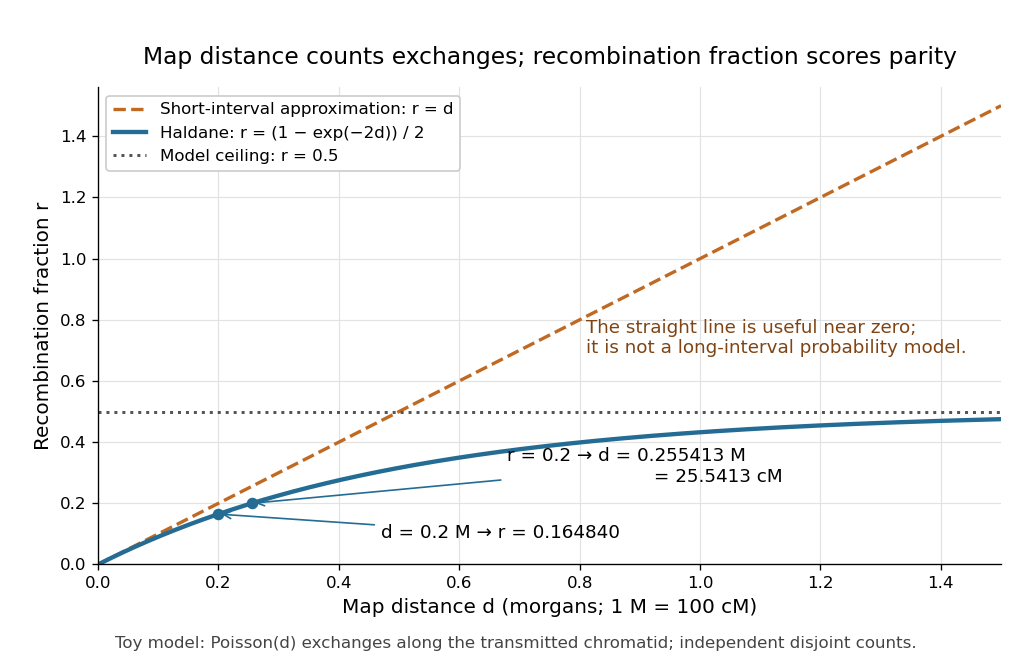
Haldane mapping function versus the short-interval approximation: genetic map distance keeps growing while the recombination fraction approaches one half
. Details. 
The model is a useful baseline, not a universal rule for every interval during meiosis. Crossover interference can change the relationship between distance and recombination fraction. For the count convention and assumptions, see Weeks, Tang and Kwon (2009): genetic map functions and exchange-count conventions. Haldane's original paper is bibliographically recorded as The combination of linkage values, and the calculation of distances between the loci of linked factors, Journal of Genetics 8 (1919), 299–309, in Selected Genetics Papers of J. B. S. Haldane, edited by K. Dronamraju (1990), contents.
Articles by others on the same topic
There are currently no matching articles.