Meiosis reduces two sets of chromosomes to one. In the ordinary diploid life cycle, this makes it possible for fertilization of two haploid gametes to restore the diploid state rather than double the number of sets in every generation. Its two divisions perform different tasks: meiosis I separates homologous chromosomes, whereas meiosis II separates sister chromatids. One round of DNA replication precedes both divisions; there is no second round between them. See [ref]
Molecular Biology of the Cell, 4th edition. Meiosis, “Duplicated Homologous Chromosomes Pair During Meiosis” and “Gametes Are Produced by Two Meiotic Cell Divisions”, Figures 20-6–20-7
.Two homologous chromosomes carry corresponding genetic loci, potentially with different alleles; two sister chromatids originate by DNA replication of one chromosome. After chromosomal crossover between nonsister chromatids, the sister chromatids need not carry identical alleles everywhere. Separating the two relationships explains why a haploid product of meiosis I still contains replicated chromosomes.
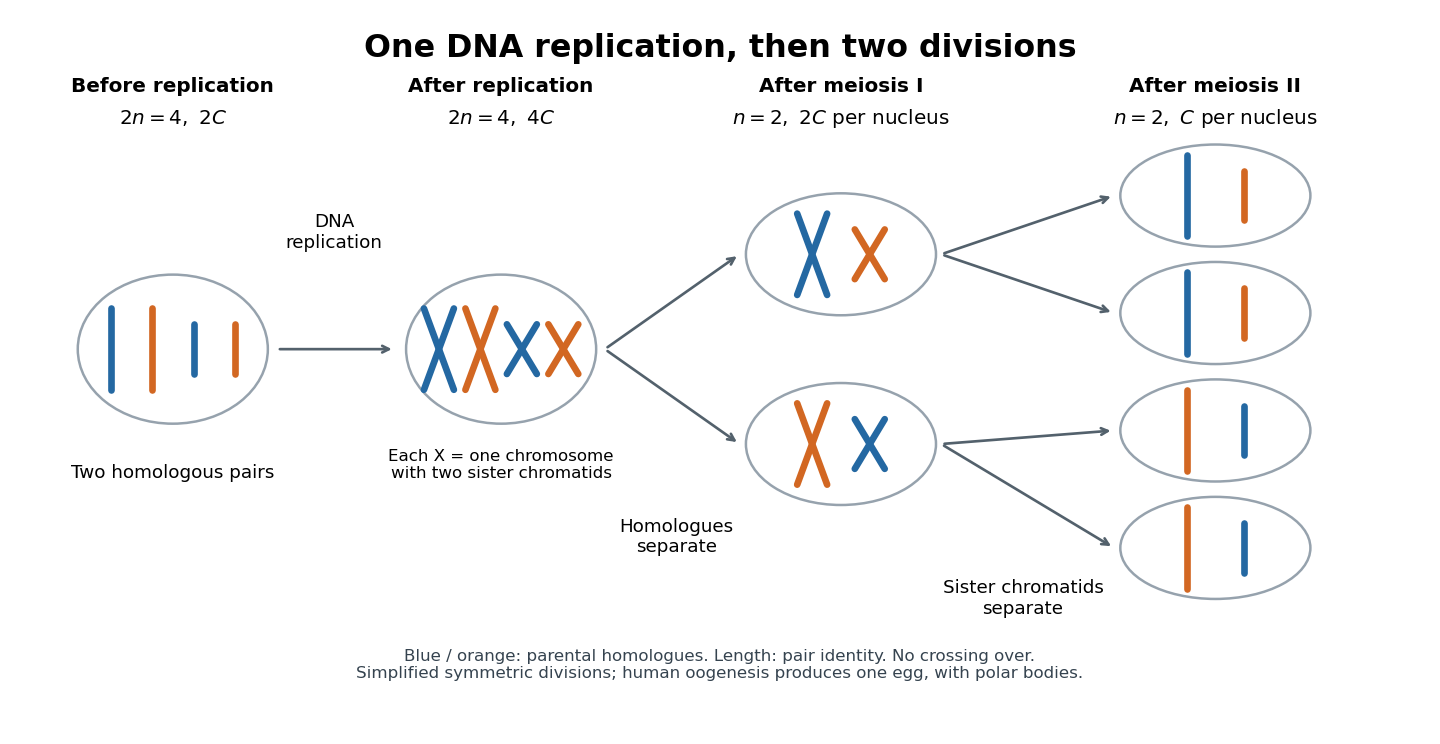
One DNA replication followed by homologous chromosome separation and separation of sister chromatids
. Original simplified model with two homologous chromosome pairs, no chromosomal crossover, and symmetric divisions. The four final compartments represent haploid products, not four functional ova. Human oogenesis uses unequal divisions, retaining most cytoplasm in one developing ovum and producing polar bodies. Details.The two divisions explain Mendelian segregation; variable orientation of different homologous chromosome pairs connects it to independent assortment. Genetic recombination adds another source of allele combinations. These mechanisms reshuffle inherited material without requiring a new mutation.
The symmetric diagram is useful for counting, but human oogenesis produces one functional ovum rather than four. The polar bodies receive discarded chromosomes and little cytoplasm. See Human Reproductive Anatomy and Gametogenesis (§43.3, Oogenesis and Figure 43.13: unequal divisions and polar bodies).

