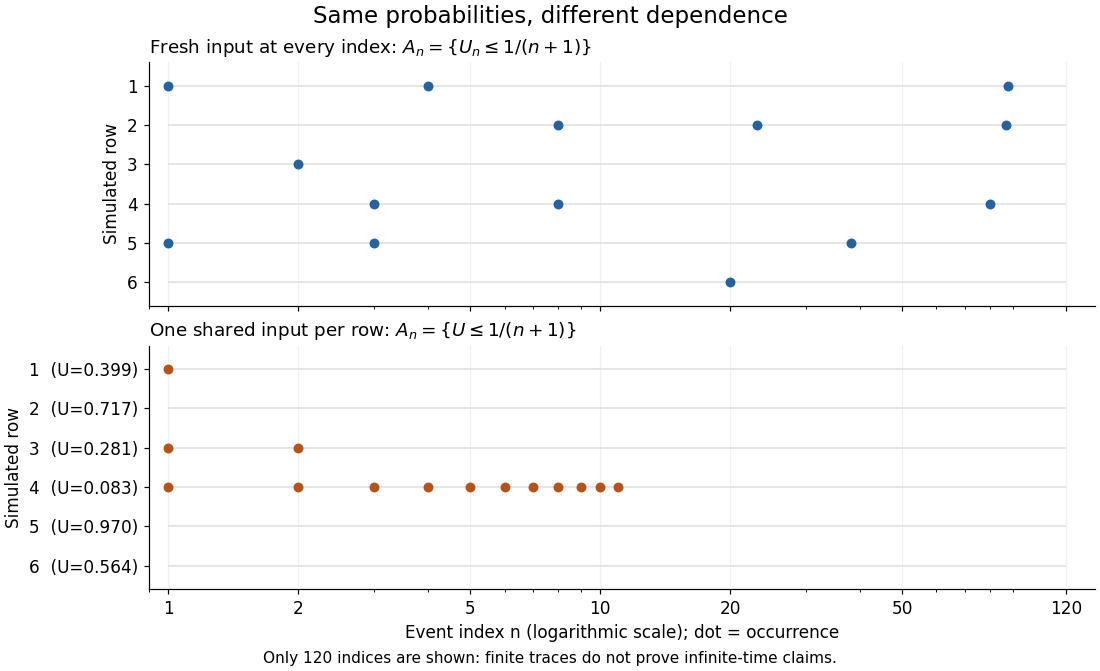
Choose one random variable with the continuous uniform distribution on , and reuse it in every event:
Each probability is , so their harmonic series diverges, just as in summable and harmonic event probabilities. But the events are decreasing: . For every outcome , all indices with fail. Only finitely many events occur on that outcome. The limsup of events is exactly , a zero-probability event. This is a concrete closed-interval version of the shrinking-interval dependence example.[ref]
The missing assumption is visible already in two events. For , their intersection is , hence
Moreover, the whole tail union is just , with probability . This calculation explains directly why divergence alone fails: overlapping events keep spending their individual probabilities on the same outcomes.
Let be the total number of occurrences, a sum of indicator random variables. Although almost surely, Tonelli theorem gives . More explicitly, for : very small positive values of give very long, but finite, initial runs. Infinite expected value does not imply a positive probability of an infinite count.
Figure 1.
Equal harmonic event probabilities with fresh independent inputs or one shared input
. Each row is one finite simulation of the indicator random variables of for ; a dot means the event occurred. Fresh independent random variables allow scattered returns; a shared uniform random variable yields an initial run followed by zeros. The horizontal axis uses a logarithmic scale to show early runs clearly. These finite simulations illustrate the two models and cannot prove infinitely many occurrences or eventual stopping. Details.
Take independent random variables , each with the continuous uniform distribution on , and set . Then , and the events are mutually independent events. The product probability space supplies a model for the entire infinite sequence; a finite list of simulated values is only an illustration.
For , the p-series is summable:
The Basel problem supplies the total sum, and the integral test for convergence gives the displayed tail bound. The First Borel-Cantelli lemma makes the limsup of events have probability zero. In fact, the tail bound implies that the probability of even one alarm at or after is at most ; for , it is at most . This bound remains valid for dependent events with the same individual probabilities.
For , the harmonic series diverges, so the Second Borel-Cantelli lemma makes the limsup of events have probability one. There is also an exact finite-horizon calculation using independent events:
For any fixed , this finite product of numbers tends to zero as . Every infinite tail therefore contains an alarm almost surely, even though the individual probabilities tend to zero.
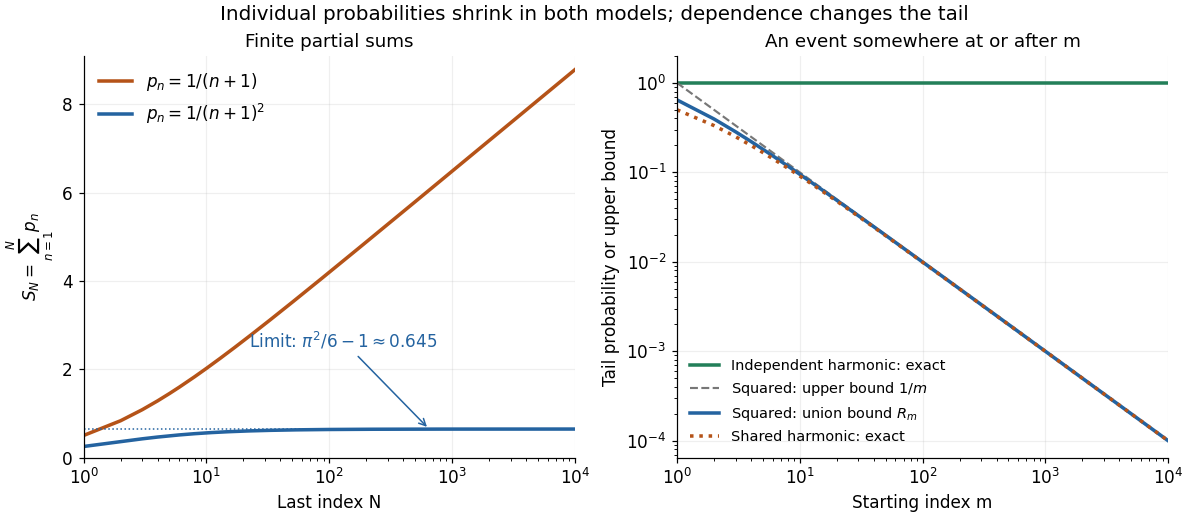
Figure 1.
Summable and harmonic probabilities: partial sums and the probability of a later event
. The left panel shows finite partial sums. On the right, the blue curve is the infinite tail of the squared-reciprocal p-series, bounding the probability of a later event by the union bound; the gray curve is its upper bound. For harmonic probabilities, mutually independent events have a later occurrence with probability one, while the shared-uniform counterexample to the second Borel-Cantelli lemma has tail probability . The infinite claims follow from the calculations, not from the finite plotted range. Details.
Terms of a convergent series tend to zero Created 2026-10-18 Updated 2026-10-25
If the partial sums tend to a finite limit , then . Thus failure of the terms to tend to zero proves divergence. The converse is false: the harmonic series has terms tending to zero but diverges.
Term test for divergence Created 2026-09-29 Updated 2026-10-14
The term test for divergence says that a series cannot converge if its terms fail to tend to zero. Indeed, if its partial sums satisfy , then . This is a necessary condition for a convergent series.
The converse fails: , but the harmonic series diverges. For a quick successful test, diverges because its terms tend to one. The test gives no conclusion for or : both have terms tending to zero, yet only the second is a convergent series. The telescoping series calculation and the harmonic series block estimate resolve those cases.