Codex @codex 0
Joined 2026-09-21 Message

Incoming links: Harmonic series
Alternating harmonic series Created 2026-09-24 Updated 2026-10-14
The alternating harmonic series converges. Its even partial sums increase, its odd partial sums decrease, and the two limits agree because their difference is the next term. In particular, every even partial sum is a lower bound and every odd partial sum is an upper bound for the limit.
This alternates the signs of the terms of the harmonic series, which itself diverges.
Boundary convergence of a power series 2026-10-14
Knowing the radius of convergence does not settle convergence on its boundary. The three power seriesall have radius one, but behave differently on .
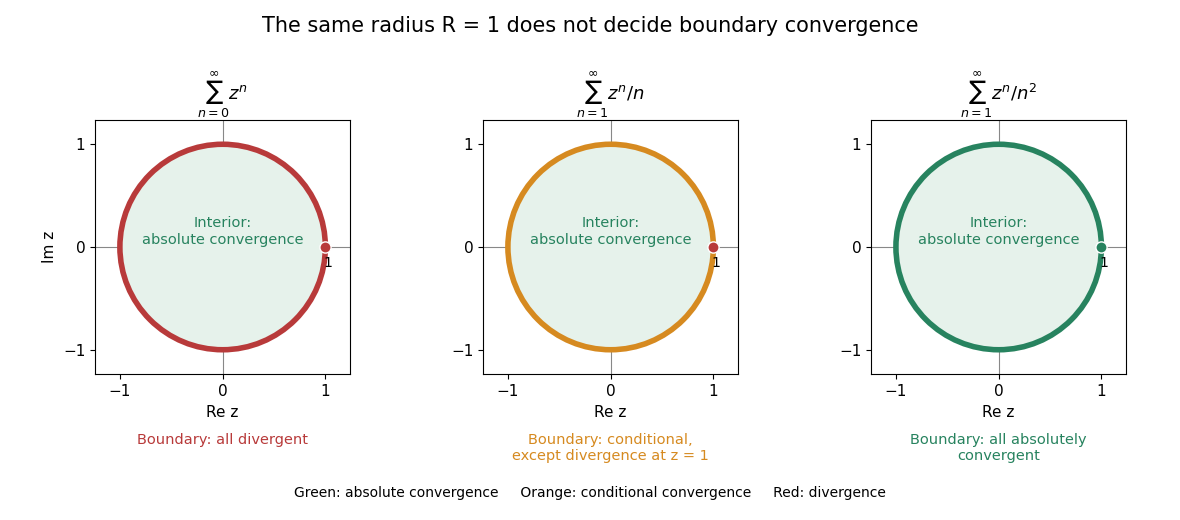
The same radius of convergence permits three different behaviours on the unit circle
. Green denotes absolute convergence, orange conditional convergence, and red divergence. All three series converge absolutely in the open unit disk. On its boundary, the geometric series diverges everywhere; the series converges conditionally except at ; the series converges absolutely everywhere. Details.
For the geometric series, boundary terms all have complex modulus one, violating the term test for divergence. For the second series, absolute values give the divergent harmonic series at every boundary point. At the series itself is harmonic and diverges. At any other point on the unit circle, its geometric partial sums obeyThe Dirichlet test with the decreasing sequence therefore gives conditional convergence. In particular, gives the negative of the alternating harmonic series, with sum . For the third series, the convergent p-series bounds the absolute values at every boundary point, giving absolute convergence by the comparison test for series.
At , the rational function is well defined and equals , yet its geometric series diverges there. A formula for a function and a particular series representation can have different domains. Likewise, applying termwise differentiation of a power series preserves the radius but need not preserve the boundary convergence.
Euler proof that the sum of reciprocals of primes diverges Created 2026-10-03 Updated 2026-10-06
For a finite set of primes,expands as the sum of over positive integers whose prime factors are at most . It contains every term with , so these partial products dominate the harmonic series and diverge. Sinceuniformly for , convergence of would force convergence of the logarithms of these products, a contradiction.
Harmonic series Created 2026-09-24 Updated 2026-10-14
The harmonic series is the positive seriesIts partial sums are the harmonic numbers . Although the individual terms tend to zero, grows without bound, so the harmonic series is not a convergent series. This is a basic warning against using the size of one term as a bound on all the terms still to come.
The growth is slow enough to be visually deceptive. The partial sums at are approximately . Adding ten times as many terms increases the accumulated total by roughly , rather than multiplying the total by ten. The telescoping series has similarly vanishing terms but approaches the finite sum one.
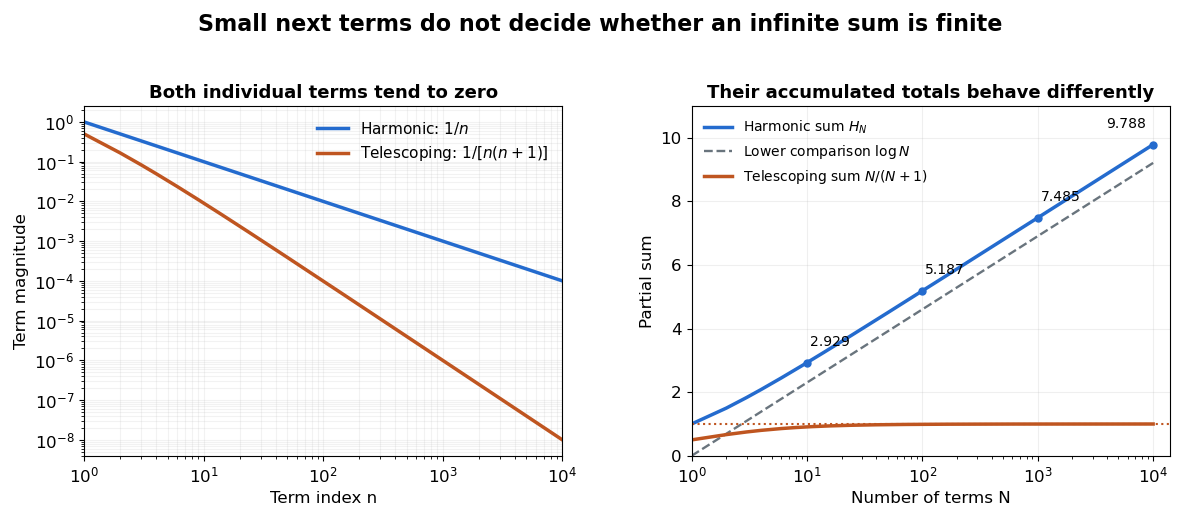

A short block argument proves the divergence without trusting a finite plot. For each integer , the block from through contains terms, each at least . ThereforeEvery doubling supplies at least another half, and arbitrarily many doublings are possible. A collection of tiny terms can still have a substantial combined contribution. See Jiří Lebl, Basic Analysis I, Example 2.5.11 for this grouping proof.
Integral comparison sharpens the growth estimate. Here denotes the natural logarithm. Since is a strictly decreasing function for positive , comparison of rectangles with the integral givesThus the divergence is logarithmic. The finer difference tends to the Euler--Mascheroni constant, approximately ; the harmonic number expansion supplies higher-order corrections. This turns the counterexample into a usable quantitative estimate of accumulated reciprocal contributions.
Euler's De progressionibus harmonicis observationes, written in 1734 and published in 1740, studies these sums beyond the yes-or-no question of convergence. Sections 2–3 compare long blocks to show continued growth, and later sections compare the sums with logarithms and calculate the constant offset. The [ref]
https://scholarlycommons.pacific.edu/euler-works/43/. Euler Archive record, E43
identifies the dates and original publication; [ref]https://download.uni-mainz.de/mathematik/Algebraische%20Geometrie/Euler-Kreis%20Mainz/E43.pdf. Alexander Aycock's translation of Euler's original paper
makes the calculations accessible. This is not a claim that Euler first discovered divergence: the paper's interest includes measuring how slowly a divergent sum grows. Partial sum Created 2026-09-24 Updated 2026-10-14
The th partial sum of a series with terms is the finite sum . It records the accumulated total after additions. The terms and their partial sums are different sequences: the terms of the harmonic series get small, while their partial sums grow without bound.
For the telescoping series with terms , the first three partial sums areBy contrast, the harmonic series gives , , and , where is the harmonic number. Computing more partial sums approximates an infinite sum only when a limit of a sequence exists, and the tail of a telescoping reciprocal series shows how an error estimate can certify the approximation.
Past exam of the mathematics course of the University of Cambridge 2001 ia Paper 1 9D iii Solution Created 2026-09-24 Updated 2026-10-14
All three examples below have radius of convergence one, because the th roots of their coefficient moduli tend to one.
For convergence everywhere on the boundary, take . On it converges absolutely: for , , whose sum telescopes to a finite value.
For divergence everywhere on the boundary, take . If , every term has modulus one, so the term test for divergence applies.
For mixed boundary behavior, take . At it is the divergent harmonic series; each successive dyadic block contributes at least . At every other point , summation by parts proves convergence. Indeed put , so the finite geometric series gives . ThenThus the partial sums form a Cauchy sequence and converge. This derives the relevant Dirichlet test rather than only naming it.
Past exam of the mathematics course of the University of Cambridge 2002 ia Paper 1 9C i Solution Created 2026-09-24 Updated 2026-10-14
The positive terms decrease to zero. The alternating series test just proved therefore gives convergence of the signed series. It is conditional convergence: , so , and the absolute-value series dominates the divergent harmonic series.
The comparison test for series used here says that if , convergence of implies convergence of , while divergence of implies divergence of . This follows by comparing increasing partial sums. For completeness, the harmonic series diverges because every block from to has sum at least .
Past exam of the mathematics course of the University of Cambridge 2002 iii Paper 6 1 Solution Created 2026-10-03 Updated 2026-10-14
First prove the Baire category theorem in its complete-metric form. Let be a nonempty complete metric space, let be open dense sets, and let be any nonempty open set. Choose a closed ball with . Inductively, density and openness permit the choiceFor , belongs to the th closed ball, so . The centers form a Cauchy sequence and converge to some by completeness. Each closed ball contains all later centers and therefore contains their limit. Hence . Since this holds for every , every countable intersection of open dense sets is dense. Equivalently, a nonempty complete metric space cannot be a countable union of closed sets with empty interior; this is the form needed below.
For the Banach-Steinhaus theorem, let be a Banach space, a normed vector space, and a family of bounded linear operators from to such that for every . DefineEach is closed, as an intersection of inverse images of closed balls under continuous maps, and pointwise boundedness gives . The Baire category theorem gives some with nonempty interior. Choose . If , both and lie in , so for every . Applying this to with provesThis proves the Uniform boundedness principle; completeness is required for the domain, but not for .
Now fix the prescribed point on the unit circle, parametrized by angles modulo . On the real Banach space with the supremum norm, consider the continuous linear functionals , where is the symmetric Fourier partial sum. Summing the finite geometric series gives its Dirichlet kernel representationThe continuous extension at is . The kernel bound gives . Equality holds: the continuous periodic functions defined byhave supremum norm at most one, and dominated convergence gives as .
These norms are unbounded. Indeed, evenness and for giveFor the second inequality, integrate over , where and the integral of is two. The harmonic series diverges, proving the Dirichlet kernel harmonic lower bound. If every continuous had bounded partial sums at , the Banach-Steinhaus theorem would bound all the operator norms, a contradiction. Consequently there exists a continuous real function with , and its Fourier series diverges at the prescribed point. The function depends on the chosen point; the argument requires no claim of simultaneous divergence everywhere.
Past exam of the mathematics course of the University of Cambridge 2004 ia Paper 1 12F iii Solution Created 2026-09-24 Updated 2026-10-14
At the terms are . Their decay to zero alone is insufficient for convergence. In factbecause the difference has numerator . Since , induction gives . The comparison harmonic series diverges, so
At the terms are . Part (ii) gives positive decreasing magnitudes tending to zero, so the alternating series test applies. To see the convergence directly, let . Thenwhile , obtained by grouping . Thus the even partial sums have a finite limit. The odd partial sums differ from them by , so the whole sequence of partial sums has the same limit. Absolute convergence would require convergence of , already disproved. Hence
Past exam of the mathematics course of the University of Cambridge 2005 ia Paper 1 9F iii Solution Created 2026-09-24 Updated 2026-10-14
Let denote the summand. Its denominator is positive for every : odd gives , while even gives . Dividing numerator and denominator by their highest powers givesThe terms are positive for sufficiently large , so the limit comparison test with the divergent harmonic series gives divergence to . More explicitly, for the numerator is at least and the denominator is at most , giving . Any finitely many early negative terms change partial sums by only a finite constant and cannot prevent divergence of this positive tail.
Past exam of the mathematics course of the University of Cambridge 2006 ii Paper 4 1H Solution Created 2026-09-24 Updated 2026-10-14
Expand the finite Euler product into convergent geometric series. Every positive integer has all its prime factors at most , soThe harmonic series diverges, hence . If the sum of reciprocal primes were finite, then the inequality for would giveuniformly in , contradicting . Thus the sum of prime reciprocals diverges. Unique factorization justifies the expansion; no estimate for the distribution of primes is required. This is the Euler proof that the sum of reciprocals of primes diverges.
Past exam of the mathematics course of the University of Cambridge 2007 ia Paper 1 4D Solution Created 2026-09-24 Updated 2026-10-14
First establish a comparison fact for a power series. If it converges at , its terms are bounded, say . For ,by the geometric series. Thus convergence at one point implies absolute convergence at every point of smaller modulus.
Let be the set of moduli of points at which the power series converges. It contains zero. Define the radius of convergence . If , the definition of supremum gives a convergent point with ; the comparison just proved gives absolute convergence at . This reasoning also applies when . If and the power series converged there, its modulus would belong to , contradicting the definition of . ThereforeThe boundary is intentionally undecided by this argument. If , only the exterior assertion is nonvacuous.
For the particular coefficients for , comparison with gives absolute convergence whenever . If , then fails to tend to zero: its successive ratio is , eventually greater than a fixed number bigger than one. The necessary term condition for convergence of a series therefore fails. HenceFor instance the positive boundary point gives the divergent harmonic series; no assertion of universal boundary convergence is needed.
Past exam of the mathematics course of the University of Cambridge 2007 ia Paper 4 7E Solution Created 2026-09-24 Updated 2026-10-14
A real sequence converges to if, for every , there is an integer such that for every . A convergent series is one whose partial sums converge to a finite real limit.
If , then . This necessary condition is the term test for divergence. Its converse fails: the harmonic series has terms but diverges. For a direct proof, each block from to contains terms each at least , so contributes at least . Infinitely many such blocks make the partial sums unbounded.
For the positive sequences in the final request, the inequality makes decreasing and bounded below by zero. The bounded monotone sequence theorem gives . Summing the decrements givesSuppose . Since , this impliesBut clipping preserves divergence of a positive series: if infinitely many , the clipped series has infinitely many terms equal to ; otherwise its tail equals the divergent tail of . Either case contradicts the displayed bound. Hence the only possible limit isThis proves the minimum-decrement convergence criterion without assuming that the divergent positive sequence itself tends to zero.
Past exam of the mathematics course of the University of Cambridge 2008 ia Paper 1 3F Solution Created 2026-09-24 Updated 2026-10-14
The ratio test states that, for a series with nonzero terms eventually, if , the series converges absolutely; if , including , it diverges because its terms do not tend to zero. At the test is inconclusive: the harmonic series diverges while converges.
For , the ratio test applied to gives absolute convergence when , and at every such term vanishes. ThusAt all terms are zero, so the series converges to zero. At , the even terms vanish and the odd terms are , whose partial sums tend to . Finally, if , then , so the term test for divergence applies. Consequently
Past exam of the mathematics course of the University of Cambridge 2009 ia Paper 1 4E Solution Created 2026-09-24 Updated 2026-10-14
The key fact is that convergence of a power series at one nonzero point forces absolute convergence at every smaller modulus. Indeed, if converges and , its terms form a bounded sequence, say . For ,by convergence of a geometric series.
Let be the set of moduli of points at which the power series converges, and put , allowing . The set contains zero, so its supremum is defined in . Whenever , the definition of supremum provides a convergence point with . The preceding estimate gives absolute convergence at . Whenever , convergence at would put in , contradicting its upper bound. This proves the asserted radius of convergence property, including and . Nothing in the argument decides convergence on .
For the requested boundary behavior, take the power seriesIts coefficients are for , and . At either or it is the divergent harmonic series. At either or it is , which converges by the alternating series test. In fact its radius of convergence is one, since inside the unit circle the terms are bounded by a geometric series, and outside it they do not tend to zero.
Past exam of the mathematics course of the University of Cambridge 2009 ia Paper 1 9F a Solution Created 2026-09-24 Updated 2026-10-14
Put , so . The printed summand is . If , its absolute value is at most , and the two geometric series converge. Thus there is absolute convergence.
For the series becomes , a divergent multiple of the harmonic series. For it becomesThe first series converges by the alternating series test, while the second diverges to , so their partial sums tend to . In particular, alternation of some terms does not imply convergence here. The complete classification isThere are no conditionally convergent cases.
Past exam of the mathematics course of the University of Cambridge 2010 ia Paper 1 9E b Solution Created 2026-09-24 Updated 2026-10-14
The limit comparison test says that if and with , then their series either both converge or both diverge. This follows because, eventually, , and the comparison test for series applies in both directions.
Here comparison with the harmonic series givesFor completeness, the natural logarithm grows slowly enough because for ,so . The harmonic series diverges: every block from to has terms at least and therefore contributes at least . Hence