An inverse problem is an ill-posed problem if it fails any requirement of a well-posed problem: existence for every admissible datum, uniqueness, or continuity of the reconstructed object as the data change. These requirements depend on the chosen spaces and norms, not just the equation. Clason's regularization notes formulate this distinction explicitly.[ref]
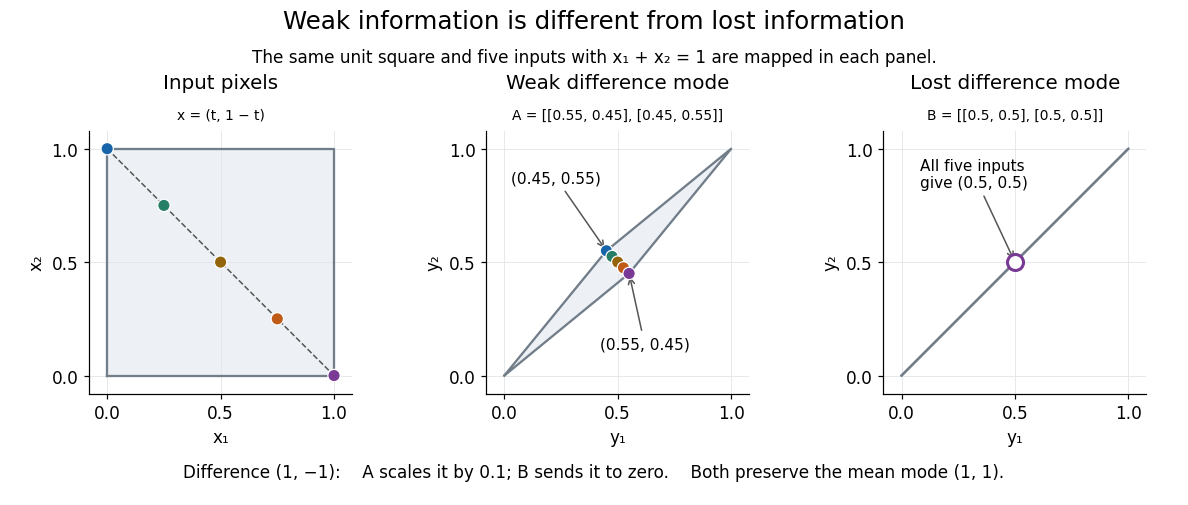
Complete averaging illustrates lost information:The difference mode belongs to the null space because . Even restricting both pixels to leaves infinitely many indistinguishable inputs. This is failure of uniqueness. Data such as also have no exact preimage under , illustrating failure of existence when arbitrary two-component observations are admissible.
The two-pixel matrix in the inverse problem example has a weakly observed difference mode, not a null space mode. Its inverse is continuous: this finite-dimensional problem is a well-posed problem with noise-sensitive conditioning. Small positive singular values alone do not imply mathematical ill-posedness. In infinite-dimensional problems, positive singular values approaching zero can make inversion unbounded: unit solution modes then produce data tending to zero. This destroys continuity even without a null space. Regularization of an inverse problem must distinguish missing information from information recoverable only at the cost of amplifying measurement noise.

Articles by others on the same topic
There are currently no matching articles.