The constant rank theorem separates the directions a smooth map preserves from the directions it forgets. If a smooth map from an open subset of to has derivative of constant rank on a neighbourhood of a point, there are local coordinate transformations in source and target in which it becomesIt keeps coordinates, discards the other , and inserts zeros. This is stronger than simplifying the Jacobian matrix at one point: it straightens the actual nonlinear map on a neighbourhood. [ref]
For a worked example, takeThe two columns agree, and the first row is nonzero, so the rank is exactly one everywhere. The image of a function is the parabola . Every line is a fiber mapping to the same point .
Choose input coordinates , , and output coordinates , . Both coordinate transformations are diffeomorphisms: their inverses are , and , . In these coordinates,The curved image has become a straight line, and the unused coordinate is explicit.
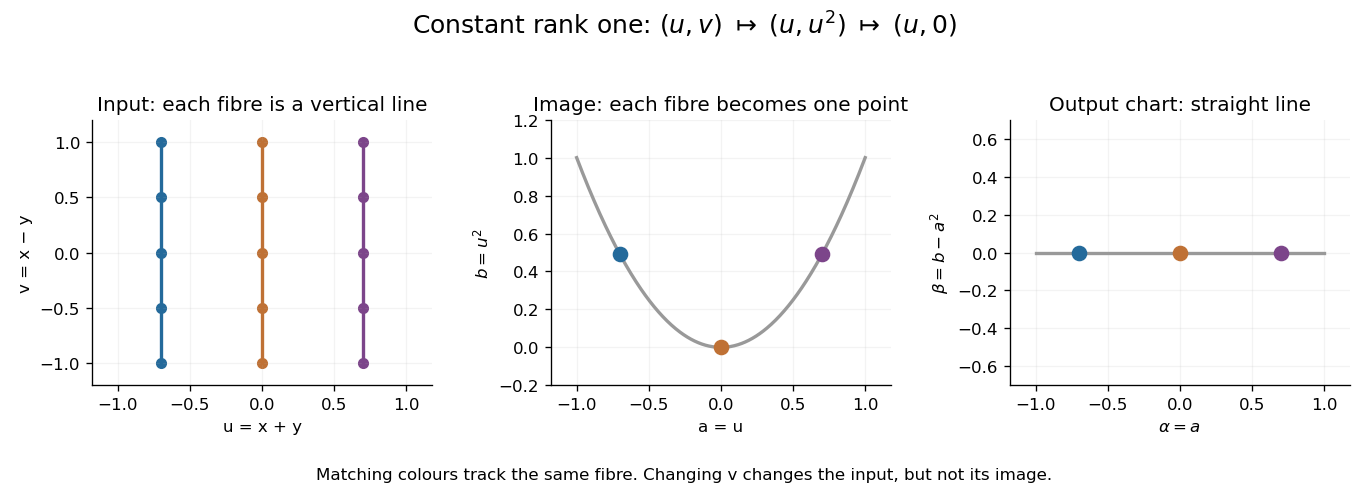
A rank-one map collapses input fibres to a parabola, which a change of output coordinates straightens
. Details. 
Constant rank on a neighbourhood is essential. The map has rank one when and two when , so the constant rank theorem does not supply one rank-one form across that line. By contrast, the full-rank square case of the theorem forgets no coordinates and recovers the inverse function theorem. The usefulness is that curved fibers and images can often be studied through this simpler local form.
For a smooth map on the plane with zero Jacobian determinant and , set . The determinant identity gives . Along a curve solving , both and have zero derivative. Local existence and uniqueness for this smooth differential equation through every nearby point produce a local foliation by curves of constant .
Articles by others on the same topic
There are currently no matching articles.