A group action is free if the only element of the group fixing any point is the identity element. Thus every stabilizer subgroup is trivial. This is a property of an action of any group, not an assertion that the acting group is a free group.
Explicitly, for a left group action of a group on a set with identity element , freeness meansEquivalently, for any there is at most one with . Indeed, if , the group action rules give , so freeness forces ; conversely, take , since the identity element already sends to itself. Thus every orbit map is injective, even when its image of a function is only part of .
For a permutation example, let the cyclic group act on the set by . The nonidentity element exchanges both pairs and fixes no point, so every stabilizer subgroup is . Its two group orbits are and . This is a free group action but not a transitive group action: there is no group element sending to . Each restriction to one group orbit is a simply transitive group action.
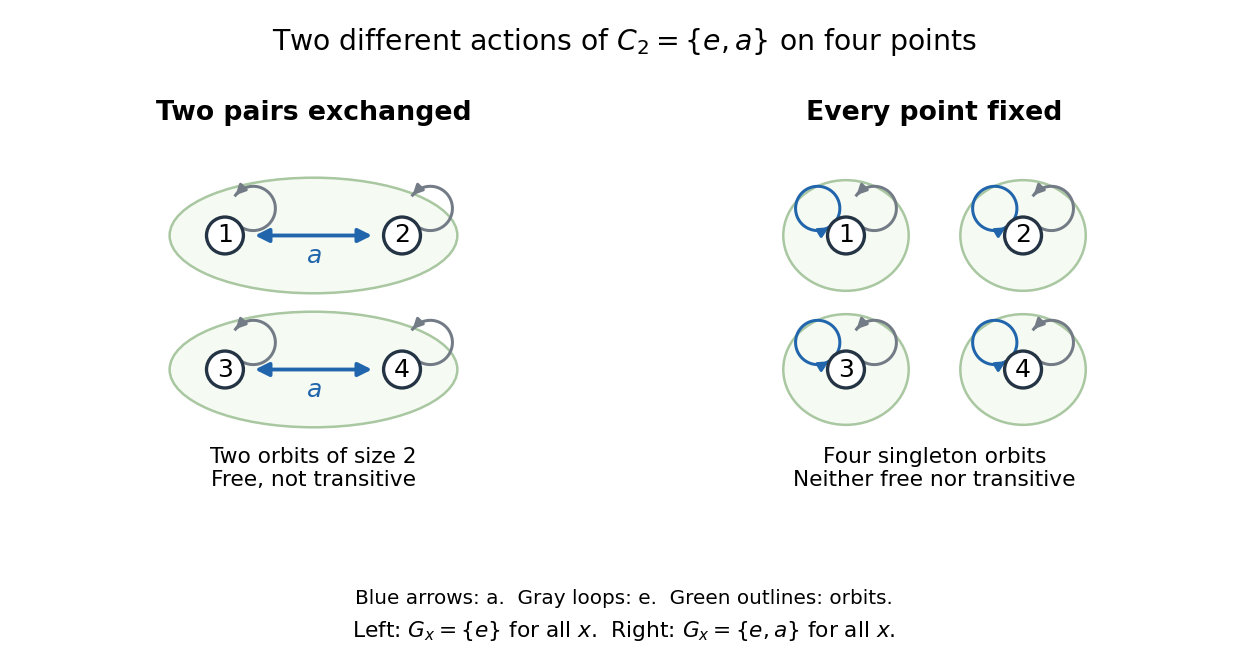

The identity element fixes every point in every group action; freeness excludes fixed points only for nonidentity elements. This also differs from a fixed point of a group action, which must be fixed by every group element. In the left diagram there are no such fixed points of a group action. In the right diagram, the same abstract cyclic group acts by : all four points are fixed points of a group action, every stabilizer subgroup is , and each group orbit is a singleton set. Consequently this second group action is neither free nor transitive. A group action with no fixed points of a group action can still fail freeness: the natural group action of the symmetric group has no point fixed by all of , but fixes .
For a finite group, the orbit-stabilizer theorem makes each group orbit of a free group action have cardinality . If is also finite, is therefore a multiple of the group order, with one copy of for each group orbit. The trivial group acts freely on every set, and acts transitively exactly on a singleton set. On the empty set freeness is vacuous; our convention under transitive group action requires a nonempty set for transitivity.
Articles by others on the same topic
There are currently no matching articles.