Let measure position along the line joining two mutually incoherent optical point sources in the focal plane, with equal detected radiant fluxes and separation . Extend the even Airy disk profile to signed , and put as in Airy disk normalization and encircled energy. Relative to the peak of one source carrying the pair's total radiant flux, their summed light intensity isThe two-dimensional point spread functions underlying these line profiles all have the same total radiant flux. The line-profile integrals themselves need not equal one.
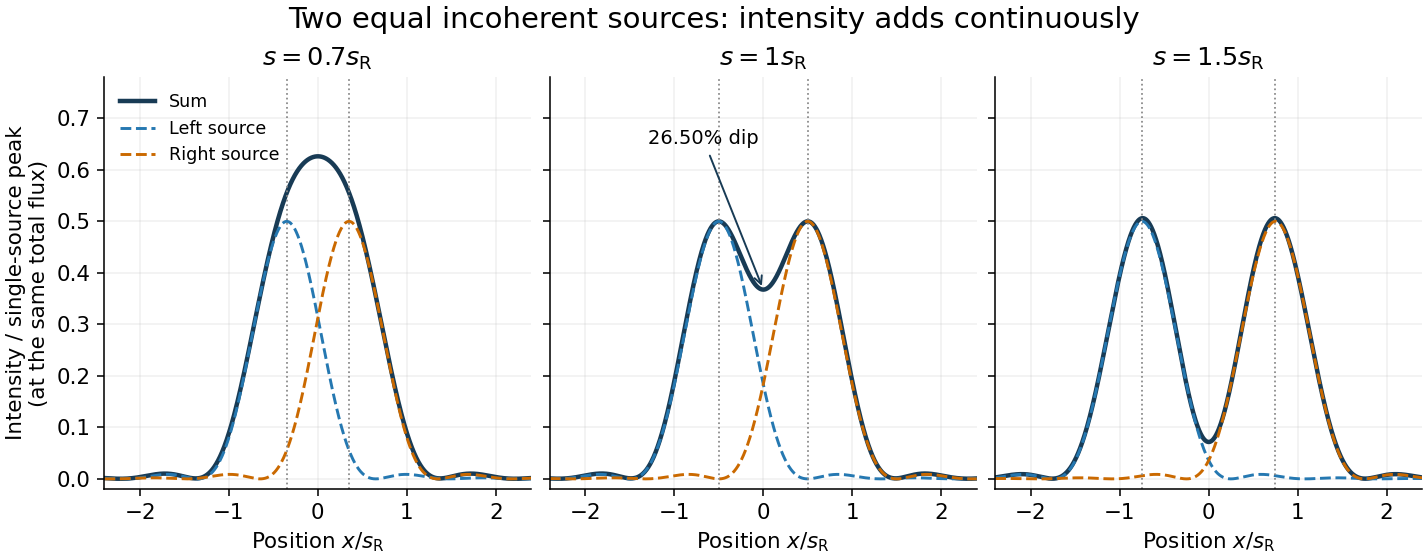

The dashed curves show individual contributions; the solid curve is their sum. All panels use the same brightness scale, and the vertical markers indicate the true source centres. At , the other source contributes zero at each centre, so . At the midpoint,The midpoint is therefore about below the source-centre peak. This is a calculation for this particular Airy disk and equal-incoherent-source convention, not a universal experimental threshold. At the two central peaks merge; at the valley is deeper. Changing separation continuously changes the profile, without a discontinuity at the Rayleigh criterion.
To see how information survives when the central peaks merge, set and . A symmetric Taylor expansion givesThe linear terms cancel because the source positions are symmetric. At the midpoint, the Airy disk derivation gives . Thus a close pair's shape differs from that of one source, but only quadratically at leading order. Detecting this small change becomes sensitive to noise and response calibration. For unequal flux fractions and , the intensity instead becomes ; its valley and peak positions need not match the equal-source example.
Articles by others on the same topic
There are currently no matching articles.