Diffraction-limited resolution is a scale for distinguishing details with a specified ideal diffraction response and a specified criterion. For two equally bright, mutually incoherent optical point sources imaged through a uniformly transmitting, unobscured circular optical pupil, the Rayleigh criterion places the centre of one Airy disk at the first zero of the other. At small angles in air this separation isHere is pupil diameter, is wavelength in air, and is the first positive zero of the order-one Bessel function of the first kind. This is the radius to the first zero, not the diameter of the central spot. Fraunhofer diffraction gives the radial peak-normalized light intensityThe removable value at zero follows from . The pupil Fourier transform reduces to a radial integral by circular symmetry, which produces the Bessel function of the first kind; its first zero supplies the factor .[ref]
In the usual scalar circular-pupil approximation for a fluorescence microscope, the corresponding object-plane Rayleigh criterion isHere is the vacuum emission wavelength, and the object-side numerical aperture already includes the medium's refractive index. Do not divide by again. For small cone angles in air, and image-plane radius agrees with this form. The assumptions include a single wavelength, ideal optical focus, and mutually incoherent emitters. High numerical aperture can require a vector description with polarization of an electromagnetic wave and emitter orientation; confocal microscopy has its own excitation-and-detection response. The same formula therefore does not describe every microscope or illumination method.[ref]
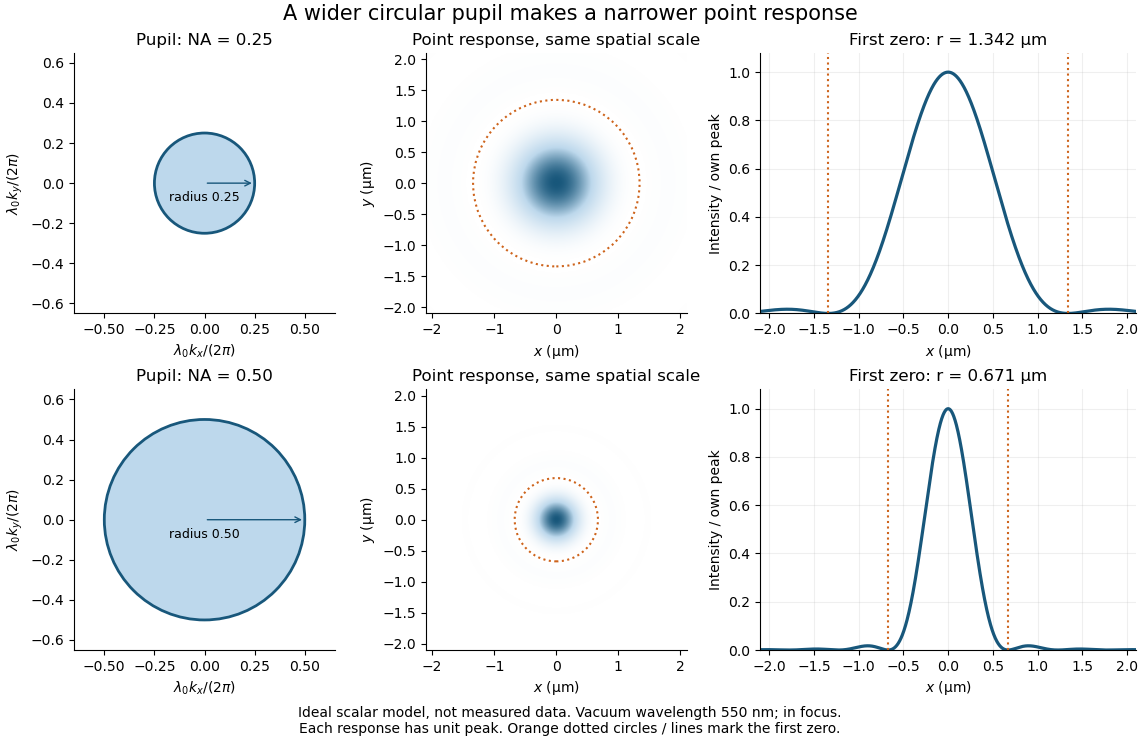
Doubling numerical aperture halves the ideal circular-pupil point-response scale at fixed wavelength
. Details. In this original model, and numerical apertures and give first-zero radii and . Each point spread function is divided by its own peak to compare shape. The pupil axes are transverse wave vector components multiplied by , so pupil radius equals numerical aperture. A wider pupil accepts a wider range of transverse wave vectors, producing a narrower image. Increasing magnification alone enlarges the same spot and does not reduce its object-plane radius.
The Rayleigh criterion is a useful visual convention, not an absolute information barrier. For equal incoherent sources with total detected radiant flux and separation vector , the ideal image isBelow the Rayleigh criterion this still differs from ; for small , symmetry cancels the linear change and the first change is quadratic in separation. Estimating two unknown source positions is then increasingly sensitive to noise, background, relative brightness and uncertainty in the point spread function. Localizing one isolated source and recovering an arbitrary extended object are different inference tasks. Measurements that separate optical modes can also extract separation information differently from direct image light intensity measurement.[ref]
There remains a real limit for arbitrary images in this model: the optical transfer function is zero above the transmitted spatial frequency band. Its cutoff for scalar incoherent imaging is in object-plane cycles per unit length. The Nyquist–Shannon sampling theorem therefore suggests object-referred detector pixel pitch , with finer sampling providing margin. Finite detector pixels also integrate over their area, suppressing contrast; coarse sampling can cause aliasing. Finer sampling cannot alone recover spatial frequencies removed by the optics, and Fourier deconvolution amplifies noise where the optical transfer function is small. Photon shot noise, read noise, optical aberrations and defocus can all worsen practical discrimination. A useful resolution claim therefore reports the object model, criterion, wavelength, numerical aperture, sampling and signal-to-noise ratio in photon counting.
The Rayleigh criterion calls two equal, mutually incoherent optical point sources just resolved when one circular-pupil Airy disk's centre coincides with the other's first zero. It is a specified discrimination convention, distinct from full width at half maximum and from precision in estimating one source's position.
For this circular optical pupil, the Rayleigh criterion uses angular separation , or in the paraxial approximation to the focal plane. The point spread functions still overlap.[ref]
For the Airy disk design example with , and , the angular convention gives , or about arcseconds, and the image-plane separation is . Two equally bright, mutually incoherent optical point sources at separations , and times this scale would have image separations , and respectively. These calculated cases are compared in incoherent two-source Airy profile.
The Rayleigh criterion is useful because it ties an easily recognized two-peak convention to a predictable optical scale. It does not assert that all information vanishes below that separation. Inferring two unknown positions also depends on photon shot noise, background, unequal brightness and uncertainty in the point spread function; locating a single isolated source is a different task. A theoretical analysis shows that alternative optical measurements can estimate the separation of two incoherent optical point sources below this scale.[ref]
Quantum Theory of Superresolution for Two Incoherent Optical Point Sources by Mankei Tsang and others. abstract: linear optics and photon counting can estimate sub-Rayleigh separation
The mutual optical coherence condition is essential. In incoherent imaging, time-averaged light intensities add. In coherent imaging, wave amplitudes add before squaring, leaving a wave interference term controlled by relative wave phase. Two holes illuminated by the same coherent laser therefore do not implement the equal-incoherent-source convention merely because their individual patterns resemble Airy disks. The coherent single-aperture laboratory test establishes the response of each aperture; it does not establish the pair's mutual incoherence.
Let measure position along the line joining two mutually incoherent optical point sources in the focal plane, with equal detected radiant fluxes and separation . Extend the even Airy disk profile to signed , and put as in Airy disk normalization and encircled energy. Relative to the peak of one source carrying the pair's total radiant flux, their summed light intensity isThe two-dimensional point spread functions underlying these line profiles all have the same total radiant flux. The line-profile integrals themselves need not equal one.
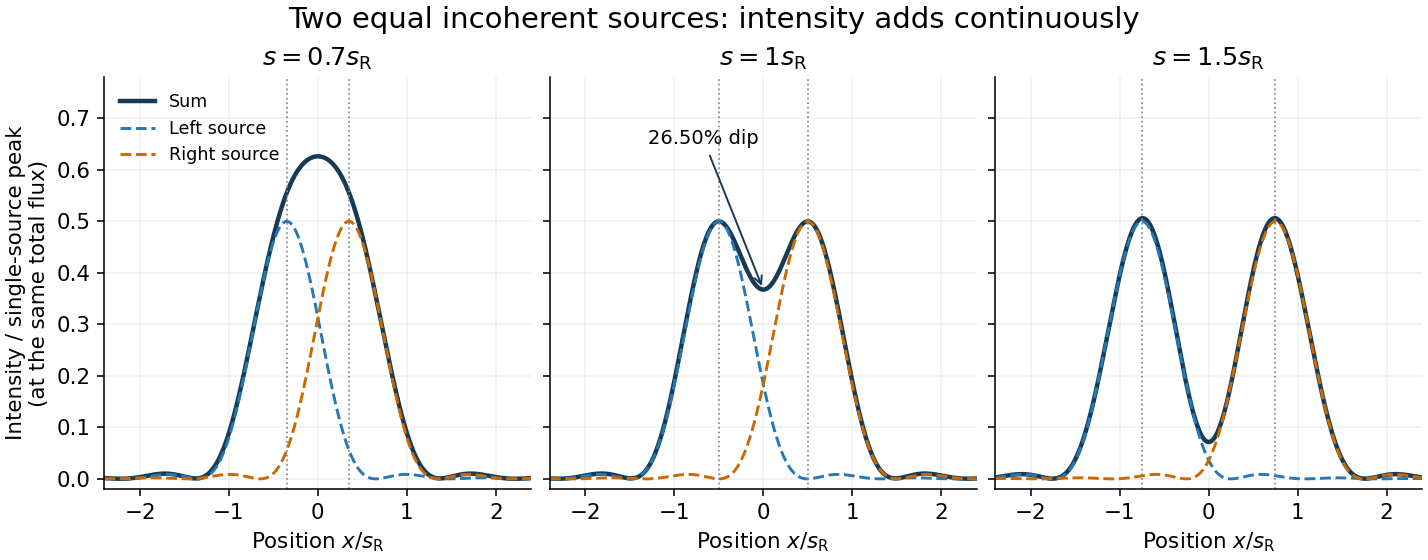


The dashed curves show individual contributions; the solid curve is their sum. All panels use the same brightness scale, and the vertical markers indicate the true source centres. At , the other source contributes zero at each centre, so . At the midpoint,The midpoint is therefore about below the source-centre peak. This is a calculation for this particular Airy disk and equal-incoherent-source convention, not a universal experimental threshold. At the two central peaks merge; at the valley is deeper. Changing separation continuously changes the profile, without a discontinuity at the Rayleigh criterion.
To see how information survives when the central peaks merge, set and . A symmetric Taylor expansion givesThe linear terms cancel because the source positions are symmetric. At the midpoint, the Airy disk derivation gives . Thus a close pair's shape differs from that of one source, but only quadratically at leading order. Detecting this small change becomes sensitive to noise and response calibration. For unequal flux fractions and , the intensity instead becomes ; its valley and peak positions need not match the equal-source example.
A spatial resolution element is one independently resolved angular or spatial scale under a specified resolution criterion. For an ideal telescope of diameter , its angular scale is of order and its angular area of order . A photodetector detector pixel or spaxel can be smaller than a resolution element without adding independent spatial information.
Articles by others on the same topic
There are currently no matching articles.