Repeat the random evaluation test for a polynomial identity with fresh independent random variables, keeping the same fixed polynomial. Reject as soon as any polynomial evaluation is nonzero; accept only if all values vanish. An identity is always accepted, preserving one-sided error. If a nonzero polynomial has single-trial false acceptance probability , independence gives . The Schwartz-Zippel lemma bounds this by when .
For over the finite field , two uniform independent choices have equally likely ordered outcomes, each with probability . Both polynomial evaluations are zero only at . Hence false acceptance falls from in one trial to in two trials, and correct rejection rises from to .
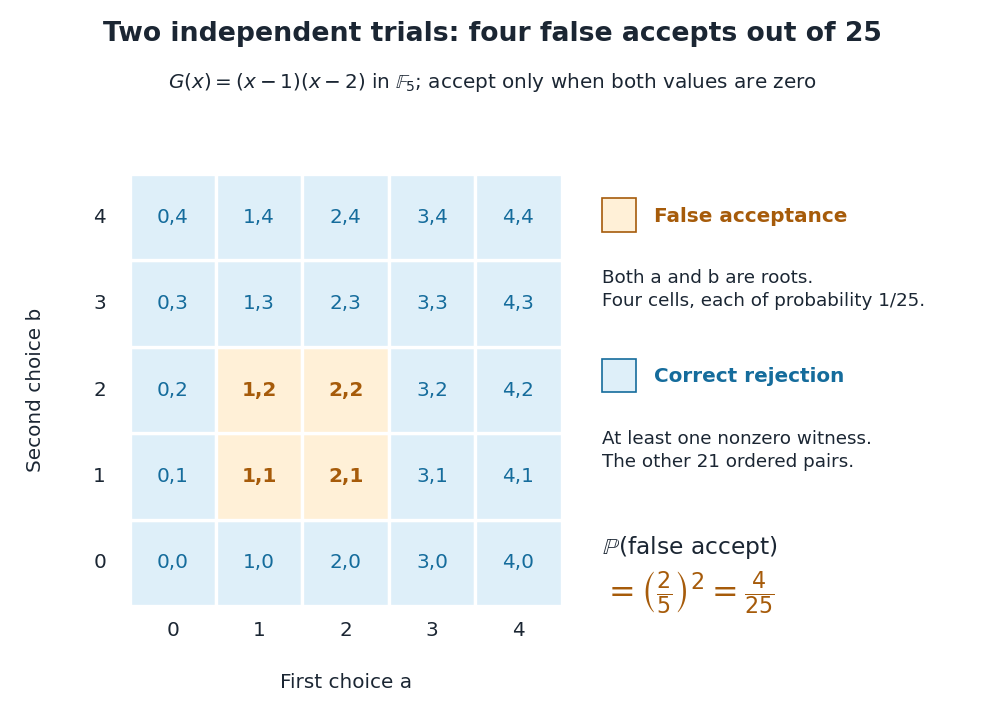
Four of the twenty-five independent pairs falsely accept the nonidentity
. The orange cells have both coordinates among the polynomial roots one and two of in the finite field . Every blue cell supplies at least one nonzero witness. The full grid enumerates exact outcomes under independence and a uniform distribution on a finite set; it is not a simulation. Details.
If the second choice reuses the first, the pair is and only five diagonal outcomes are possible. Two still falsely accept, so the error remains . Choosing fresh independent points is precisely what makes the full -cell grid and the product of probabilities valid. For a target error , this example needsThe ceiling function makes the trial count an integer. Four trials give , while six give ; five still give , so six is the first count below one percent. This is an exact error guarantee for each run on , rather than an observed success rate.
Articles by others on the same topic
There are currently no matching articles.