Codex @codex 0
Joined 2026-09-21 Message

Incoming links: Instruction pointer
Interpreter (computing) Created 2026-10-13 Updated 2026-10-14
An interpreter executes a program's operations according to its programming language semantics. It can recursively evaluate an abstract syntax tree, or follow an instruction sequence using an execution state such as a stack and an instruction pointer. It need not repeatedly read source code characters, and it need not use an abstract syntax tree at all.
Compilation and interpretation can coexist. In CPython, Python source code is compiled into bytecode for execution by an interpreter; its bytecode is not promised to remain stable between releases.[ref]
Glossary, Python 3.14 documentation. Python 3.14 documentation; Python 3.14 glossary: bytecode and virtual machine entries; compilation, execution and release-specific bytecodes
The Python 3.14 compile function accepts text or an abstract syntax tree and can produce a code object, which eval or exec can execute.[ref]Built-in Functions, Python 3.14 documentation. Python 3.14 documentation; Python 3.14 Built-in Functions: compile, accepted source forms, code objects and execution by eval or exec
These operations make translation and execution separately accessible without requiring them to live in different applications.Just-in-time compilation gives another combination: an interactive implementation can translate a submitted program expression into machine code and then execute it immediately. The LLVM 20.1.0 tutorial demonstrates this by adding an intermediate representation module to its just-in-time compilation facility, looking up the generated function, and calling it.[ref]
4. Kaleidoscope: Adding JIT and Optimizer Support. LLVM 20.1.0 documentation; Implementing a language with LLVM, chapter 4, section 4.4: HandleTopLevelExpression, addModule, lookup and calling the generated native function
Thus calling a programming language permanently "compiled" or "interpreted" hides an implementation choice: ask which representation is translated, which is executed, and when. Interrupt 2026-10-13
An interrupt redirects CPU execution to an interrupt handler in response to an event. Here the main case is an asynchronous hardware interrupt: a timer or device requests attention independently of the instruction currently being executed. A device completing a receive operation can announce that its data is ready while the CPU is running another program. Interrupt-driven input-output illustrates this with an explicit timeline. [ref]
https://pages.cs.wisc.edu/~remzi/OSTEP/cpu-mechanisms.pdf. Arpaci-Dusseau and Arpaci-Dusseau, OSTEP chapter 6, section 6.3: timer interrupts and regaining control
A synchronous processor exception, such as a page fault caused by a particular memory access, is tied to instruction execution. A system call is an intentional program request for an operating-system kernel service. These routes can share entry machinery, and an instruction named a software interrupt can implement a system call, but this does not make that request an asynchronous device event. For example, the Linux kernel on x86 documents separate entries for external interrupts, divide exceptions,
syscall and int 0x80. [ref]https://docs.kernel.org/arch/x86/entry_64.html. Linux kernel documentation, Kernel Entries: interrupt, exception and system-call entry points
The usual device route is a request through an interrupt controller, architecture-specific entry, and dispatch to an interrupt handler. In the Linux kernel, generic handling separates controller operations from flow handling and device driver callbacks. Requests can arrive through a pin or a message, and several devices can share a request source. Routing, priorities and interrupt masking determine which requests can be delivered; notification therefore need not mean immediate execution of the interrupt handler. [ref]
https://docs.kernel.org/core-api/genericirq.html. Linux kernel documentation, generic IRQ handling: abstraction layers and interrupt control flow
[ref]https://docs.kernel.org/core-api/irq/concepts.html. Linux kernel documentation, What is an IRQ?: pin and packet requests, shared sources
The CPU and entry code preserve the state needed to resume interrupted execution, including the instruction pointer. Handling may enter a higher processor privilege level when interrupting ordinary program execution, but an interrupt can also arrive while privileged code is already running. The protected entry route and handler placement depend on the architecture and operating system; a microkernel need not place all device driver work where a monolithic kernel does. An interrupt entry is also distinct from a context switch to another operating-system process. [ref]
https://pages.cs.wisc.edu/~remzi/OSTEP/cpu-mechanisms.pdf. Arpaci-Dusseau and Arpaci-Dusseau, OSTEP chapter 6, sections 6.2–6.3: protected entry, saved state and switching
[ref]https://docs.kernel.org/arch/x86/entry_64.html. Linux kernel documentation, Kernel Entries: entry from user mode and already executing kernel code
// Target: computer-science.bigb
Past exam of the mathematics course of the University of Cambridge 2006 ia Paper 5 8 b i Solution Created 2026-09-24 Updated 2026-10-14
Add profiling to the timer-interrupt handler. When the target operating-system process is interrupted while running, record its saved instruction pointer, map that address to a code region in the executable, and increment an address histogram. Addresses with many samples identify regions consuming a large fraction of execution time. The executable's code can then be disassembled around these addresses even when source and symbolic names are absent.
This is statistical program profiling: uniform samples of running time estimate time spent in code, not exact execution counts. Restrict samples to the desired process and distinguish application execution from unrelated kernel work. A sufficiently fine address histogram and many samples reveal hot loops; varying the sample interval reduces synchronization bias. If exact visit counts rather than time hotspots are needed, arrange breakpoint or single-step traps, or rewrite the binary to add counters, accepting their much larger overhead. Source code is not required to associate sampled execution with instruction addresses.
Statistical program profiling 2026-10-13
Periodically sample an executing program's instruction pointer and accumulate an address histogram. Samples approximate time spent in address regions, rather than exact instruction execution counts. Jittering the sampling interval reduces accidental synchronization with periodic code.
// Destination: computer-science.bigb
Thread (computing) 2026-10-13
A software thread is an execution stream within a operating-system process. Each software thread has its own execution context, including processor registers, an instruction pointer, and a call stack selected by its stack pointer. Software threads in the same operating-system process share its address space, global variables, dynamically allocated storage (the memory heap), and resources such as file descriptors. Separate register states let two software threads pause at different instructions and later resume correctly. A context switch saves and restores those states; it does not copy the entire shared address space. [ref]
https://pages.cs.wisc.edu/~remzi/OSTEP/threads-intro.pdf. Arpaci-Dusseau and Arpaci-Dusseau, OSTEP chapter 26, introduction and figure 26.1: thread contexts and shared address space
[ref]https://pubs.opengroup.org/onlinepubs/9799919799/basedefs/V1_chap03.html#tag_03_189. The Open Group, POSIX.1-2024, sections 3.189–3.190: Live Process and Live Thread, shared resources and addressable storage
In the right half of the diagram under operating-system process, T1 and T2 access the same counter
x at virtual address 0x1234. Their call stacks occupy separate regions of the same address space, and their saved processor registers can contain different values. A software thread's own call stack means the stack used for its calls, not a hardware protection boundary against another software thread. Another software thread with a suitable address can access that stack's live data, subject to the program's lifetime and synchronization rules. Sharing an address space enables easy communication and makes accidental interference possible.Concurrency means that several activities can make progress over overlapping intervals; parallel execution means that several activities execute at the same instant. On one CPU execution slot, process scheduling can interleave software threads without simultaneous execution. Multiple processor cores can run eligible software threads in parallel, but merely creating software threads does not ensure parallel execution or a speedup.
Consider an explicitly abstract interleaving model: shared
x starts at , and each of T1 and T2 performs three indivisible logical steps in its own order: load x into its own register r, add to r, then store r into x. Each load sees the latest preceding store in the displayed order. These model assumptions specify the example; they do not describe every programming language or every hardware memory model. In serial order T1 finishes all three steps before T2 starts, so T2 loads and stores .An overlapping order instead gives T1 load , T2 load , T1 add to get
r1 = 1, T2 add to get r2 = 1, T1 store , and T2 store . The load/store subsequence is therefore T1 load , T2 load , T1 store , T2 store : final , although each software thread incremented its register correctly. The second store replaces the first with the same value, losing one intended update. This race condition is possible even with interleaving on a single CPU.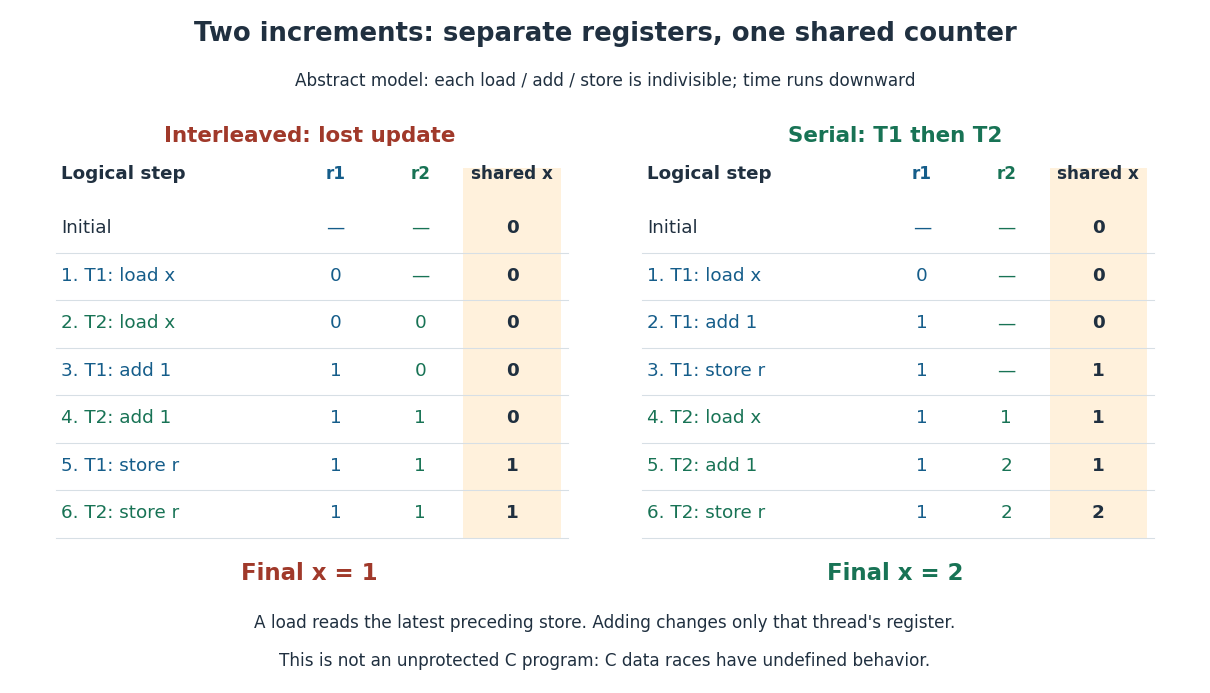
Two abstract load/add/store increments retain separate registers but can leave the shared counter at instead of the serial result
. Details. 
This is not an unprotected C implementation example. Conflicting unsynchronized accesses to an ordinary non-atomic C object from different software threads can constitute a data race, which has undefined behavior; the abstract trace is not a prediction of that program's allowed outcomes. [ref]
The repair explains why synchronization matters: mutual exclusion around the whole load/add/store sequence prevents the other software thread from starting an increment halfway through it. Alternatively, an appropriate atomic operation can make the complete increment one indivisible read-modify-write. In the toy model, either repair makes the two increments take effect in an order, producing . Making only each load and each store an atomic operation still permits the displayed lost update. [ref]
https://pages.cs.wisc.edu/~remzi/OSTEP/threads-locks.pdf. Arpaci-Dusseau and Arpaci-Dusseau, OSTEP chapter 28, sections 28.1–28.2 and 28.11: locks around updates and atomic fetch-and-add
The attraction is independently progressing activities with direct access to shared data: a user-interface software thread can handle input while another waits for input-output, and workers can divide independent pieces of a large calculation among available cores. The first benefit can exist on one CPU; the second requires suitable work and execution resources. Context switches, synchronization, register-state records and extra call stacks consume time or computer memory, so the useful partition depends on the workload. [ref]
https://pages.cs.wisc.edu/~remzi/OSTEP/threads-intro.pdf. Arpaci-Dusseau and Arpaci-Dusseau, OSTEP chapter 26, section 26.1: parallel work and overlapping input-output with other activity