Three explicit functions separate the hypotheses from the conclusion. These are original mathematical illustrations, not measured data.
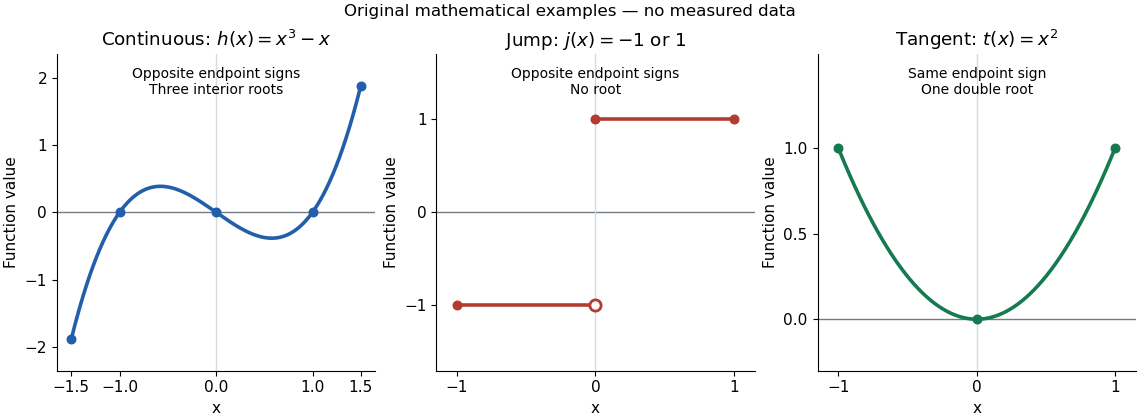
The polynomial function is a continuous function on , with and . The intermediate value theorem guarantees at least one zero of a function in the interior, while the polynomial factorization displays three: . Thus strict opposite signs do not establish uniqueness.
The everywhere-defined functionhas and , yet no zero of a function. Its jump discontinuity at zero is exactly where the continuity hypothesis fails. A drawn vertical connector would be misleading: the function graph contains neither the intermediate heights nor a zero of a function at that jump. Even continuity only on the interior is insufficient: setting for and gives opposite endpoint signs on with no zero of a function, because the left one-sided limit at is not .
The polynomial function on is a continuous function, and , yet . Its root of a polynomial at zero has multiplicity of a root two. The function graph touches its horizontal tangent line there and stays positive on both sides: existence of a zero of a function does not require a sign change. More generally, near a real root of a polynomial , a polynomial factorization with and has the same sign on both sides sufficiently close to , since the continuous function retains its sign. The intermediate value theorem does not rule out values outside the range between endpoint outputs.[ref]
Calculus Volume 1 by Gilbert Strang and others. §2.4, Example 2.37: positive endpoint values do not exclude an interior zero; Theorem 2.11 requires continuity on the whole interval

Articles by others on the same topic
There are currently no matching articles.