Differences between supplied proficiency-test items can contribute to a proficiency-test z-score even when the laboratory's own measurement procedure has zero systematic error. Model the result from laboratory aswhere is an independently established batch target, is the supplied unit's deviation, is a fixed laboratory systematic error, and is analytical variation. Assume centered independent and , with variances and , and treat the assigned value in proficiency testing as exactly for this model. Then the proficiency-test z-score satisfieswhere is the standard deviation for proficiency assessment. A large deviation cannot be attributed to from the score alone. The primary guide requires item reference material homogeneity and reference material stability to remain appropriate when a stricter assessment scale is selected.[ref]
Selection, Use and Interpretation of Proficiency Testing (PT) Schemes by Brian Brookman and Ian Mann. §8.2.3, printed p. 21, smaller assessment scales and item suitability
A homogeneity study with replicated test portions can separate two variance components. Select units and measure independently drawn portions from each using one verification method, with measurement order randomized across units. Under the random effect model , independent equal-variance within-unit errors give the one-way analysis of variance mean squaresTheir expectations are and . A method-of-moments variance component estimate is therefore . Here the within-unit component is treated as analytical variation; variation between portions of the same unit would also enter it unless separated by further measurements. Clipping a negative estimate to zero enforces a nonnegative variance component; it introduces boundary bias and does not establish perfect material uniformity.
For an original arithmetic example, four units yield the following paired mass concentration readings, in :The overall arithmetic mean is . These chosen data give , and , with squared concentration units. Suppose a participant also has analytical variance and the assessment scale is . The stipulated unbiased score then has standard deviation , despite the absence of a laboratory systematic error in the model.
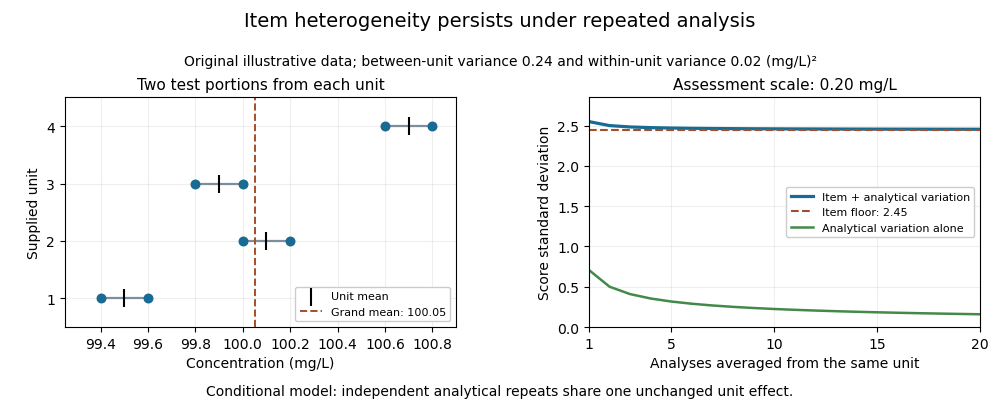

Averaging independent analyses from the same unit changes the analytical contribution to but retains its unit effect:For the chosen numbers, the score's standard deviation approaches as increases. Repeatedly reading one aliquot may reduce an even narrower instrumental contribution. Sampling independently supplied units addresses a different source of variation.
This is an explanatory measurement model, not a prescribed proficiency-testing acceptance rule. Its variance components require evidence about portion size, preparation and measurement conditions. Instrumental drift confounded with unit order, changing material, correlated errors or an uncertain consensus benchmark require additional terms and an appropriate design. The provider's homogeneity evidence is essential to interpreting the score; a smaller numerical scoring denominator does not improve the items.
Articles by others on the same topic
There are currently no matching articles.