
Absorbance Created 2026-10-13 Updated 2026-10-18
Absorbance is the dimensionless quantity , where and are reference and transmitted radiant powers at the chosen wavelength. For example, means one tenth of the reference power is transmitted. Under the Beer-Lambert law, absorbance can determine an absorbing species' concentration; attenuation by cloudiness or unrelated colored solutes needs separate controls. [ref]
Beer–Lambert law. IUPAC Compendium of Chemical Terminology, fifth edition (Gold Book) by International Union of Pure and Applied Chemistry; IUPAC Gold Book: absorbance and its concentration relation
Beer-Lambert law Created 2026-10-13 Updated 2026-10-18
The Beer-Lambert law relates absorbance to an absorbing species' concentration and path length by in a homogeneous medium using sufficiently narrow-band light. The coefficient depends on the species, wavelength and chemical solution conditions. This makes Ellman's reagent useful for quantitative thiol assays once its released colored species has been calibrated. [ref]
Beer–Lambert law. IUPAC Compendium of Chemical Terminology, fifth edition (Gold Book) by International Union of Pure and Applied Chemistry; IUPAC Gold Book: Beer-Lambert law and validity conditions
Here is molar concentration, is the geometric length through the sample, and is the molar absorption coefficient. The ideal beam has parallel light rays, a single wavelength, and a medium with uniform composition and isotropy; finite spectral width must be small relative to features in the optical spectrum.[ref]
Beer–Lambert law. IUPAC Compendium of Chemical Terminology, fifth edition (Gold Book) by International Union of Pure and Applied Chemistry; Beer–Lambert law, entry B00626: opening definition, equations and spectral-bandwidth qualification
For a spectrophotometer, distinguish the source's output from the reference that reaches the photodetector. Let be the received radiant power through a reference blank and the received radiant power through the sample, after subtracting the photodetector's dark response. Both refer to the same selected wavelength band and collection geometry. Define the blank-normalized transmittance and absorbance byThe reference blank includes the solvent and other assay ingredients except the absorbing target. Matching cuvettes and conditions makes their common losses divide out. Thus this is relative to the reference blank; it is not the absolute transmittance of the entire cuvette and its contents. Both radiant powers can be expressed in watts, while their ratio, , and its logarithm, , are dimensionless. An instrument displaying transmission means , not .
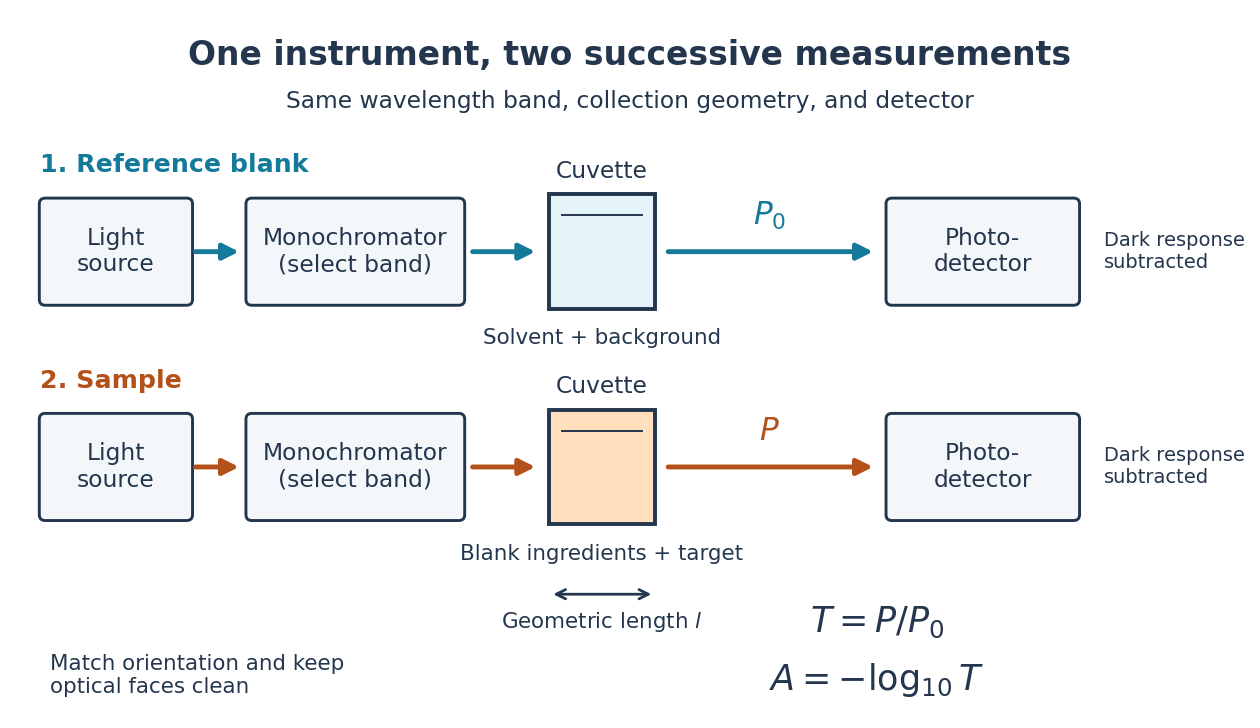

Why take a logarithm? Consider two consecutive identical absorbing layers. Each transmits a fraction of the radiant power entering it, so together they transmit . Their absorbances add because . Doubling the sample length doubles absorbance while squaring transmittance. This turns multiplicative loss into an additive scale and makes a straight line useful for inferring molar concentration.
A short model derivation makes the assumption explicit. Suppose a thin layer of thickness removes the fraction of its incoming radiant power, where is a fixed constant of proportionality and is a uniform molar concentration. The corresponding ordinary differential equation, initial condition, and solution areTaking the base-ten logarithm gives , so . The exponential decay follows from equal layers removing equal fractions of what remains. Proportionality to molar concentration additionally assumes that the absorbing chemical species retains the same response as its molar concentration changes; the geometric argument alone does not establish that.
Molar absorption coefficient 2026-10-18
The decadic molar absorption coefficient specifies absorbance per geometric length and molar concentration. With in centimetres and in , has units ; its SI unit is .[ref]
Beer–Lambert law. IUPAC Compendium of Chemical Terminology, fifth edition (Gold Book) by International Union of Pure and Applied Chemistry; Beer–Lambert law, entry B00626: coefficient name and conventional and SI units
The units cancel in . Since and , one equals . Specify the wavelength and chemical solution conditions when giving a molar absorption coefficient: changing the absorbing chemical species can change it even at fixed total analytical concentration.