A finitely supported sequence has only finitely many nonzero coordinates. Their vector space is commonly denoted .
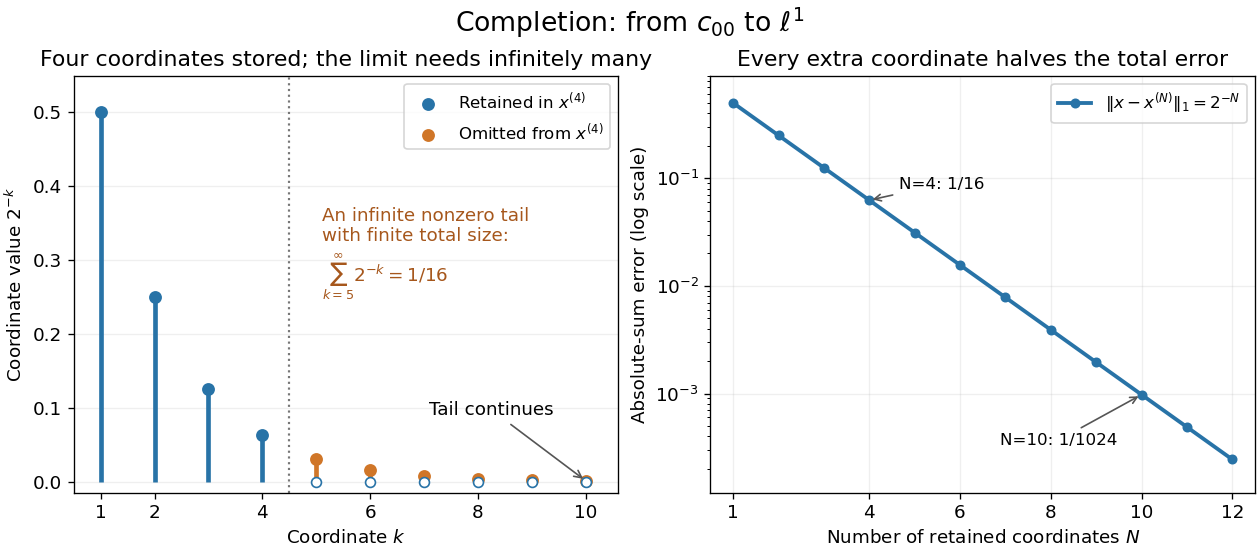
Equip the vector space of finitely supported sequences with the norm inherited from the absolutely summable sequence space. Consider the truncationsFor , the geometric series givesTherefore is a Cauchy sequence. Any possible norm limit must have coordinate equal to , since . That forces infinitely many nonzero coordinates, so no limit lies in . There is nothing wrong with the approximations: the space is missing their limit.
Inside the absolutely summable sequence space, the limit is and its exact truncation error is . Four retained coordinates leave error ; ten leave . More generally, truncating any element of the absolutely summable sequence space leaves a tail whose norm tends to zero. Together with completeness, this identifies that Banach space as the completion of a normed space with this norm. Finite storage and an infinite mathematical object fit together through a controlled error.

For , coordinate truncations converge in , so is dense. It is not dense in : every finitely supported sequence is at distance at least one from the constant-one sequence.
Articles by others on the same topic
There are currently no matching articles.