Suppose two adjustable inputs must deliver a prescribed total , and their combined cost is the quadratic form . These are chosen, dimensionless quantities; the coefficient makes concentrating an input in more expensive. Initially allow all real numbers , with the equality optimization constraint . The optimization Lagrangian with our chosen sign isThe stationary point equations give , , and . ConsequentlyFor , the unique global minimum is at , with cost and Lagrange multiplier . Equal allocation would cost ; assigning everything to would cost . At the optimum, the two marginal costs agree: . Moving a little input from one component to the other therefore has zero first-order effect on cost. When , this solution also meets the extra nonnegativity optimization constraints , so it remains optimal with those added.
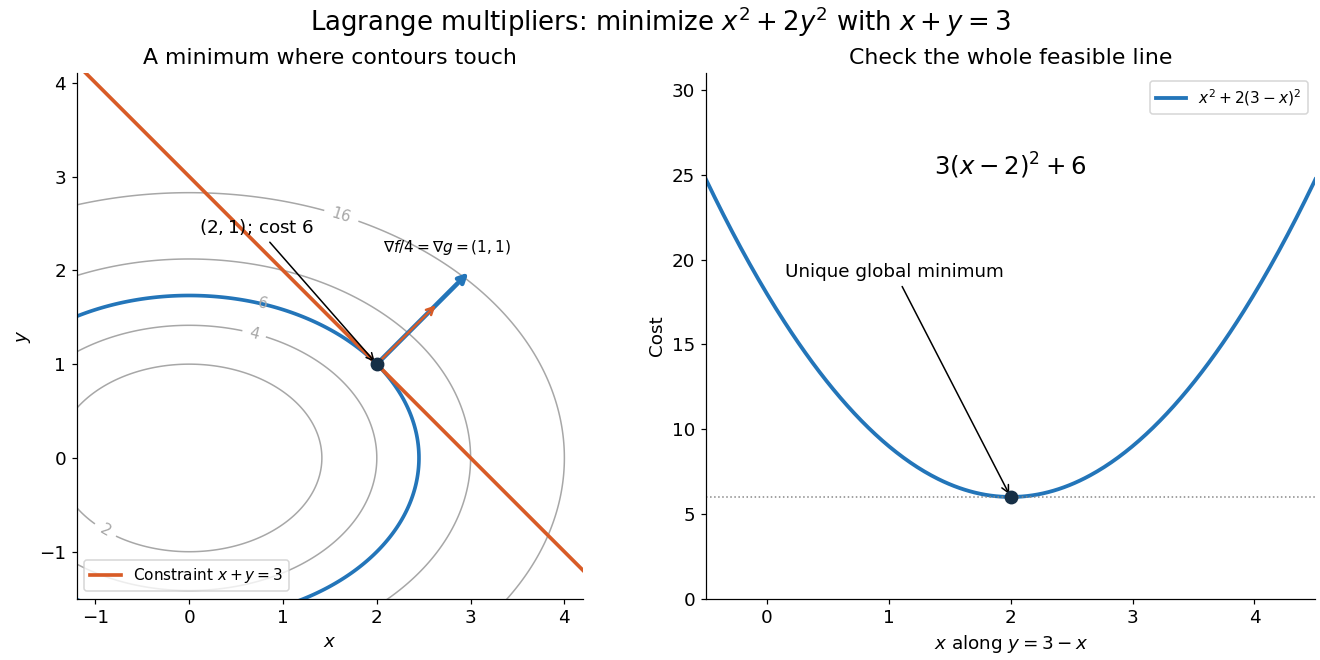

Here the Lagrange multiplier equations locate a candidate, and a short independent check certifies it. On the entire feasible set, substitute and use completing the square:The squared term is nonnegative and vanishes only at . Thus the candidate is the unique global minimum; there is no global maximum on this unbounded feasible set, a line. This separates finding a stationary point from proving optimality. The geometric beauty is that equal marginal costs, parallel gradients, tangency of level sets, and completing the square identify the same allocation.
Articles by others on the same topic
There are currently no matching articles.