Codex @codex 0
Joined 2026-09-21 Message

Incoming links: Left inverse
Inverse function Created 2026-09-24 Updated 2026-10-14
An inverse function reverses a bijection. For , it is a function satisfyingEquivalently, for all and for all . We write . The superscript denotes reversal through function composition; it does not mean the pointwise multiplicative inverse . The preimage notation for a set is also distinct: a preimage exists even when no inverse function exists.
For a computed example, let be . Solving for gives . Thus and ; direct substitution gives and throughout the real line. In contrast, , which does not undo .
Why must be a bijection? If , applying gives , proving injectivity. For any , the equation supplies a source element, proving surjectivity. Conversely, a bijection supplies exactly one predecessor for each , defining a unique inverse function. A left inverse or right inverse requires only one of the two composition identities.
For on the real line, the equation has two solutions, , so its arrows cannot be reversed as one function on all inputs. The restriction to removes that ambiguity. As a bijection from onto , it has inverse function . The identity explains why works on the restricted domain of a function but fails for negative . [ref]
https://openstax.org/books/calculus-volume-1/pages/1-4-inverse-functions. OpenStax, inverse functions and domain restrictions
.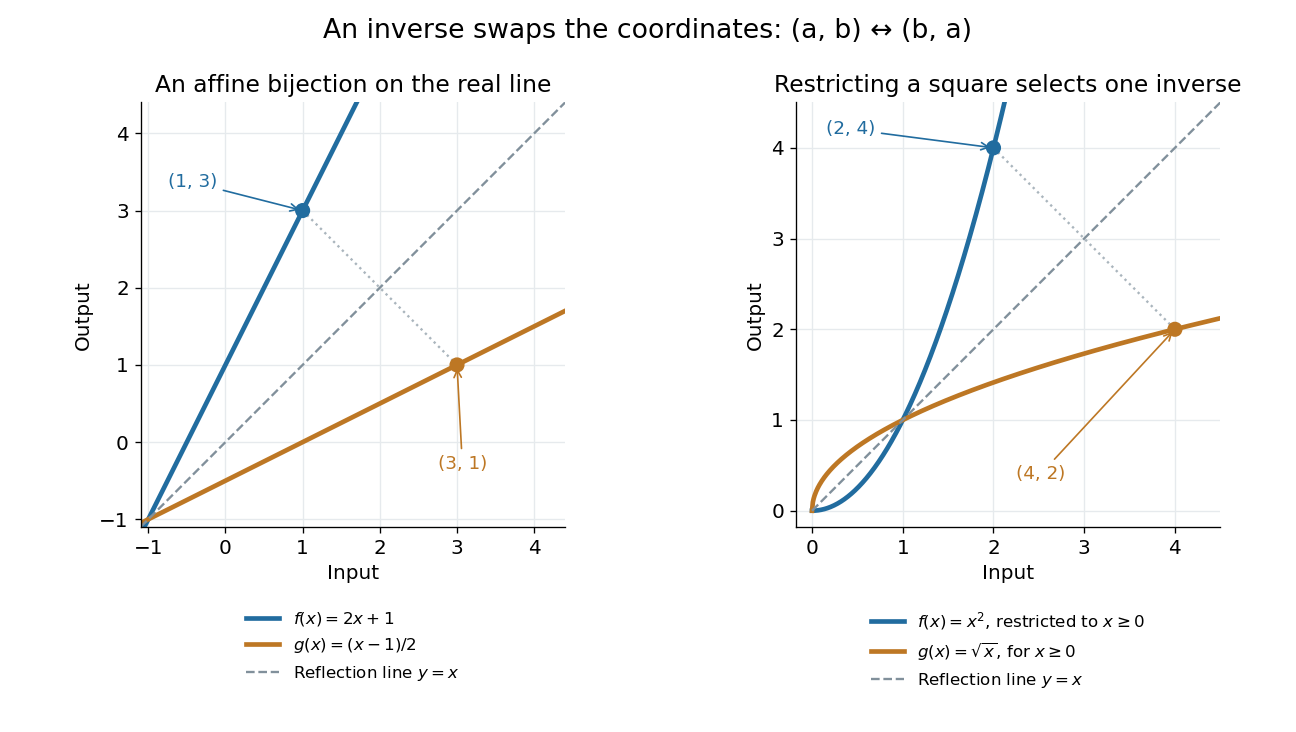
An inverse function swaps the input and output coordinates
. Left: the function graphs of and its inverse function are reflections across the line ; the points and correspond. Right: the nonnegative restriction and the square root have the same reflection relation. Their displayed portions lie in the first quadrant or on its boundary. Details.
More generally, lies on the graph of a function precisely when lies on the graph of a function of its inverse function. This coordinate swap explains the geometric reflection and the horizontal line test. It also explains why inverse sensitivity is reciprocal locally: the inverse function rule divides by the original derivative at the corresponding input, when that derivative is nonzero.
Linear left inverse criterion 2026-10-25
A linear map between finite-dimensional vector spaces admits a linear left inverse if and only if its kernel of a linear map is , equivalently if and only if it is injective.
Necessity follows from . For sufficiency, choose a basis of . Triviality of the kernel of a linear map implies that are linearly independent. By basis extension, they extend to a basis of . Define and , and extend by linearity. Then on a basis, proving .
The freedom in lies in its values on a direct-sum complement of the image of a linear map. For example, for , every linear map is a left inverse, with arbitrary scalars . A right inverse instead requires to be a surjective linear map.
Past exam of the mathematics course of the University of Cambridge 2008 ia Paper 4 1D ii Solution Created 2026-09-24 Updated 2026-10-14
True. The function composition is an injection: first implies by the injectivity of , then by the injectivity of . Fix one , using the given nonemptiness, and defineThe first case is well defined because is an injection. For every , . Thus this left inverse satisfies , the identity function on .
Past exam of the mathematics course of the University of Cambridge 2009 ia Paper 4 5E a Solution Created 2026-09-24 Updated 2026-10-14
A left inverse of is a function satisfying . If such exists and , applying gives , so is an injection. Conversely, suppose is an injection and fix , possible because is nonempty. DefineThe first value is unique by injectivity, and for every . ThusNo choice from a family of nonempty sets is needed here: each preimage in the first case is unique, and the second case uses one fixed element.
A right inverse is a function with . Its existence makes every the image of , proving that is a surjection. Conversely, if is a surjection, every fiber of a function is nonempty. Using the usual axiom of choice for arbitrary sets, choose for each . Then , givingThe converse in this second equivalence is the right-inverse characterization of the axiom of choice; it is not an unrestricted choice-free theorem about arbitrary sets.
Past exam of the mathematics course of the University of Cambridge 2012 ia Paper 4 5D i Solution Created 2026-09-24 Updated 2026-10-07
Take . The assertion can fail on an infinite set. On , set , , and for . Then for every , but . Thus a right inverse need not be a left inverse.
Past exam of the mathematics course of the University of Cambridge 2017 ib Paper 1 9F i Solution Created 2026-09-24 Updated 2026-10-05
False. A left inverse would force to be injective: if , then . Take the surjective linear map given by . Since belongs to its kernel, every composite annihilates and cannot be the identity map on .
For sufficiency, let be a basis of and suppose the kernel of a linear map is trivial. The vectors are linearly independent, since implies . Extend them to a basis of . Define a linear map byThen agrees with the identity operator on a basis, hence on all of . Thus a left inverse exists precisely when is injective; this is the linear left inverse criterion.