The linear limb-darkening law parametrizes angular specific intensity by a stipulated limb-darkening coefficient :Here denotes specific intensity at one frequency, or radiance integrated over a specified interval of frequency or wavelength; it does not denote radiant intensity. Within this stipulated range, gives a uniform disk and . The linear limb-darkening law is linear in , while its radial profile is curved. In the linear source function example above, when and .
For the illustrative choice , the specific intensity at , , and the limiting edge is respectively , , and . These are synthetic values, not measurements of the Sun. Real optical spectra and stellar atmospheres need not obey a linear limb-darkening law; more flexible profiles can be necessary for accurate exoplanet transit photometry. [ref]
Analytic Light Curves for Planetary Transit Searches by Kaisey Mandel and Eric Agol. §1, p. L171: the linear law is insufficient for the cited high-quality transit observations; §4 defines a quadratic law
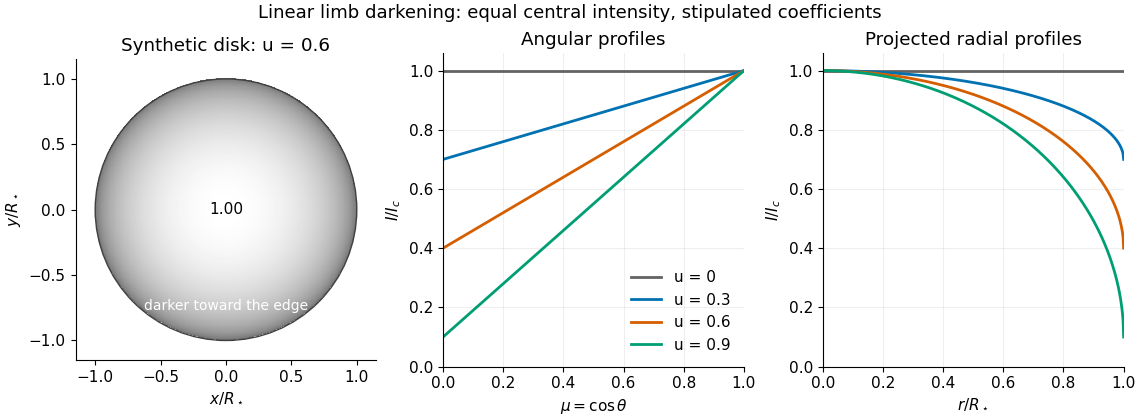
Synthetic stellar disk and angular and radial limb darkening profiles
. The disk uses the stipulated linear limb-darkening law with . The profiles compare four stipulated limb-darkening coefficients at equal central specific intensity. Shading represents relative brightness, without prescribing a wavelength or copying a solar measurement. Details.
The parameter in the linear limb-darkening law specifies its contrast between disk centre and the limiting edge. Its interpretation requires the chosen law and interval of frequency or wavelength. A limb-darkening coefficient fitted to an exoplanet transit may trade off against the transit impact parameter and planet radius; it is not a direct measurement of one layer's temperature.
Articles by others on the same topic
There are currently no matching articles.