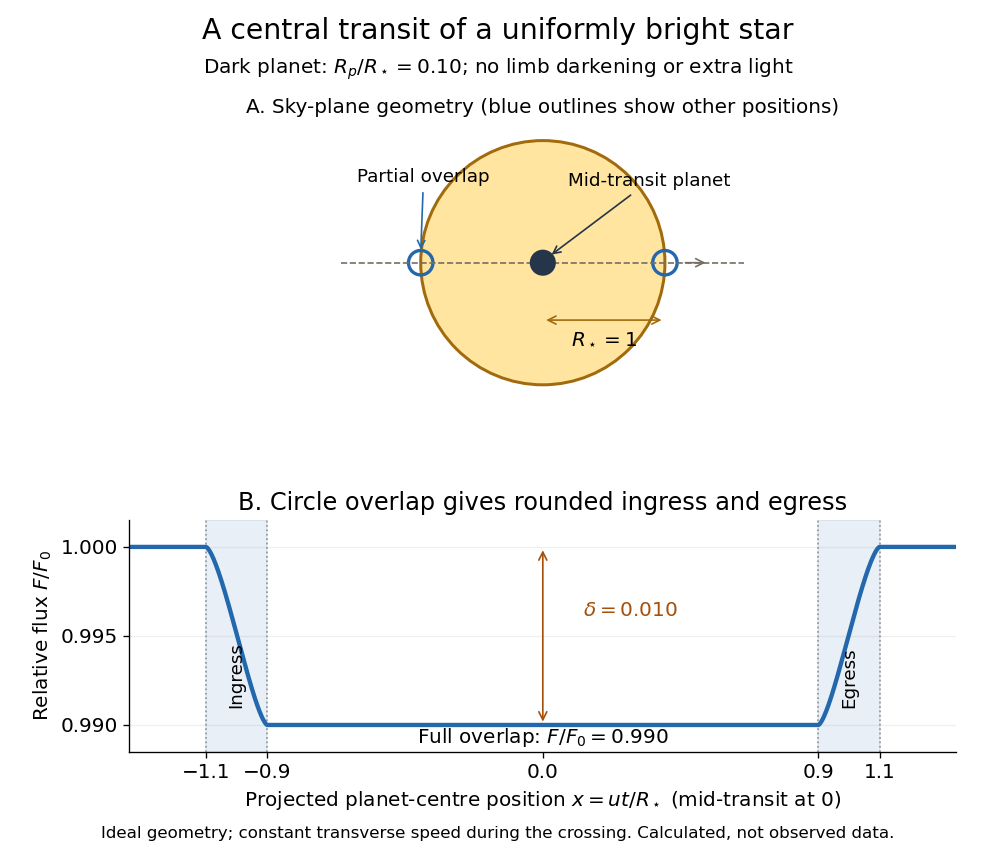
Exoplanet transit photometry measures the decrease in a star's observed radiative flux during an exoplanet transit. Define as the unobscured star's observed radiative flux and as the value at time . For a dark, opaque exoplanet crossing a uniformly bright circular stellar disc, a fully superimposed planetary disc blocks exactly the fractionHere and are the planet and star radii. This exoplanet transit depth determines a radius ratio, ; an absolute planet radius requires an independently estimated stellar radius. For , : a one-percent dip, with . Halving the radius ratio to reduces the exoplanet transit depth to , a quarter as much.
For the central exoplanet transit illustrated below, the transit impact parameter is . Write and let be the projected centre-to-centre separation in units of . The light curve is , where is the overlap area of circles of radii and . There is no overlap when ; the planetary disc is fully inside when , giving . Between those limits, the overlap area grows or shrinks continuously. Thus even a uniform star has curved ingress and egress, with a flat bottom only during full overlap. The illustration uses approximately constant transverse velocity over the short crossing, so with mid-transit at . Analytic models also handle limb darkening. [ref]
https://arxiv.org/abs/astro-ph/0210099. Mandel and Agol (2002)
.

The simple exoplanet transit depth formula assumes constant stellar brightness, no limb darkening or starspots, negligible light from the exoplanet, and no transit dilution by other light. It describes full overlap in a non-grazing exoplanet transit, requiring for a full-overlap interval. A grazing exoplanet transit never hides the whole planetary disc against the star, and limb darkening weights different blocked areas differently. Repeating dips are valuable evidence, but eclipsing binary stars and starspots can imitate parts of the signal, so confirmation and joint modelling matter.
The probability that a genuinely transiting planet with specified parameters is recovered by a survey and passes its selection procedure. It includes light curve noise, observing gaps, search algorithms and vetting. It differs from geometric transit probability; synthetic-transit injection and recovery can estimate it.
The fractional decrease in observed radiative flux during an exoplanet transit, relative to the out-of-transit baseline. For a uniform star, a dark planet, full disc overlap, and no transit dilution, the exoplanet transit depth is . For a nonuniform star it depends on the blocked specific intensity as well as the radius ratio.
Constant extra light makes an exoplanet transit appear shallower. If the host star supplies out-of-transit observed radiative flux and an unresolved source supplies , let . Then . For , a true exoplanet transit depth of appears as ; ignoring transit dilution gives a radius ratio instead of , under the same uniform-disc assumptions.
A starspot is a relatively cool, dark region on a star's surface associated with a magnetic field. Starspots change the light curve as the star rotates. A planet crossing a starspot blocks less light than it would from an unspotted region, producing a local upward anomaly during an exoplanet transit; unocculted starspots can instead deepen the normalized exoplanet transit depth. They can also distort spectral lines and imitate a Doppler spectroscopy signal.
A departure of transit arrival times from a constant-period ephemeris can reveal gravitational interactions with other bodies. Dynamical fits may constrain an exoplanet mass independently of transit depth, providing a mass to combine with radius for exoplanet interior models.
For two nearly circular Kepler orbits near a first-order period ratio, the slow resonant argument circulates on the displayed superperiod when longitude of periapsis precession is negligible. If , then . Within resonant-argument libration, this circulation formula is replaced by an amplitude-dependent libration period.
A first-order resonant orbital perturbation changes the semi-major axis and therefore the mean motion. Integrating the sinusoidal mean-motion variation over the near-resonant transit-timing superperiod gives a mean-longitude amplitude proportional to . Converting phase to transit time gives the displayed amplitude ratio. It assumes small perturbations, circulating resonant argument, effectively fixed free orbital eccentricity, and dominance of this enhanced term over direct phase and forced-eccentricity contributions. The formal divergence as signals failure of this expansion, not infinitely large transit times.
In leading mean-conjunction geometry a common observer phase for two resonant arguments requires and modulo . With , the exact modular criterion isNecessity follows by subtracting the two congruences after multiplication; sufficiency follows from the integer linear combinations of and , whose set is . For exterior centres and interior centres at orders one to three, only satisfies it. This is phase compatibility, not a guarantee of an observed exoplanet transit: timing, observer orientation, resonant-argument libration widths and true-versus-mean longitude must also be considered.
For an edge-on orbit crossing the centre of a uniformly bright stellar disk at distance , projected speed is and chord time is . A steady cross-sectional-area current therefore places area in front of the star, givingThis requires a geometrically narrow, optically thin wire with negligible overlap. A noncentral chord, limb darkening, finite angular extent and large optical depth change the estimate; it cannot predict dimming greater than one.
An exoplanet passes in front of its host star as seen by an observer and blocks part of the stellar flux. Exoplanet transit photometry infers geometry and radii from the resulting light curve. A true alignment involves the true anomaly, not generally the mean anomaly.
The probability that an isotropically oriented circular orbit produces an exoplanet transit, assuming . Uniformity of gives the displayed result. Orbital eccentricity, a restriction to full rather than grazing crossings, or a non-isotropic orientation distribution changes the expression.
The first-to-fourth-contact duration of an exoplanet transit by a spherical opaque planet of radius ratio on a circular orbit. The transit impact parameter is . The formula includes finite planet size and orbital curvature; it reduces to the transit duration of a small planet when and . It describes contact geometry, not a uniquely specified light-curve threshold in the presence of limb darkening.
The total duration runs from first to fourth contact; the fully superimposed duration runs from second to third contact. Circular-orbit formulas contain for the former and for the latter. Confusing the two changes inferred impact parameter, even if the period and transit depth are unchanged.
For a circular orbit, define , and . Inverting contact geometry gives . The inferred value is conditional on the stellar scale, the total-duration convention and the orbital model; it must satisfy . A non-grazing complete crossing additionally has .
The orbital speed near transit differs from the circular value by approximately . At otherwise fixed geometry, duration is shortened by the inverse of this factor. Without eccentricity and periapsis constraints, a measured duration need not select one unique impact parameter.
Assume Kepler's third law, a negligible planet mass, and . Define . The total duration of a circular planetary transit determines , giving the displayed stellar radius. Unknown orbital eccentricity, transit dilution or a different stellar mass-radius calibration introduces additional uncertainty.
The minimum projected planet-star separation during an exoplanet transit, divided by the stellar radius. It determines the stellar chord length and hence the transit duration of a small planet.
For two exactly coplanar circular orbits around the same star, transit impact parameters scale as semi-major axis, hence as . Any overlap by the outer planet requires . In the point-planet limit the period ratio is bounded by . Tangency has zero duration, so this is a geometric supremum; practical detection also requires sufficient signal-to-noise ratio and survey coverage.
For a small planet on a nearly circular Kepler orbit, a stellar chord at normalized transit impact parameter has length . Dividing by transverse orbital speed gives the duration. A central transit has the longest duration within this approximation. Eliminating with Kepler's third law yields for known mean stellar mass density. Finite planet radius, appreciable orbital eccentricity, and corrections change the bound.
For an opaque or detectably extinguishing spherical debris cloud of radius much larger than the stellar radius, a central exoplanet transit lasts approximately . Combining this with the Hill radius gives the displayed mass estimate. For cloud impact distance , replace by : the central formula then gives a lower mass estimate unless the chord geometry is known.
Articles by others on the same topic
There are currently no matching articles.