A dark, opaque circular planet of radius blocks specific intensity over its overlap with the projected star. With and no transit dilution, the instantaneous exoplanet transit depth is exactlyWhen , the entire planetary disk is inside the stellar disk, and specific intensity varies little across that disk, small-planet transit weighting reduces toHere is the projected centre separation divided by . The numerator samples the local specific intensity; the denominator normalizes by the whole star's mean specific intensity. The small-size argument and the distinction between full overlap and ingress are explicit in the original analytic treatment. [ref]
Analytic Light Curves for Planetary Transit Searches by Kaisey Mandel and Eric Agol. §2, p. L171, geometry; §5, p. L174, small-planet approximation restricted to the interior
For a short approximately straight crossing at constant transverse velocity , write with at mid-transit, and let be the transit impact parameter. Then and . With stipulated and , a central crossing has mid-transit exoplanet transit depth approximately , whereas gives . A uniform disk would give for either fully overlapping crossing. The brighter central chord produces a deeper dip and the off-centre chord a shorter crossing at the same .
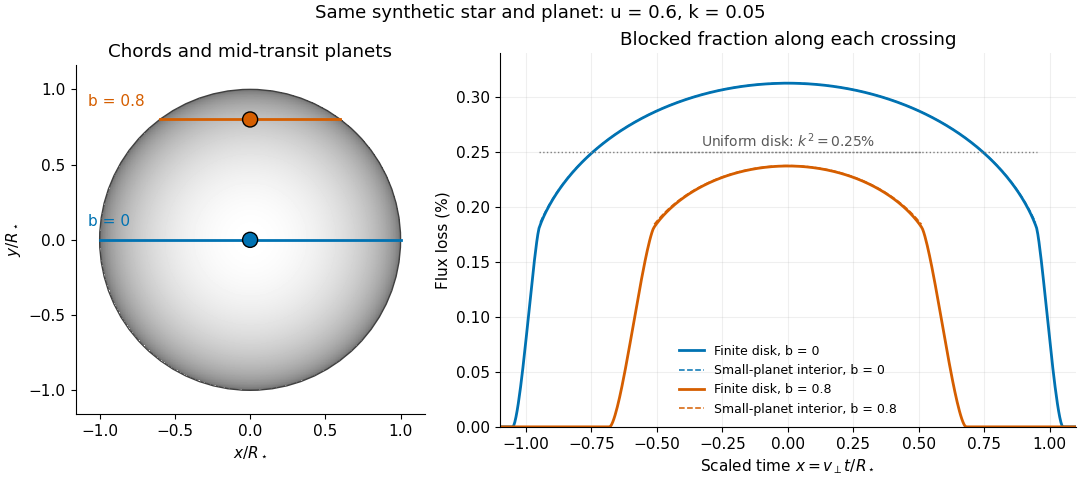
Two transit chords across the same synthetic limb-darkened disk flux distribution
. Stipulated and ; the coloured curves integrate the occulted specific intensity over the finite planetary disk, including ingress and egress. Dashed curves show small-planet transit weighting only where the whole planetary disk is inside the star. Horizontal dotted segments give the uniform-disk full-overlap depth . The chord panel shows mid-transit positions; the horizontal coordinate in the light curve is distance travelled divided by stellar radius, equivalent to scaled time at constant transverse velocity. Details.
At fixed away from the edge, a two-dimensional Taylor's theorem expansion over the symmetric planetary disk cancels the first derivatives; the first correction to the blocked radiant flux is of order if the second derivatives remain bounded. This error estimate is not uniform at the edge, where the radial derivative of the linear limb-darkening law diverges. Ingress, egress, a grazing exoplanet transit, and a crossing of a starspot require the overlap integral or a suitable more complete model. Inferring without the local-to-mean specific intensity ratio can bias the estimated planet radius.
Articles by others on the same topic
There are currently no matching articles.