Stig Lundquist, the author printed as S. Lundquist, reported an early laboratory test in 1949. The apparatus used mercury in a stainless-steel cylinder, a vibrating disk, and a floating mirror to indicate the motion at the liquid surface. The reproduced apparatus drawing also shows a scale; the accompanying account gives an applied magnetic field of .[ref]
Numerical investigations of rotating MHD in a spherical shell by Andrey Sheyko. Andrey Sheyko, Numerical investigations of rotating MHD in a spherical shell (2014), p. 8, Figure 1.4 and following paragraph; reproduction of Lundquist's apparatus
The imposed magnetic field ran along the cylinder, while the bottom disk oscillated to excite azimuthal motion. Varying the drive frequency sought a standing wave resonance. A later authored experimental account describes this as an early hint: the resonance peak was not reached, and magnetic damping was substantial.[ref]
Torsional Alfvén waves in a dipolar magnetic field: experiments and simulations by Z. Tigrine and others. 2019, Section 1, paragraph beginning “Only a few laboratory experiments”: mercury vessel, bottom crenelated disk, resonance search and unreached peak
The experiment therefore tested a bounded azimuthal shear disturbance, related to a torsional Alfvén wave, rather than an infinite plane wave or a compression-driven magnetosonic wave.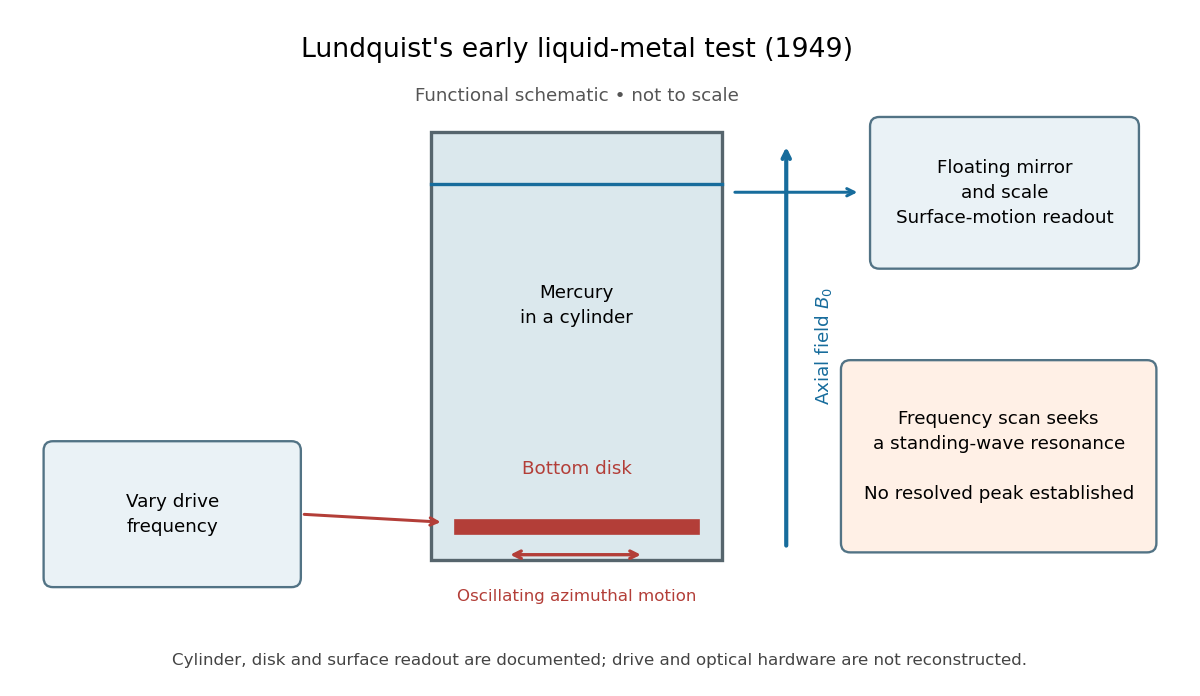

The magnetic field provides the controlled physical parameter: the ideal Alfvén wave prediction makes a propagation speed proportional to its strength, while a resonance also depends on the vessel's boundary conditions. A quantitative test must compare the driven response with finite-electrical conductivity theory and account for mechanical coupling and wall losses. An observed surface motion alone cannot distinguish all these mechanisms. The reproduced apparatus account gives neither a numerical drive frequency nor a field-off comparison. Lundquist's paper itself calls the experiment preliminary and proposes further investigations.[ref]
Experimental Investigations of Magneto-Hydrodynamic Waves by Stig Lundquist. Abstract, final sentence: preliminary experiment and proposed investigations
Articles by others on the same topic
There are currently no matching articles.