Consider an original model at fixed vacuum wavelength and temperature . Stipulate a transparent sample with Verdet constant , length , uniform adjustable , and a field-independent analyzer-zero offset . These are chosen values, not measured glass properties. On a continuously tracked small-angle branch,Taking half the difference gives ; half the sum recovers . Hence . A field-reversal difference of is twice the single-field rotation, not that rotation itself. More generally this subtraction removes every contribution that is even under , provided the sample and apparatus remain otherwise matched.
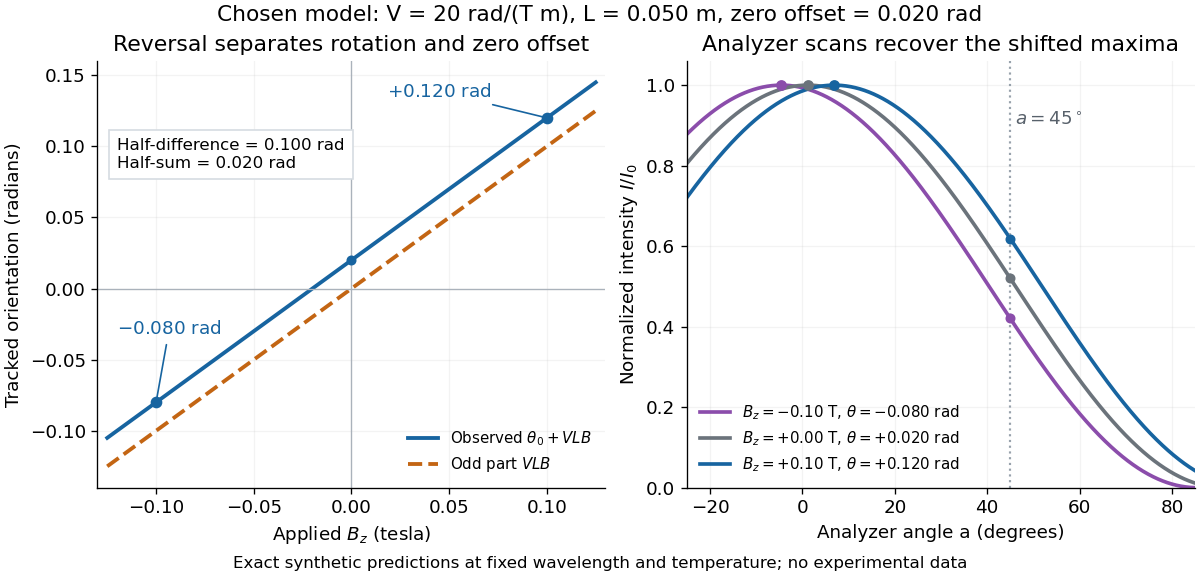

An ideal polarimeter analyzer at laboratory angle reads normalized light intensity . Here is the light intensity immediately before the analyzer, separately calibrated for each condition. A scan locates the maximum at modulo . At , expansion about zero gives , with angles in radians. At crossed extinction, the response instead begins as and loses the sign near zero. The favorable slope follows directly by differentiating Malus's law; its sign reverses if the angular convention is reversed.
Articles by others on the same topic
There are currently no matching articles.