Light initiates methane chlorination by photodissociation of through homolysis. The elementary bookkeeping isHere denotes the photon energy. The first propagation step replaces a chlorine radical with a methyl radical; the second regenerates a chlorine radical. Adding the two propagation equations cancels both free radicals and gives : chloromethane and hydrogen chloride are made while the chain carrier is regenerated.[ref]
6.6 Radical Reactions. Organic Chemistry by John McMurry, §6.6: chlorine photolysis and the two-step methane chlorination cycle
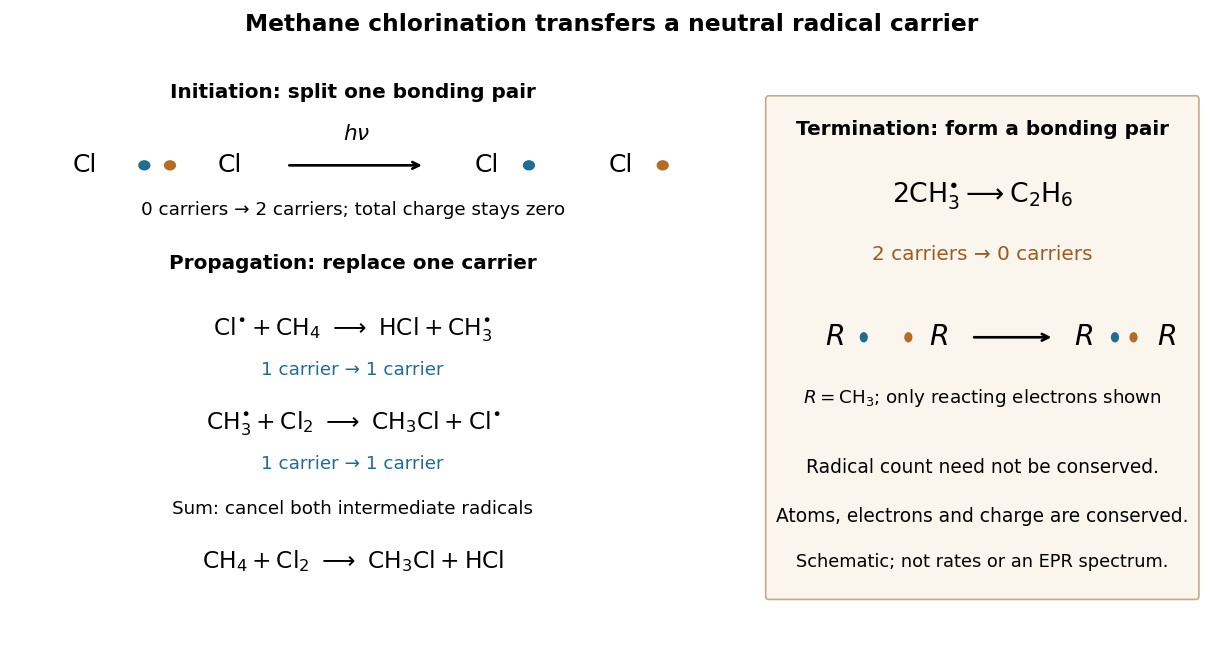
Methane chlorination: initiation supplies carriers, propagation replaces them, termination removes them
. The left panel follows the reacting electron pair in homolysis, then counts chain carriers through two propagation steps. The right panel shows recombination termination. Every chemical species in this example is neutral. Electron marks are bookkeeping, not a measured electronic wavefunction or a reaction-rate plot. Details.
For example, recombination of methyl radicals makes ethane and a covalent bond from two unpaired Electrons, removing two carriers. Recombination of two also terminates carriers; in the gas phase, stabilization of the product requires disposal of released energy, for example to a third collision partner. The figure omits that partner. Termination competes with propagation, and further chlorination can consume chloromethane, so this cycle alone does not predict a pure product or a measured reaction rate.[ref]
10.2 Preparing Alkyl Halides from Alkanes: Radical Halogenation. Organic Chemistry by John McMurry, §10.2, Figure 10.2 and following paragraphs: radical combination terminates the chain; further substitution gives product mixtures
Articles by others on the same topic
There are currently no matching articles.