Missing-section ambiguity in volume reconstruction is nonuniqueness caused by unobserved material between acquired sections. Even perfect image registration cannot determine every structure inside that material. It is an inverse problem: different three-dimensional specimens can produce exactly the same retained image stack. The serial-section acquisition sequence makes the missing observation explicit: cut, collect and image sections, then align and stack the surviving observations.[ref]
Serial Section TEM by JEOL. Figure1(a)–(e), physical sections, alignment and stacking
For an original exact counterexample, consider a binary column of three adjacent voxels, ordered along the cutting direction. A value 1 denotes a marked material and 0 denotes its absence. Two possible columns areIf the middle section is missing, both acquired records are . Yet is one connected column and consists of two separated parts. The acquisition map that retains only the first and last entries satisfiesThis is an ambiguity in the observations, not a failure of a particular reconstruction program. Linear interpolation inserts the middle value 1 and selects , but that choice uses a smoothness assumption rather than an additional measurement.
With expected section spacing , losing the section centered at leaves acquired centers at and . Keep their physical positions: silently relabeling them as adjacent observations also distorts depth. Additional physical observations or justified constraints may reduce the possible reconstructions. A visually smooth surface alone cannot distinguish the two columns above.
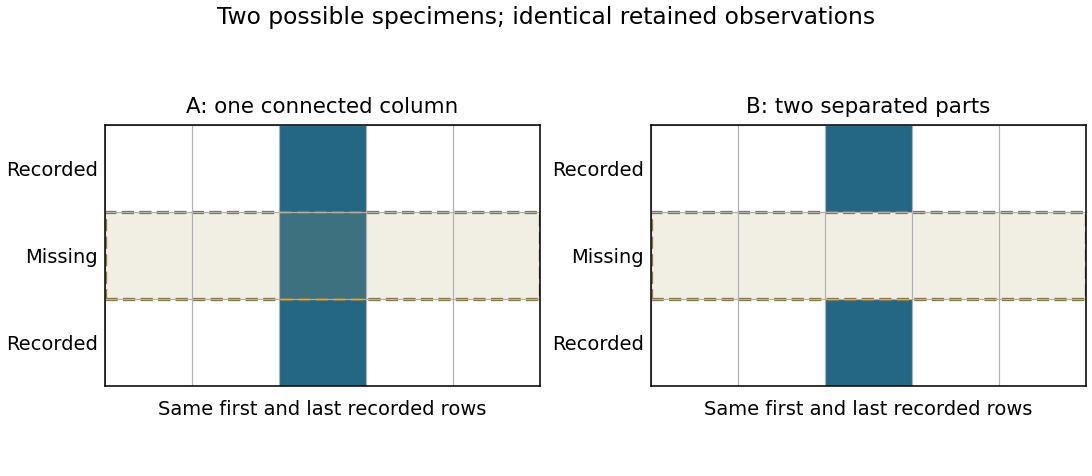
Original binary-volume counterexample: the two possible middle layers give identical retained sections but different connectivity
. Details. 
Articles by others on the same topic
There are currently no matching articles.