Serial-section electron microscopy reconstructs a volume from an ordered image stack of thin physical slices. In the transmission electron microscopy implementation, an ultramicrotome cuts successive slices, which are collected on a support and imaged through the specimen. Image registration aligns corresponding features; image segmentation identifies structures to follow between slices. JEOL's glossary describes sections of 40–100 nm and illustrates the separate registration and segmentation stages.[ref]
The motivation is geometrical: one isolated slice cannot show whether a feature continues, divides, or ends outside that slice. An ordered image stack provides observations along the third coordinate, although finite section-thickness anisotropy and missing material limit what can be inferred. A change between neighboring images may come from specimen structure, a slice deformation, or imperfect image registration.
For a chosen numerical example, suppose each of consecutive sections has uniform thickness , with lateral pixel pitch . Ignoring lost material and thickness variation, the sections coverThe voxel sampling is 12.5 times coarser along the cutting direction. These are chosen dimensions, not measurements from either cited experiment. The first and last section centers are only apart: center-to-center extent differs from total represented thickness. Neither spacing is automatically the achieved spatial resolution.
Image resampling onto a cubic grid can make an image stack easier to display, but interpolation supplies no additional independent observations. Likewise, smooth image registration cannot resolve missing-section ambiguity in volume reconstruction: a small connecting feature could lie wholly inside lost material. Checking a reconstructed connection therefore needs evidence in the acquired slices, not just a visually smooth rendered surface.
A historically important automation change illustrates the distinction between section and surface imaging. In 2004, Winfried Denk and Heinz Horstmann placed an ultramicrotome with a diamond knife inside a scanning electron microscope. Their serial block-face scanning electron microscopy imaged the exposed block surface between cuts instead of collecting the removed sections. They reported stacks several hundred layers deep, 50–70 nm sectioning, and typically less than 10 nm lateral position jitter. These observations tested an apparatus for acquiring closely aligned serial images; they did not remove the finite spacing between observations.[ref]
Serial Block-Face Scanning Electron Microscopy to Reconstruct Three-Dimensional Tissue Nanostructure by Winfried Denk and Heinz Horstmann. Abstract; Results, lateral-position stability; Materials and Methods, Microtome
A mechanical detail makes the measurement chain concrete. Their specimen-advance lever reduced the motorized micrometer's motion by 0.11. Thus its stated position measurement uncertainty of 50 nm contributed after that reduction; other sources of section-thickness error still required assessment.[ref]
Serial Block-Face Scanning Electron Microscopy to Reconstruct Three-Dimensional Tissue Nanostructure by Winfried Denk and Heinz Horstmann. Materials and Methods, Microtome, specimen-advance mechanism
Missing-section ambiguity in volume reconstruction is nonuniqueness caused by unobserved material between acquired sections. Even perfect image registration cannot determine every structure inside that material. It is an inverse problem: different three-dimensional specimens can produce exactly the same retained image stack. The serial-section acquisition sequence makes the missing observation explicit: cut, collect and image sections, then align and stack the surviving observations.[ref]
Serial Section TEM by JEOL. Figure1(a)–(e), physical sections, alignment and stacking
For an original exact counterexample, consider a binary column of three adjacent voxels, ordered along the cutting direction. A value 1 denotes a marked material and 0 denotes its absence. Two possible columns areIf the middle section is missing, both acquired records are . Yet is one connected column and consists of two separated parts. The acquisition map that retains only the first and last entries satisfiesThis is an ambiguity in the observations, not a failure of a particular reconstruction program. Linear interpolation inserts the middle value 1 and selects , but that choice uses a smoothness assumption rather than an additional measurement.
With expected section spacing , losing the section centered at leaves acquired centers at and . Keep their physical positions: silently relabeling them as adjacent observations also distorts depth. Additional physical observations or justified constraints may reduce the possible reconstructions. A visually smooth surface alone cannot distinguish the two columns above.
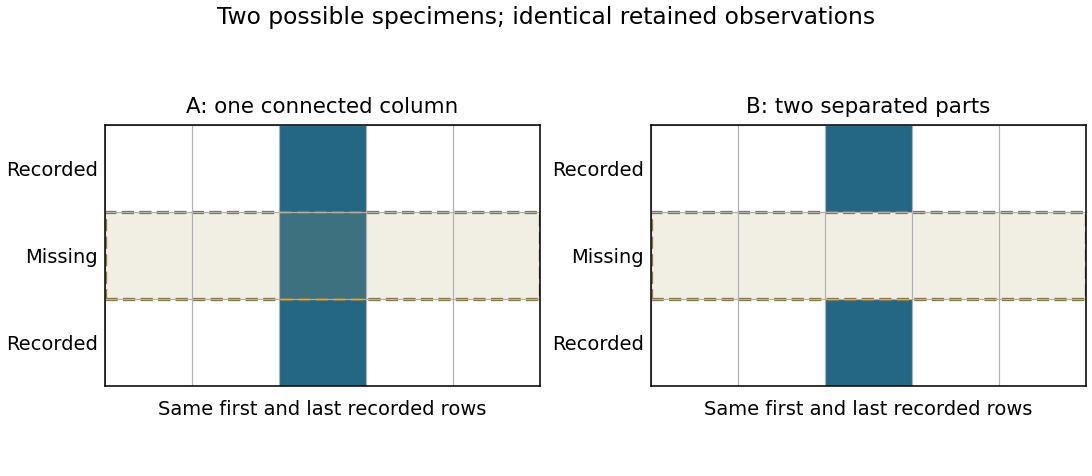
Original binary-volume counterexample: the two possible middle layers give identical retained sections but different connectivity
. Details. 
Section-thickness anisotropy describes unequal spatial sampling along and across a serial-section image stack. For uniform section thickness and square lateral pixel pitch , a useful dimensionless ratio isIt compares assigned sampling scales, rather than automatically specifying an achieved spatial resolution. Section collection followed by image alignment and stacking produces a physical cutting coordinate that must be calibrated separately from lateral image dimensions.[ref]
For an original example, let and . Then and a rectangular voxel has volume . A displacement of three pixels laterally and two section intervals axially has physical lengthTreating all three index coordinates as though they had spacing would instead give , a serious geometrical error.
Image resampling to cubic voxels can regularize display coordinates, but the inserted axial samples are interpolation, not new independent observations. Likewise, 200 uniform sections represent of thickness while the first and last centers are only apart. For variable or missing sections, retain the actual section coordinates rather than assuming a single constant .
Articles by others on the same topic
There are currently no matching articles.