A trigger changes which particle populations are common in the recorded sample. Let be the number of particles in an event, and stipulate an independent Bernoulli distribution for each particle's ability to produce an accepted telescope signal, with success probability . If any successful particle suffices, the event acceptance isThis is a deliberately simplified model. Its includes the joint geometrical acceptance and response of the whole telescope; it is not an assumed universal single-counter efficiency. Actual shower directions, spatial correlations and shared electronics can violate the independence assumption.
The conditional probability formula givesFor chosen underlying fractions , and , the two acceptances are and . Five-particle events consequently form about of recorded events. A population that is only of incoming events can occupy nearly of the photographs. This is selection bias, not evidence that the source population changed.
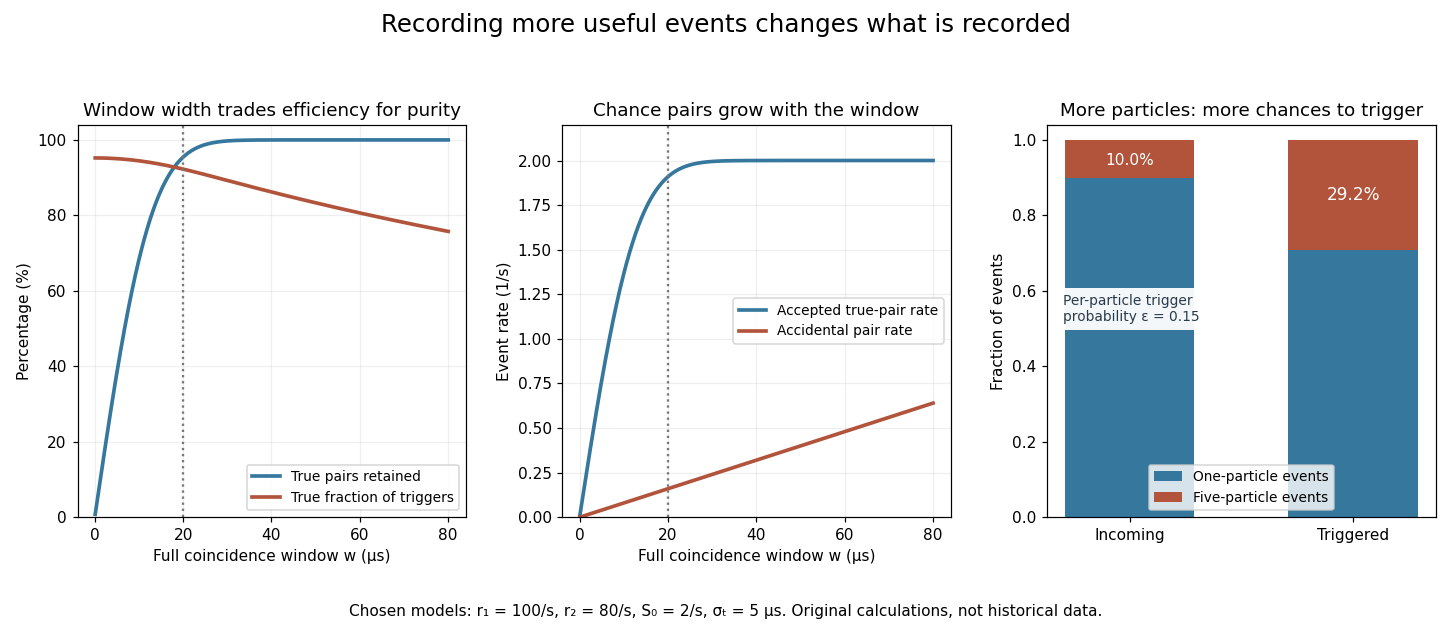
A coincidence window trades timing acceptance against background, while a trigger enriches events with more particles
. Original calculations with the explicitly chosen rates, Gaussian timing spread and independent-particle acceptance model in the text. No historical event counts or measured timing curves are reproduced. Details.
Articles by others on the same topic
There are currently no matching articles.