Patrick Maynard Stuart Blackett and Giuseppe Occhialini began their cosmic-ray collaboration in 1931. They used the coincidence methods of Walther Bothe and Bruno Rossi to make a particle initiate its own recording. Blackett later reported tracks on about of their counter-controlled photographs, compared with roughly – for random expansions in small chambers. Those figures describe the reported apparatus and conditions, not a universal detection efficiency.[ref]
Cloud Chamber Researches in Nuclear Physics and Cosmic Radiation by Patrick Maynard Stuart Blackett. Cloud chamber researches in nuclear physics and cosmic radiation, lecture 13 December 1948, pp. 104–105: collaboration, coincidence precedent and photographic yield
In their 1933 account, Geiger counters above and below the chamber fed a coincidence circuit. Its pulse operated a thyratron, magnet and spring-release valve, letting a light piston expand the gas. A mercury-vapor lamp then illuminated the drops. A water-cooled solenoid supplied the magnetic field; two oblique cameras allowed track reconstruction. Moving the lower counter changed which trajectories could be recorded.[ref]
Some Photographs of the Tracks of Penetrating Radiation by Patrick Maynard Stuart Blackett and Giuseppe Paolo Stanislao Occhialini. Some Photographs of the Tracks of Penetrating Radiation, pp. 699–701, section 1 and Fig. 2; p. 719, Description of Plates: expansion sequence, cameras and alternate counter position
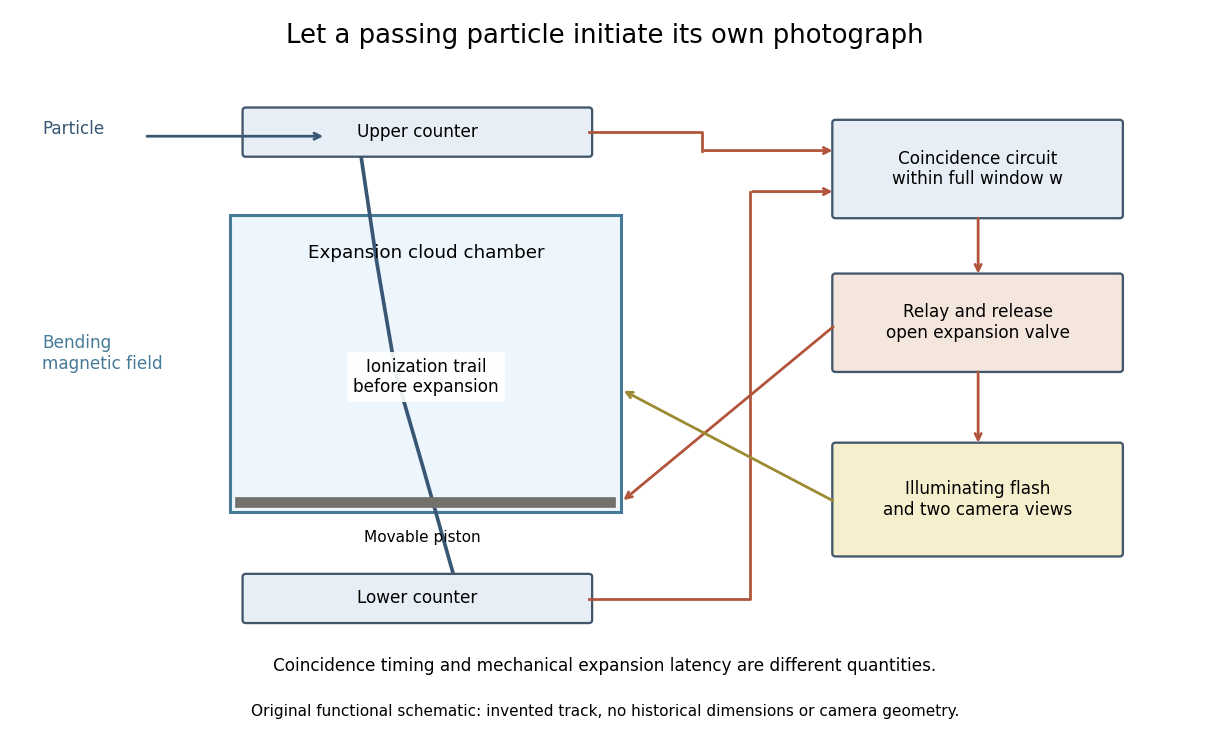
Counter coincidence initiates expansion, illumination and photography in a functional reconstruction of the Blackett-Occhialini method
. Original diagram, not a scale drawing or a historical photograph. The pictured track and positions are illustrative; magnetic curvature and event direction require further measurements. Details.
Two timing problems must be separated. The coincidence circuit's window distinguishes nearly simultaneous counter signals. The mechanical expansion latency determines how much the existing ionization trail spreads before droplets form. For a chosen one-coordinate diffusion model with initial variance , diffusion coefficient and expansion delay ,Taking , and gives . This is an original illustrative calculation, not the historical track width. It shows why a fast electronic pulse does not by itself guarantee a sharp photograph: the subsequent mechanical response also matters.
The photographs revealed groups containing positive and negative electron-like tracks, complementing the Anderson positron track experiment. Their interpretation depended on track curvature, direction, ionization and particle range, not simply on the presence of a coincidence.[ref]
Some Photographs of the Tracks of Penetrating Radiation by Patrick Maynard Stuart Blackett and Giuseppe Paolo Stanislao Occhialini. Some Photographs of the Tracks of Penetrating Radiation, pp. 702–708 and p. 718, Summary: associated tracks and evidence for positive electrons
Blackett explicitly noted that the counter control favored larger particle showers.[ref]Cloud Chamber Researches in Nuclear Physics and Cosmic Radiation by Patrick Maynard Stuart Blackett. Cloud chamber researches in nuclear physics and cosmic radiation, p. 108: multiplicity-dependent triggering and overrepresentation of large showers
The multiplicity bias from a detector trigger gives a small model of that effect: a recording method can improve the study of rare interactions while making its photographs unrepresentative of the incident population. Articles by others on the same topic
There are currently no matching articles.