A Newtonian binary chirp is a leading-order model in which loss of orbital energy to gravitational radiation makes an almost circular binary system shrink and its gravitational-wave frequency rise. Here is a derivation with explicit SI units. Let the constant component masses be in kilograms, , , separation in metres, and orbital angular frequency in radians per second. Newtonian gravity, circular motion and the quadrupole formula giveThe factor rather than appears because the dominant mass quadrupole moment repeats twice per orbit. Since , radiative energy loss implies , henceThe quantity is a time in seconds. Thus has units and has units , as required for frequency change per second. This model assumes weak gravity, slow relative motion, negligible eccentricity of a conic, no spin corrections and adiabatic evolution over an orbit. It does not describe merger or ringdown.
Separating variables gives a finite formal coalescence time and accumulated wave phase :Indeed ; the formal divergence at signals extrapolation outside the approximation. Over a finite frequency interval, the number of gravitational wave cycles is . This accumulated phase is why a chirp mass can be constrained even when distance and inclination remain entangled.
The chirp mass is the combination of two component masses controlling the leading Newtonian binary chirp. Inverting its frequency equation givesUse in hertz and in hertz per second to obtain kilograms. For equal component masses , . A stipulated solar mass system therefore has solar masses. In a cosmological observation the time and frequency measured at the detector instead yield , where is redshift; phase evolution alone does not independently determine the source mass and redshift.
To construct an original example rather than imitate GW150914, set , , and adopt the rounded solar mass . Compare and solar mass binaries starting at . Stop each at the stipulated orbital compactness thresholdThis is a conservative pedagogical stopping rule, not a claimed error bound: the relative speed already reaches . Higher-order corrections accumulate wave phase well before merger, and precision inference requires better models. The two cutoffs are approximately and respectively; doubling the chirp mass multiplies at fixed by .
For a nearby stipulated source at distance , neglect redshift and define inclination as the angle between the orbital angular momentum and the line of sight. The leading quadrupole formula yieldsThe numerator of has units , matching , so both polarizations are dimensionless. Its growth and the rising frequency produce the tightening, strengthening oscillations. For face-on viewing the polarization components have equal magnitudes in phase quadrature; for edge-on viewing the cross component vanishes, agreeing with circular-binary quadrupole radiation.
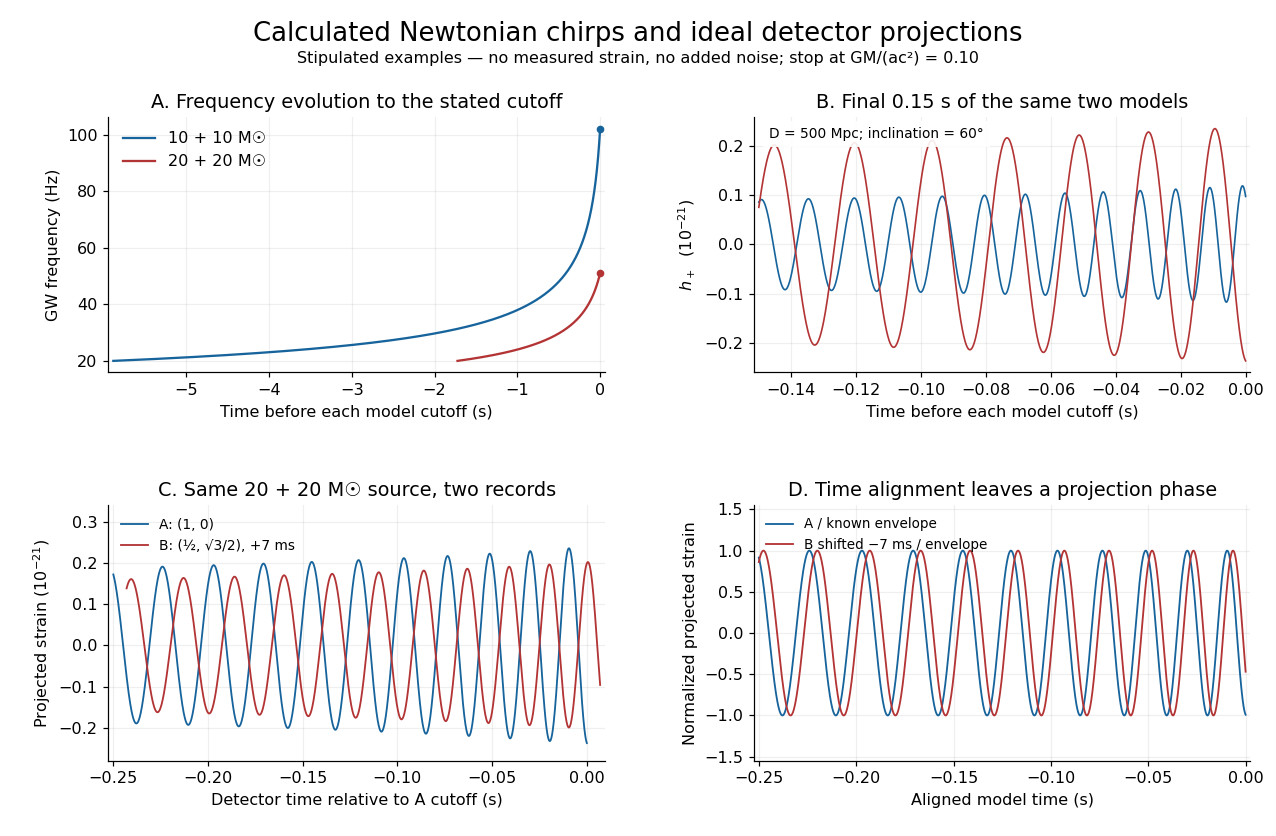
Stipulated Newtonian binary chirps and two ideal detector projections
. Calculated examples only: no measured LIGO strain or noise. Upper panels compare equal-mass binaries up to . Lower panels use solar masses, and degrees. Ideal overhead detectors have and ; the second record has a stipulated delay, then is shifted back for comparison. These geometries and delay are not fitted Hanford–Livingston responses. Details.
Shifting an arrival time aligns the chirp evolution, but different polarization projections need not overlay after only a sign flip. The last panel divides the ideal projected records by their known envelope factors to expose this phase difference. A physical source model must jointly explain those differences, not erase them by arbitrary rescaling. Independent integration of the separation equation, the radiated power and checks the analytic chirp against orbital energy balance over the entire stipulated interval.
Articles by others on the same topic
There are currently no matching articles.