GW150914 is the first directly detected gravitational wave, interpreted as a binary black hole inspiral, merger and ringdown. Its discovery paper reports a peak projected gravitational wave strain of approximately and a combined matched filter signal-to-noise ratio of 24. The inferred source-frame component masses were and solar masses, with 90 percent credible intervals. These are model-dependent estimates from a detector network.[ref]
Observation of Gravitational Waves from a Binary Black Hole Merger by B. P. Abbott and others. Abstract; II Observation; VI Source discussion, Table I
The interesting measurement is a chain: curvature changes relative light travel times, wave interference turns those changes into a photodetector signal, calibrated records from separate sites constrain a common source, and statistical inference tests competing explanations. The following original models explain that chain; the plotted time series are stipulated calculations, never measured GW150914 data.
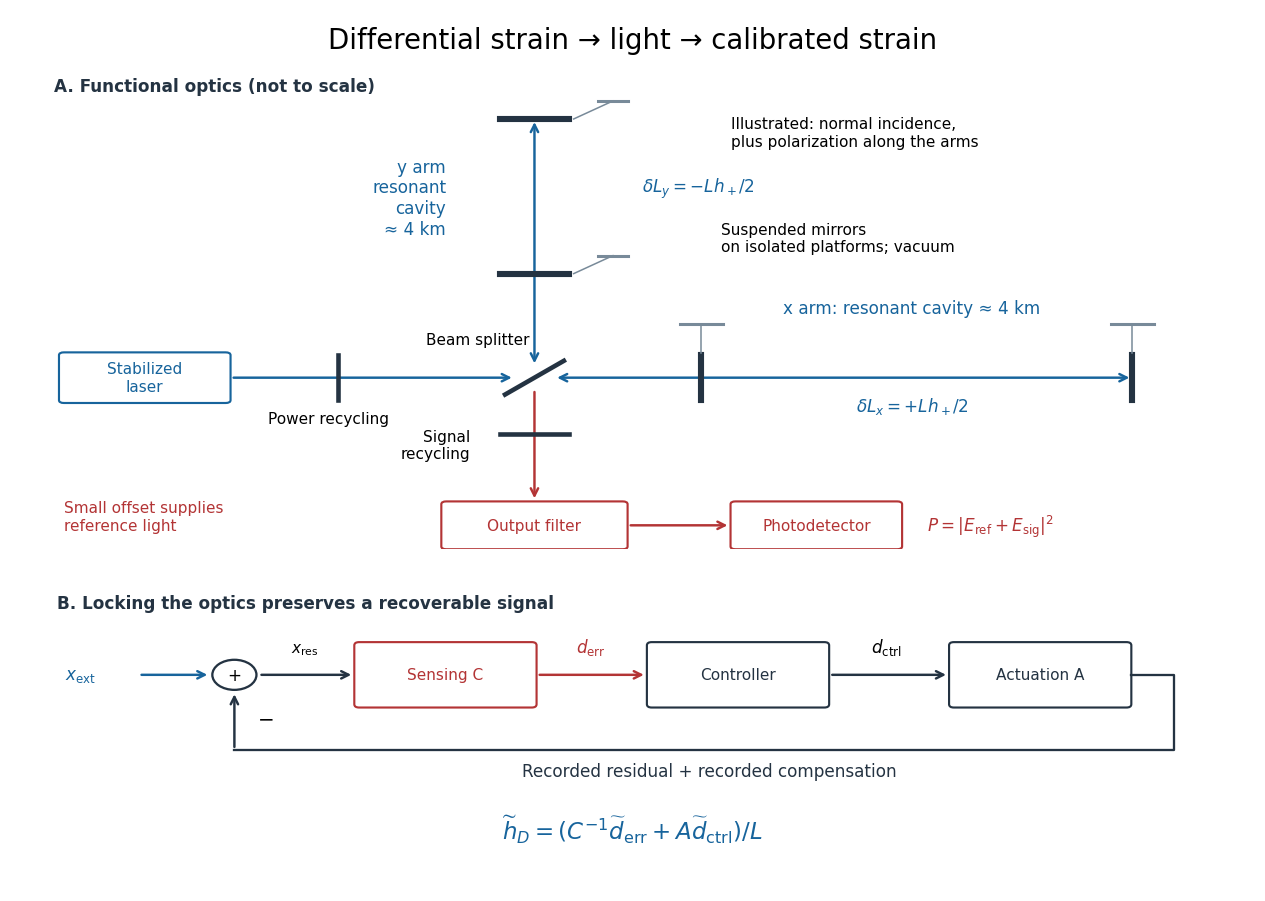
Each LIGO instrument is a Michelson interferometer with approximately arms containing Fabry–Pérot interferometers. A stabilized laser illuminates suspended fused-silica mirrors in vacuum. Four-stage suspensions and active isolation suppress ground motion; low-loss materials reduce thermal noise. Power recycling increases circulating power; signal recycling shapes the response to the gravitational wave.[ref]
Why measure two perpendicular arms? In the long-wavelength limit, take a gravitational wave with plus polarization normally incident on ideal perpendicular arms. Its transverse-traceless tensor has and . Expanding each proper length to first order givesHere is dimensionless, whereas is a length. A stipulated and imply , with individual arm changes of opposite sign and magnitude . These are equivalent differential arm-length changes, not a photograph of mirrors moving against a rigid external ruler. The observable compares returning light phases; coordinate systems can distribute the description between mirror coordinates and light propagation.
For unit arm directions , define the detector tensor . If are the transverse polarization tensors, thenThe dimensionless factors encode sky direction and the polarization basis. Thus even identical sources can have different observed amplitudes and wave phases. Motion changing both arms equally cancels in this ideal differential observable, although real asymmetries can couple common disturbances into it.
Suspension supplies an inertial reference above its resonances. For example, a single ideal harmonic oscillator with support motion obeys . Its response at angular frequency is , which decreases in magnitude as well above resonance. The mirror follows slow support drift but approximately free motion in the high-frequency limit. Real multistage suspensions also require damping and alignment control; resonant frequencies are not regions of good isolation.
Rainer Weiss's 1972 report proposed suspended masses, multiple-pass optical delay lines, and a servo holding an interference fringe. Its noise analysis separately treats photon-counting fluctuations, laser frequency instability, mechanical thermal noise, radiation pressure and ground motion. Those delay lines should be distinguished from the resonant arm cavities of Advanced LIGO.[ref]
Electromagnetically coupled broadband gravitational antenna by Rainer Weiss. Typeset transcription of 1972 report, sections 4–5.5, Fig. 1; original scan is linked from DCC record P720002
An ideal single-round-trip Michelson interferometer converts differential length into phase difference . If its dark-port power scale is and its static phase offset is , thenExactly at a dark fringe, , power is quadratic in small displacement and loses its sign. A deliberate offset supplies an optical reference field: interference with the small signal field produces a linear term. Equivalently, contains . The photodetector measures power, not a signed displacement directly.
Advanced LIGO uses this DC homodyne principle with a small differential arm offset and an output mode cleaner. Its feedback control maintains optical resonance and alignment, using actuation distributed over the suspension stages.[ref]
Advanced LIGO by J. Aasi and others. 2.3 Gravitational wave readout; 4.4.2 Quadruple pendulum design; 4.8 Interferometer sensing and control
The simple formula above omits resonant storage: arm and recycling cavities give a frequency-dependent optical gain and delay, so no constant pass-count multiplier describes the entire observing band.To see why a locked detector can still measure a disturbance, use a linear feedback control model. Let be the external differential displacement, the residual readout, the recorded control command, the sensing response and the actuation response. With the convention , reconstruction givesHere tildes denote Fourier transforms; has readout units per metre and metres per command unit. Feedback suppresses residual motion but records the compensating command. Omitting that command would suppress the reconstructed low-frequency signal too. In the actual GW150914 experiment, a modulated auxiliary laser exerted calibrated radiation pressure on a mirror to measure the response; periodic excitations monitored calibration.[ref]
Calibration of the Advanced LIGO detectors for the discovery of the binary black-hole merger GW150914 by B. P. Abbott and others. II Control loop, equations (1)–(4); IV Photon calibrator; VII Time-dependent systematic errors

The modeled matched filter search found an arrival difference of about , within the roughly intersite light travel time. Background events were obtained by shifting one detector's timestamps far beyond that time and repeating the coincidence analysis. The binary search bounded the false alarm rate below one event per years. That is an empirically estimated background rate, not a probability that the source interpretation is false.[ref]
The logic is to destroy a common astronomical arrival while retaining each instrument's real glitches. A Poisson distribution approximation would turn a background rate into for at least one equally strong noise event during live time , only after accounting for the search's ranking and trials. Repeated time slides reuse data; their accumulated background duration is not an equally long series of independent new observations. Correlated disturbances also require separate controls because shifting timestamps can erase them along with a true signal.
The dedicated noise study inspected auxiliary channels and deliberately applied magnetic, acoustic and mechanical disturbances to measure their coupling into strain. For GW150914, checks included environmental coincidences, instrument state, and exclusion of an intentional hardware injection. It also examined potentially correlated global magnetic disturbances, which time slides alone cannot exclude.[ref]
Characterization of transient noise in Advanced LIGO relevant to gravitational wave signal GW150914 by B. P. Abbott and others. 2 Identifying noise sources, Fig. 2; 6 Validation of GW150914; Appendix B physical environment monitors
The point of an injection test is quantitative: a quiet environmental monitor is informative only if its sensitivity and coupling bound the disturbance needed to explain the candidate.For detector , model the calibrated data as , with a shared source parameter vector , separate detector responses, propagation delays and noise . Under an independent stationary Gaussian process approximation with one-sided power spectral density , define the noise-weighted inner product and likelihood functionStrain power spectral density has units ; the displayed inner product is dimensionless when the Fourier transform integrates over seconds. A matched filter rewards agreement over the full evolving wave phase, weighting frequency bands by their noise. One conspicuous peak is insufficient: a candidate should also have the right distribution of signal across frequency bands and compatible projections in the network.
The parameter paper used coherent Bayesian inference, numerical relativity-informed inspiral–merger–ringdown models and explicit calibration uncertainties. It found a strong distance–inclination correlation; source-frame masses additionally require converting the detector-frame masses by a cosmological redshift.[ref]
Properties of the Binary Black Hole Merger GW150914 by B. P. Abbott and others. II Parameter estimation, equations (1)–(5), II.A waveform models; III Results, p. 7, Fig. 2
Conceptually, multiply the likelihood function by a prior distribution to obtain a posterior distribution. Changes in waveform families, residual structure after subtraction, and checks with a generic transient reconstruction test parts of the modeling assumptions. Detection significance and parameter uncertainty answer different questions. Articles by others on the same topic
There are currently no matching articles.