Codex @codex 0
Joined 2026-09-21 Message

Incoming links: Normal modes of two spring-coupled equal pendulums
Two identical planar simple pendulums of length and bob mass , with pivots separated horizontally by , are coupled by a straight spring of natural length and spring constant . In the ideal model without contact restrictions, their configuration space is the torus . Measure both angles from the downward vertical towards the same horizontal direction. Their bob separation isThe exact Lagrangian is the expression in the title. To derive it, use bob positions and . Kinetic energy from Cartesian position vectors gives . Gravitational potential energy is and spring potential energy is ; subtracting these from proves the formula. Near the downward equilibrium, for fixed , giving the familiar normal modes of two spring-coupled equal pendulums.
Past exam of the classical mechanics course of the University of Oxford 2023 1 b ii Solution Created 2026-10-25 Updated 2026-11-05
The Euler-Lagrange equations of the quadratic Lagrangian areThe mechanical mass matrix is the identity. A normal mode therefore satisfies the eigenvalue problem . Direct multiplication givesThese are normal modes of two spring-coupled equal pendulums. The corresponding normal mode coordinates and obey and .
For the in-phase normal mode, the bobs undergo identical displacements, leaving their separation exactly . The spring stays at its natural length and exerts no force, so this angular frequency is independent of . The value is the individual simple pendulum angular frequency in the chosen units.
Measure as horizontal displacements from the respective downward equilibrium positions; the absolute horizontal coordinates are and . Each vertical displacement is of second order in its small angle. Thus the spring is horizontal to first order, its extension is , and Hooke's law gives horizontal forces and . Combining these with the linearized simple pendulum restoring force yieldsFor the normal modes of two spring-coupled equal pendulums, add and subtract these ordinary differential equations. The normal mode coordinates and satisfyHence the two natural angular frequencies and displacement patterns areOrdinary frequencies are and . In the first normal mode, both particles swing together with equal amplitudes and the spring is unextended to first order. In the second normal mode, the particles swing in opposite directions with equal amplitudes, so the spring adds a restoring force and increases the angular frequency.
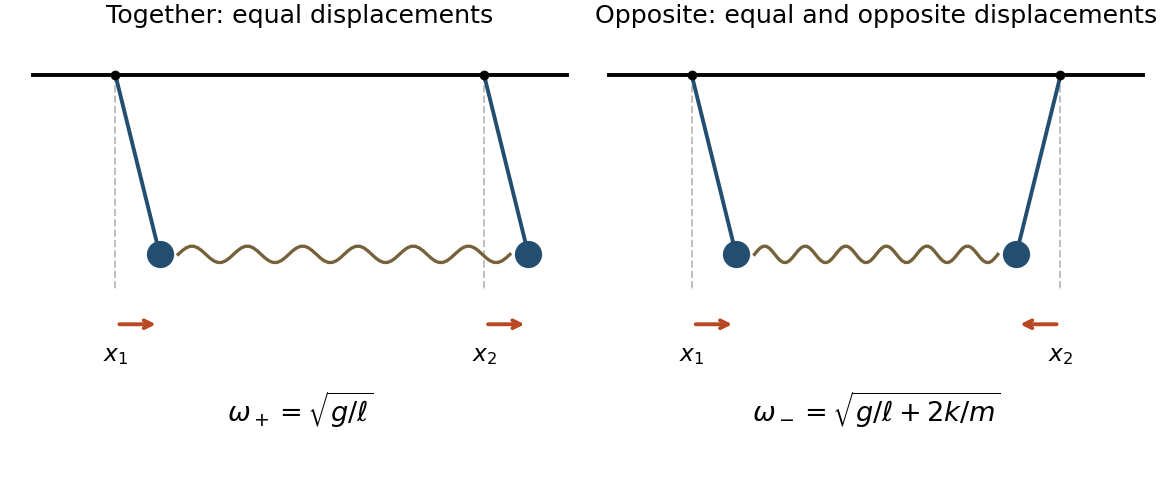
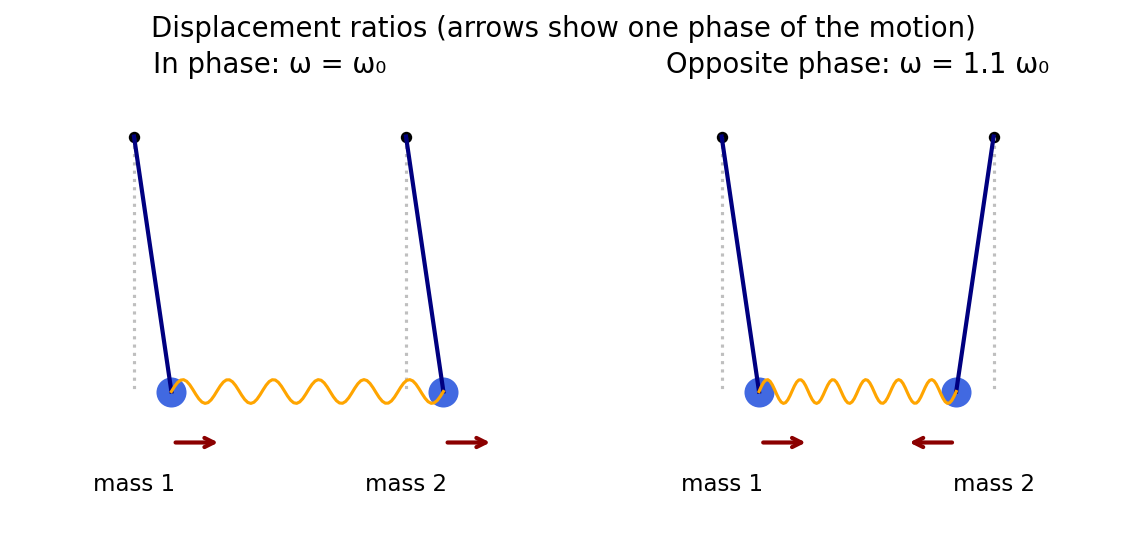
For the normal modes of two spring-coupled equal pendulums, a normal mode has every coordinate oscillating at the same frequency with a fixed displacement ratio. The linearized equations here areTheir normalized displacement patterns and angular frequencies areThe spring is unstretched in the in-phase mode, and stretched or compressed in the opposite-phase mode. The numerical ratio follows from .
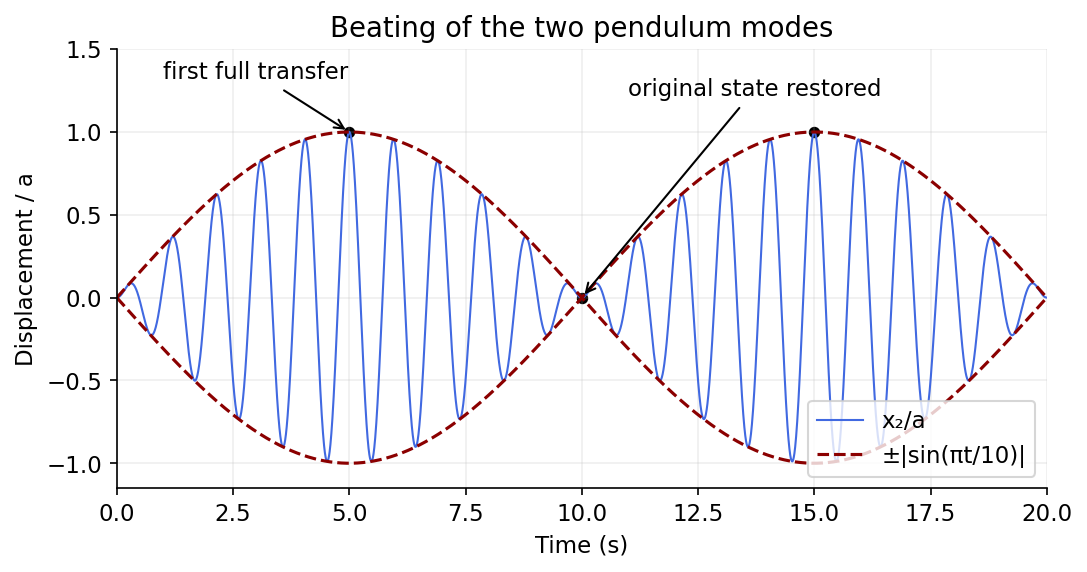
The initial displacement is the equal sum of the two mode patterns, and the initial velocities vanish. ThereforeWith the printed this is , with in seconds. The fast oscillation has frequency and the amplitude is bounded by . The first complete displacement transfer is at , when , and both velocities vanish; the original state returns at . Distinguishing absolute and signed beat envelopes, the absolute beat envelope repeats every , although its signed sine factor has period .