Choose an inertia unit and an angular speed unit , so physical principal moments of inertia are , physical angular velocity is , and normalized time is . The Euler equations for a torque-free rigid body becomeThis is a physically admissible ideal planar mass distribution: is the perpendicular axis theorem. A book of finite thickness need not have these exact ratios.
For an original comparison, start with angular velocity , or , respectively. With , the transverse Euclidean norm stays small about axes one and three, but becomes order one about axis two. For the intermediate-axis start, its linearization givesThe hyperbolic functions contain a growing exponential function with rate . Reducing tenfold delays reaching the same small transverse amplitude by approximately normalized time units, once the growing term dominates. That delays the instability. Once the transverse angular velocity is comparable to the main component, the linearization ceases to describe the motion.
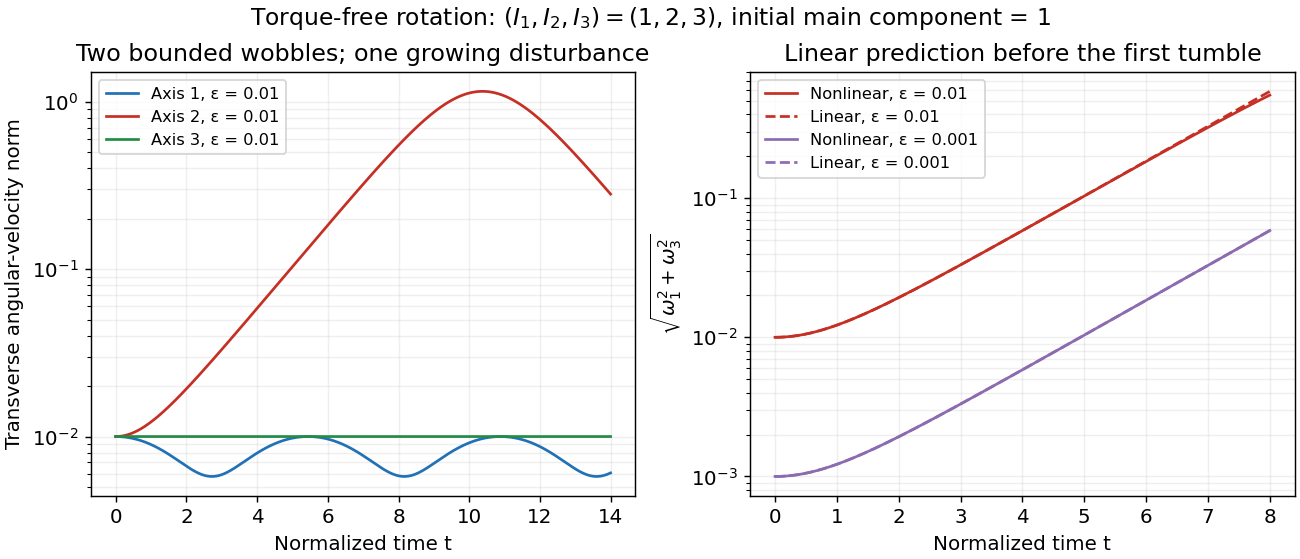
Small perturbations about the three principal axes
. Original Runge-Kutta method calculations for the normalized intermediate-axis model, with initial angular velocity , and . Left: transverse Euclidean norm relative to each initial principal axis. Right: full Euler equations for a torque-free rigid body compared with the displayed linearization, also using . Dashed curves are linear predictions. These are model curves, not measured throws. Details.
Articles by others on the same topic
There are currently no matching articles.