In principal body coordinates, Euler's equations express angular momentum balance as , with applied torque . Setting the torque to zero gives the following torque-free specialization.
The Euler equations for a torque-free rigid body conserve rotational kinetic energy and squared angular momentum,Their common level sets are the intersection of two ellipsoids in angular-velocity space.
Eliminating and between the conserved energy and squared angular momentum givesThe right-hand side is a quartic polynomial in ; its real turning points delimit the nutation of the body-frame angular velocity.
For principal moments and symmetry-axis unit vector , angular momentum and angular velocity obeyThus , , and the symmetry axis are coplanar at every instant.
For a rigid body with three distinct positive principal moments of inertia and zero external torque about its centre of mass, steady rotation about the first or third principal axis is Lyapunov stable in angular velocity, while rotation about the intermediate principal axis is unstable. Here steady rotation means in the principal body frame, with constant . A small sideways perturbation remains small about the extreme principal moments of inertia, but generically grows about the intermediate one. Stable does not mean that the wobble decays: without damping, there is no asymptotic stability. Coincident principal moments of inertia and a stationary body are excluded.[ref]
3. The Motion of Rigid Bodies. Classical Dynamics by David Tong, §3.4.3, The Asymmetric Top: Stability, printed pp. 57–58, equations (3.40)–(3.45)
No external torque is needed for a body to tumble. Conservation of angular momentum fixes in the fixed space frame, but the body can turn relative to , so its angular velocity components in the principal body frame change. The torque-free rigid-body invariants constrain this motion. A supported gyroscope with gravitational torque has different governing assumptions.
Choose an inertia unit and an angular speed unit , so physical principal moments of inertia are , physical angular velocity is , and normalized time is . The Euler equations for a torque-free rigid body becomeThis is a physically admissible ideal planar mass distribution: is the perpendicular axis theorem. A book of finite thickness need not have these exact ratios.
For an original comparison, start with angular velocity , or , respectively. With , the transverse Euclidean norm stays small about axes one and three, but becomes order one about axis two. For the intermediate-axis start, its linearization givesThe hyperbolic functions contain a growing exponential function with rate . Reducing tenfold delays reaching the same small transverse amplitude by approximately normalized time units, once the growing term dominates. That delays the instability. Once the transverse angular velocity is comparable to the main component, the linearization ceases to describe the motion.
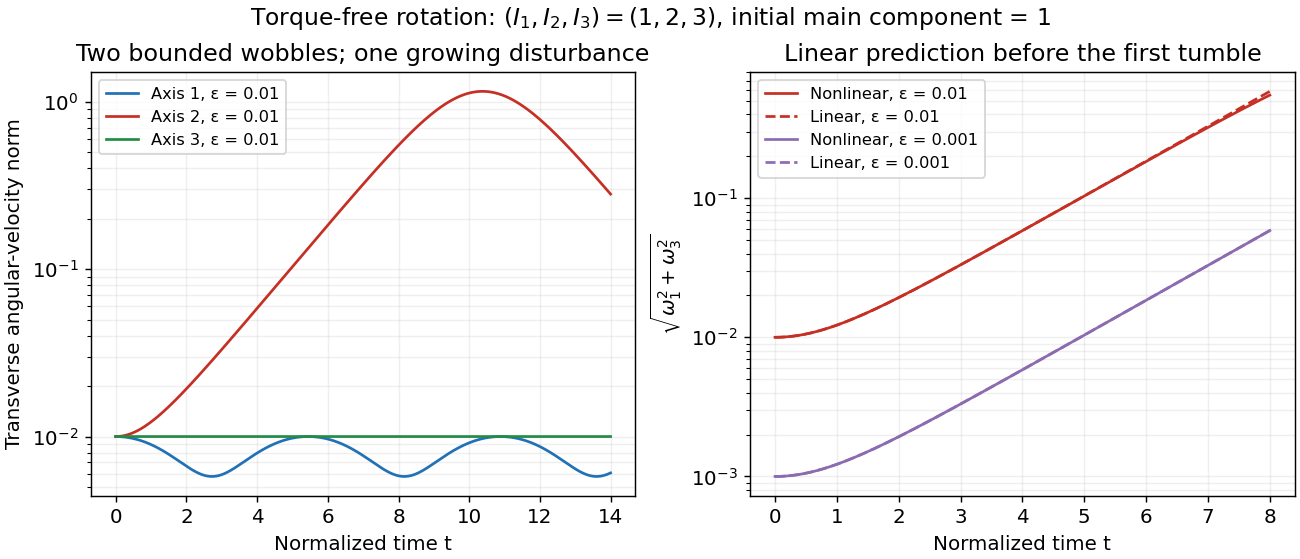
Small perturbations about the three principal axes
. Original Runge-Kutta method calculations for the normalized intermediate-axis model, with initial angular velocity , and . Left: transverse Euclidean norm relative to each initial principal axis. Right: full Euler equations for a torque-free rigid body compared with the displayed linearization, also using . Dashed curves are linear predictions. These are model curves, not measured throws. Details.A useful readout of a tumble is the alignment of the intermediate principal axis with the conserved angular momentum direction . In the principal body frame, write and . ThenA change from to means that the directed body axis has turned nearly relative to . It does not mean that reversed in the fixed space frame. The unsigned line through that principal axis hides this distinction, so a marked end matters in an actual demonstration.
For the normalized intermediate-axis model with , the rotational kinetic energy and squared angular momentum are and . Hence : this initial condition lies close to, but off, the intermediate-axis separatrix. An independent calculation evolves and a rotation matrix taking body components to space components. The intermediate principal axis crosses at normalized times approximately and , alternating long nearly aligned intervals with quicker reversals.
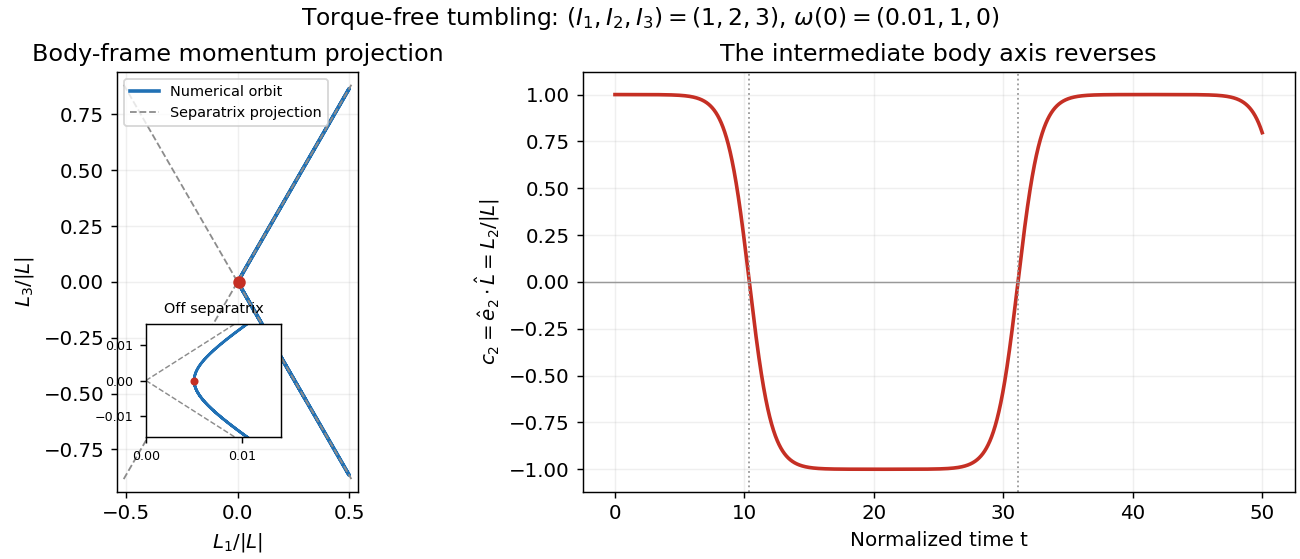
Torque-free reversals of a nearly aligned body axis
. Original independent Runge-Kutta method calculation in angular momentum and rotation matrix variables, starting with in the normalized intermediate-axis model. Left: body-frame orbit projected onto ; dashed lines are the intermediate-axis separatrix projections . The red point is the initial condition; the inset resolves its separation from those lines. Right: , with dotted lines at the first two zero crossings. The full angular momentum vector remains fixed in space. Details.Both calculations use step size without rescaling either invariant. Over , the tumbling calculation changes rotational kinetic energy and squared angular momentum by less than relative to their initial values. Reconstructing in the fixed space frame gives relative error below . Halving the step changes the body components and rotation matrix entries by less than . These checks distinguish physical tumbling from numerical drift. On the exact intermediate-axis separatrix, approach to an intermediate-axis rotation takes infinite time; the recurrent off-separatrix example here is different.
Clemson's documented apparatus is a book held tightly closed with several rubber bands. Toss it freely with spin about each principal axis in turn: the stated visual readout is steady orientation for the smallest and largest principal moments of inertia, but a flip before the catch for the intermediate one. The same book and the two extreme-axis throws provide comparison controls; the bands support the rigid body approximation by restraining the pages. This is a documented qualitative demonstration, not a measurement of .[ref]
Spinning Book by Clemson University. Spinning Book by Clemson University, physics lecture demonstrations, 1Q60.40: Purpose, Description and Equipment
For a rectangular book with length , width and thickness , where , a uniform mass model gives principal moments of inertia , and . The intermediate principal axis runs across the width through the centre of mass; the maximum is normal to the cover. A marked cover or end helps distinguish ordinary spin from reversal of a directed body axis.
Interpret only the interval after release and before the catch: hand contact applies torque, whereas gravity in a uniform gravitational field has zero net torque about the centre of mass because . Air resistance, page motion, an imperfect release and short flight limit the approximation. A toss ending before the perturbation grows need not reveal instability. Comparable initial angular speeds and flight durations would improve the comparison; these are suggested controls, not quantified controls reported by Clemson.
For , the transverse linear stability rates about steady rotation with signed component areAxes one and three have transverse eigenvalues and , producing bounded oscillations. Axis two has transverse eigenvalues , giving growing and decaying exponential functions. A neutral longitudinal perturbation corresponds to a small change of . Generic intermediate-axis disturbances contain a growing component; a precisely chosen decaying direction is exceptional. For the normalized intermediate-axis model with , the values are , and .
Proof outline: the linearization of the Euler equations for a torque-free rigid body about the third principal axis gives transverse perturbations obeyingand henceCyclic permutation gives the other rates. For nonlinear Lyapunov stability of the extreme rotations, use the torque-free rigid-body invariants: the conserved quadratic forms and have strictly positive transverse coefficients about axes one and three respectively. They bound transverse angular velocity, while bounds its longitudinal change near nonzero rotation. Imaginary transverse eigenvalues alone would not establish this nonlinear conclusion.[ref]
The practical lesson is to choose a stable principal axis when using rotation to maintain an instrument's pointing direction. Both extreme principal moments of inertia are stable in the ideal torque-free model; if internal damping lowers rotational kinetic energy while approximately preserving angular momentum, the minimum energy instead favors the largest principal moment of inertia. A control system must account for torque, changing mass distributions and flexibility before applying this ideal result.
On the invariant level , the torque-free rigid-body orbit is a separatrix joining the two intermediate-axis rotations. Withone orientation has ; the other components are constant multiples of .
Articles by others on the same topic



Euler's equations in the context of rigid body dynamics describe the rotation of a rigid body about a fixed point. When dealing with the motion of a rigid body, it's often useful to consider it as a system of particles and apply Newtonian mechanics. However, for rotating bodies, Euler's equations provide a more efficient approach.