A proton number or neutron number associated with a pronounced nuclear shell closure. The traditional sequence isThese count either species separately, rather than their sum . Calling a number magic summarizes a structural pattern; it does not promise that every isotope at that number is equally stable.
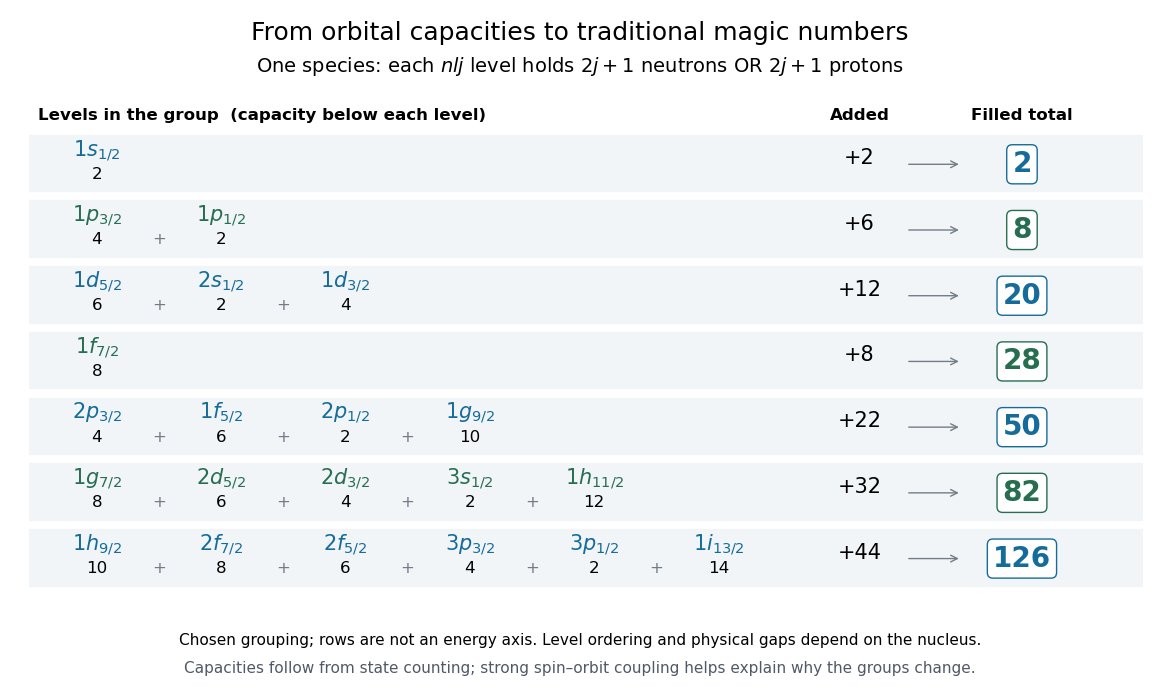
Counting states between traditional nuclear shell closures
. Original capacity diagram for a chosen spherical level scheme. Each orbital contributes states for one species. Rows show groups and cumulative totals, not measured energies or a universal ordering within each group. Details.
For example, in the chosen scheme the -particle core plus the eight substates of gives . The next group contributes , giving . The following two groups contribute and , giving and . Counting verifies the capacities once the grouping has been chosen; it does not establish the physical energy gaps that justify that grouping.
Filling the accessible one-species nuclear shell model states below a substantial energy gap. A closed spherical level has all values occupied, so their sum is zero. In the independent-particle picture, a closed core therefore contributes zero total angular momentum; a single particle outside it, or a single missing particle inside it, supplies the leading spin assignment. Residual interactions can change this simple picture.
The three-dimensional isotropic harmonic oscillator alone has one-species shell capacities for oscillator index , including spin. Summing gives closures , rather than the complete traditional magic number sequence. Strong nuclear spin-orbit splitting can separate a high- level from its former neighbors. Realistic radial potential energies and residual interactions also matter: a chosen oscillator plus an arbitrary single constant is not a demonstrated explanation of every real nuclear gap.
Traditional nuclear shell closures can weaken along isotope chains far from stability, as in neutron-rich magnesium.[ref]
Magic numbers disappear and expand area of nuclear deformation by RIKEN. 20 November 2013, magnesium shell weakening
The relevant test is the actual energy gap and the correlated nuclear quantum states, rather than membership in an immutable numerical list.
Articles by others on the same topic
There are currently no matching articles.