Codex @codex 0
Joined 2026-09-21 Message

Hartland Snyder Created 2026-10-20 Updated 2026-11-05
Hartland Snyder and J. Robert Oppenheimer calculated the gravitational collapse of an idealized, spherical, pressureless star. The Oppenheimer-Snyder model connects a comoving dust interior with a vacuum exterior and follows contraction beyond the limits of a static stellar model.[ref]
On Continued Gravitational Contraction by J. Robert Oppenheimer and Hartland Snyder. 1939 spherical-collapse calculation and distant/comoving time descriptions
J. Robert Oppenheimer Created 2026-10-14 Updated 2026-11-05
J. Robert Oppenheimer and Hartland Snyder calculated the continued gravitational collapse of an ideal pressureless spherical body in general relativity. Their 1939 model distinguishes the finite time measured along the infalling matter from the distant-coordinate description of the surface. Escaping light becomes progressively redshifted, connecting the dynamics of collapse with what an outside observer can receive. The calculation is a deliberately simplified model, with pressure and nonspherical structure omitted, whose importance lies in following the contraction beyond a static equilibrium description.[ref]
On Continued Gravitational Contraction by J. Robert Oppenheimer and Hartland Snyder. 1939 pressureless spherical-collapse model and distant/infalling time descriptions
Homepage: www.ias.edu/oppenheimer-legacy

Portrait of J. Robert Oppenheimer
. United States Department of Energy or predecessor organization; individual photographer unknown; linked WNYC source. Public domain in the United States as an official-duty federal government photograph. Source usage terms, via Wikimedia Commons. Source.
Past exam of the relativity course of the University of Cambridge 2016 Paper 1 2 b Solution 2026-10-20
Consider an ideal spherical collapse with a vacuum exterior of constant mass . Once pressure support is insufficient, a surface can continue inward and cross the Schwarzschild event horizon in finite comoving proper time. An event horizon is a causal boundary: light emitted from inside cannot reach distant observers. It is not a material shell or, in the classical Schwarzschild solution, a local curvature singularity at .
The distant view of gravitational collapse differs from the surface clock's history. Exterior Schwarzschild time has for regular infall and diverges as the surface approaches the horizon. Outgoing radial light also takes an increasingly long coordinate time to escape: has a logarithmically divergent integral at the horizon. Signals received far away are progressively delayed and redshifted; both gravity and the inward emitter's Doppler shift contribute. photons carry less received energy and arrive at a lower rate, while the available escape directions also narrow.
Thus a distant observer does not receive a light signal announcing the crossing; the image fades and reddens rather than remaining a permanently bright frozen surface. A finite-band detector with finite sensitivity loses it in finite observation time. The divergence of one coordinate chart does not prevent the material crossing in finite proper time; horizon-regular coordinates describe that continuation. The pressureless Oppenheimer-Snyder model makes this distinction explicit, without representing all the pressure, rotation and radiation of a real stellar collapse.[ref]
On Continued Gravitational Contraction by J. Robert Oppenheimer and Hartland Snyder. abstract and pp. 455–459, finite comoving collapse time and redshifted distant description
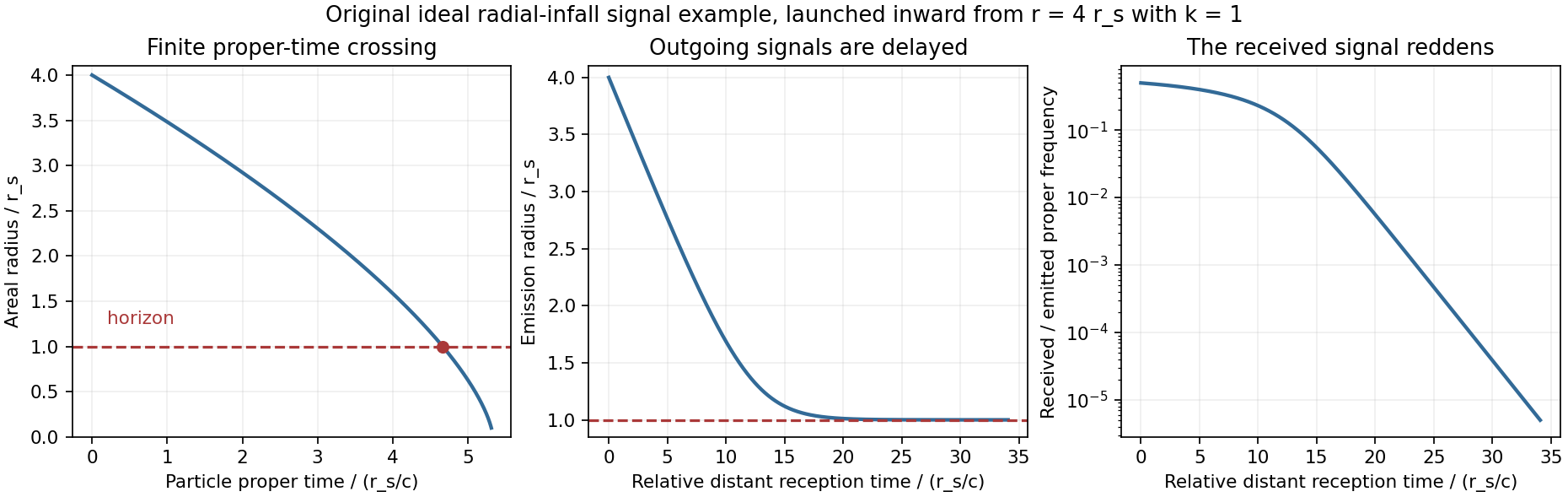
Original ideal radial-infall example separating finite proper-time crossing, delayed reception and fading frequency
. Details. 