A GaAs–AlGaAs semiconductor heterostructure confines electrons normal to the interface in a semiconductor quantum well. Remote modulation doping supplies a high-mobility two-dimensional electron gas. Negative split gates deplete it laterally, leaving a narrow quantum point contact with discrete transverse subbands and continuous longitudinal momentum. A single occupied subband requires transverse excitation gaps larger than thermal and applied-bias energies.
Take and count one spin-resolved channel. In a length , right-moving states have density ; each contributes charge current . ThusThe second expression is the right reservoir's left-moving contribution expressed in the same left-to-right conventional-current sign. Since ,The limit needs and ballistic transport. Velocity cancels the one-dimensional state density. Two degenerate spin channels give , not an extra factor hidden in the quoted single-channel result.
For elastic phase-coherent scattering, expand each incident flux-normalized mode in outgoing lead modes. Its transmitted fraction is ; sum over all open outgoing and occupied incident . Linearizing the reservoir occupations gives the Landauer formulaThe source's denotes this amplitude matrix, not temperature or a probability matrix. Flux normalization is essential: ordinary wave-amplitude ratios need a velocity factor. Reservoirs equilibrate, contacts supply incoming Fermi distributions, and inelastic processes within the channel are neglected. Spin is included among channel labels. At , only transmissions at contribute; perfect channels each add one quantum. This is a two-terminal conductance including contact resistance, even with no internal backscattering.
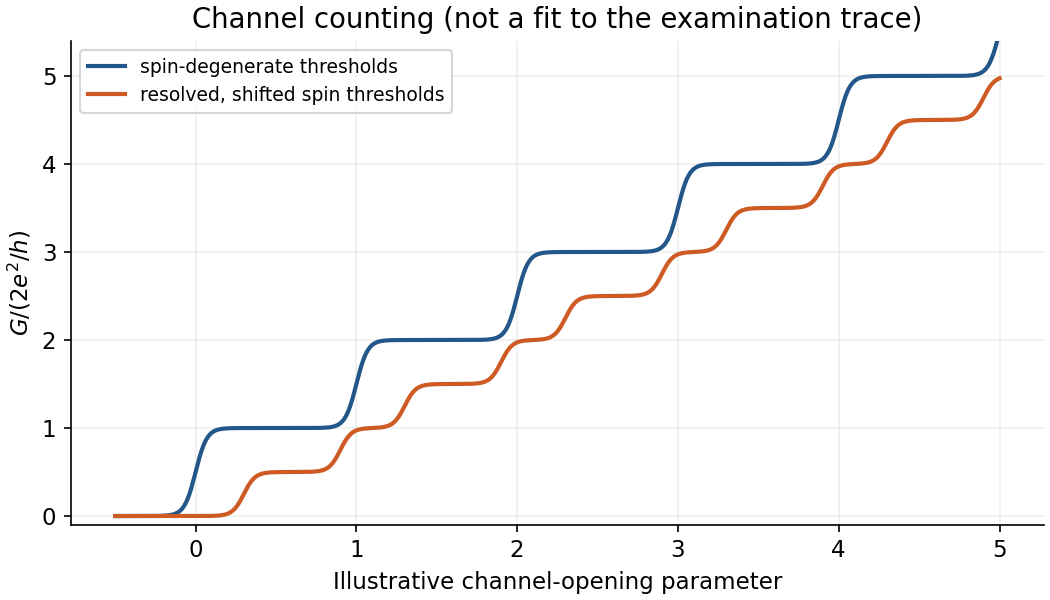
Trace I has steps near integer as less-negative gate voltage opens successive spin-degenerate subbands. At the printed parallel field , Zeeman splitting separates the two spin thresholds, allowing approximately half-sized steps in the plotted units; the onset also shifts. Thermal broadening, imperfect transmission and unresolved thresholds round the plateaux. A parallel field primarily resolves spin in the ideal thin-interface model; finite layer thickness can also shift subband energies. The plot alone does not determine a unique effective factor or microscopic disorder model.

Articles by others on the same topic
There are currently no matching articles.