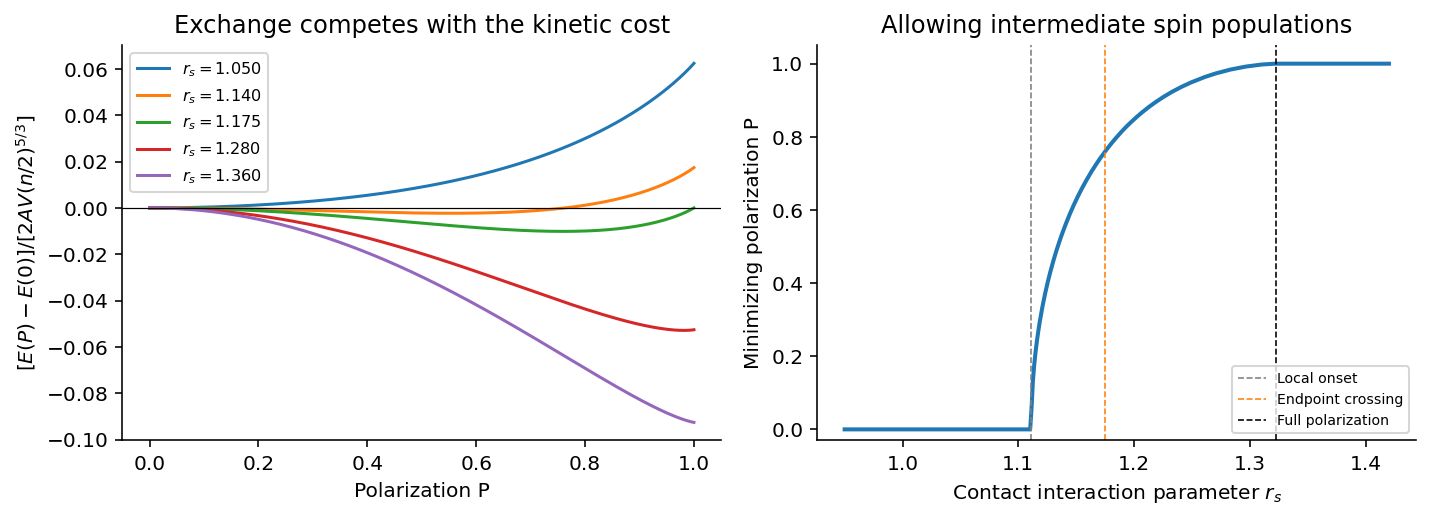
At fixed total density, the unpolarized and fully polarized candidate energies arePolarization increases the kinetic energy because one spin species must occupy a larger Fermi sphere, but gains negative exchange energy. The fully polarized candidate wins this endpoint comparison ifUsing the defined givesThus the specified two-state comparison indeed predicts a polarized state below the unpolarized state's energy for .
The endpoint and continuous polarization thresholds of a contact electron gas are different. To check the actual onset within the same uniform Hartree-Fock model, allow to vary continuously. In units ,The unpolarized state loses local stability already at . Full polarization becomes the minimizing endpoint only when , or . Between those values the optimum is partly polarized. Consequently is the requested endpoint crossing, not the exact onset of spontaneous polarization after all spin populations are allowed.

Articles by others on the same topic
There are currently no matching articles.