The Hartree-Fock method minimizes the expectation of an interacting-electron Hamiltonian over normalized Slater determinants of orthonormal one-particle spin orbitals. It is a variational, self-consistent mean-field approximation. The determinant enforces fermionic antisymmetry exactly within that class, while each orbital responds to the mean charge density and a nonlocal exchange operator generated by the occupied orbitals.
For an electron gas, this accounts for kinetic pressure, the average electrostatic field, same-spin exchange and the associated exchange hole, and possible spin polarization. It does not account for general dynamical electron correlation, such as the correlated avoidance of opposite-spin electrons, and cannot capture all screening or collective fluctuations merely by optimizing one determinant. Uniform plane waves are an additional restriction, not the definition of Hartree-Fock itself.
In the energy functional, the one-body term is the sum of electron kinetic energy and ionic-potential energy. The direct two-body term is the Hartree energy: the classical interaction of the mean electron density with itself. Its factor avoids counting every pair twice. The negative Fock term comes from exchanging the two indistinguishable electron labels in the antisymmetric state. For a spin-independent interaction, spin orthogonality makes this exchange act only between equal spin components. For an orbital interacting with itself, direct and exchange contributions cancel exactly; the exchange term removes the spurious one-electron self-interaction. Ionic background terms and their prescribed cancellation must be included consistently with the direct term.
Use normalized plane-wave spin orbitals and fill a separate Fermi sphere for each spin species. Each spin state counts once, soIts kinetic energy per volume isThe spin-independent contact interaction has uncancelled direct energy , with . By the imposed background assumption this direct contribution cancels. For the Fock term the contact delta function sets the two spatial positions equal; its spin factors then select equal spins. The local one-body density matrix for each spin has diagonal value , givingCombining these results gives the contact-interaction Hartree-Fock spin energyHere has units of energy times volume. The result is the model with the stated background subtraction; an isolated contact-interacting gas without that subtraction retains its direct contribution.
For the unpolarized gas write . The positive direct Hartree energy before background cancellation and the kinetic energy areTheir ratio is thereforeThis compares the separate direct and kinetic terms. The net Hartree-plus-background contribution after the stipulated cancellation is zero, so it would be incorrect to interpret as that residual contribution divided by . The exchange-energy magnitude in the unpolarized state is , not .
At fixed total density, the unpolarized and fully polarized candidate energies arePolarization increases the kinetic energy because one spin species must occupy a larger Fermi sphere, but gains negative exchange energy. The fully polarized candidate wins this endpoint comparison ifUsing the defined givesThus the specified two-state comparison indeed predicts a polarized state below the unpolarized state's energy for .
The endpoint and continuous polarization thresholds of a contact electron gas are different. To check the actual onset within the same uniform Hartree-Fock model, allow to vary continuously. In units ,The unpolarized state loses local stability already at . Full polarization becomes the minimizing endpoint only when , or . Between those values the optimum is partly polarized. Consequently is the requested endpoint crossing, not the exact onset of spontaneous polarization after all spin populations are allowed.
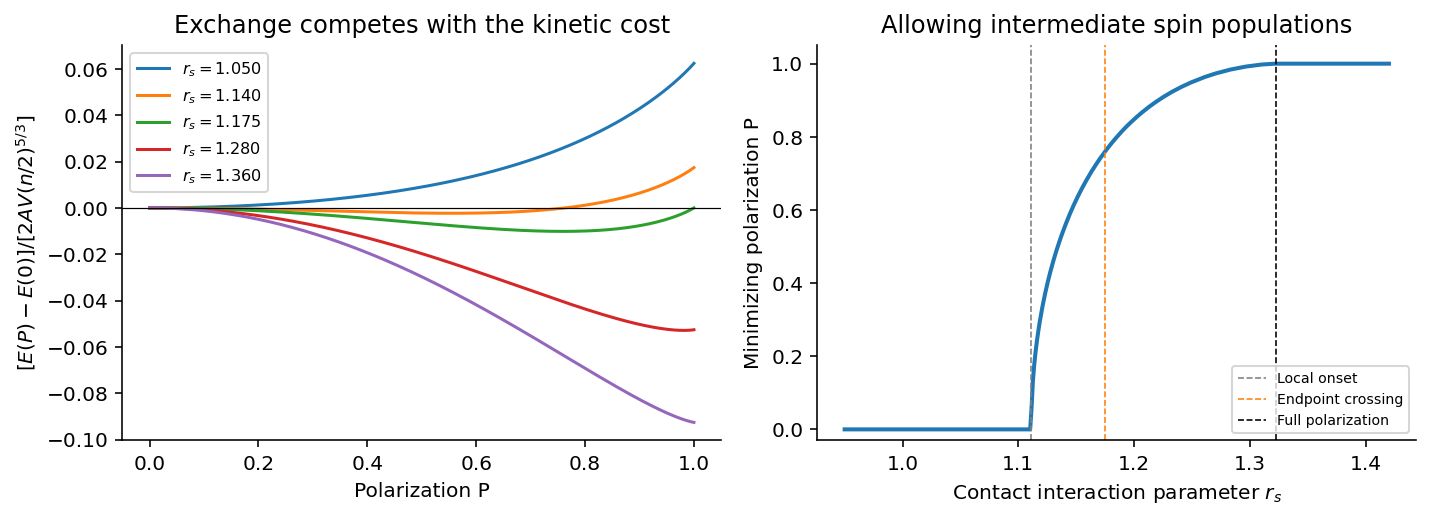
Contact-interaction spin energies showing partial polarization between the local onset and full saturation
. Details. The central limitation is that a Hartree-Fock electron gas includes exchange but omits the correlation energy that is not representable by one determinant. Opposite-spin electrons can lower their repulsion by avoiding one another in a correlated unpolarized state. Hartree-Fock misses that avoidance while retaining the exchange advantage of aligned spins, so it need not place a magnetic instability at a reliable interaction strength. The relevant energy differences between competing spin states can be much smaller than their total energies. Correlation calculations of the electron gas explicitly address this competition.[ref]
Ground State of the Electron Gas by a Stochastic Method by D. M. Ceperley and B. J. Alder. Author manuscript, physical PDF pages 4–8: competing phases, correlated trial functions and energy differences
There are further model restrictions. A constant contact coupling discards the momentum dependence of the Coulomb interaction and the resulting nontrivial screening. Real materials have a lattice, band structure and material-dependent effective interactions. Spatial magnetic textures or other competing states are excluded by a comparison restricted to uniform Fermi spheres. Even before those changes, part c's two endpoints do not find the continuous polarization onset.
The symbol also needs care. Here it is an energy ratio proportional to . The usual Dimensionless Wigner-Seitz radius of a three-dimensional Coulomb electron gas is , proportional to . They are not the same density parameter. A quoted experimental value of the latter cannot be compared numerically to without a model-specific mapping. The contact interaction, missing correlations, restricted variational class and parameter convention prevent the number from being a quantitative experimental prediction. The paper supplies no particular experimental threshold, so none is invented here.
Landau quasiparticles describe the long-lived low-energy excitations of an interacting normal Fermi liquid. Starting from a free Fermi gas, imagine switching on interactions without changing the phase or destroying the one-to-one labelling of low-energy states. The resulting excitation carries the quantum numbers of a dressed particle but has a renormalized energy and interactions with other excitations. Its microscopic wavefunction need not resemble a bare electron state. The occupied momenta define a Fermi surface, and the quasiparticle energy measured from the chemical potential vanishes on that surface.
The Landau quasiparticle energy functional expresses the change near equilibrium in terms of occupation changes:Differentiation gives the energy of one quasiparticle in the distorted distribution. This is a phenomenological expansion around the true interacting ground state, not the assertion that its total energy equals that of independent particles. For an isotropic system, spin-symmetric and spin-antisymmetric components of are expanded in Legendre polynomials. Multiplication by the appropriate Fermi-surface density of states defines dimensionless Landau parameters . The original formulation relates a change in the distribution to the energy shift.[ref]
On the Theory of the Fermi Liquid by Lev Davidovich Landau. Page 70, quasiparticle interaction and distribution variation
Pauli blocking makes the low-energy excitations sharp. The phase space for a quasiparticle to scatter while creating another particle–hole pair shrinks as the Fermi surface is approached, giving the regular three-dimensional low-energy Fermi-liquid quasiparticle lifetimeThus at zero temperature its width is small compared with its excitation energy. The single-particle spectral function has a pole with quasiparticle residue , generally less than one, and an incoherent remainder. In a conventional Fermi liquid the occupation distribution has a discontinuity of height at the Fermi surface, rather than a unit free-particle step.
For an isotropic three-dimensional system, define to include both spins. The quasiparticle density of states determines the low-temperature electronic heat capacity, . In the usual Landau-parameter normalization, the spin response is modified by and the compressibility by . In a Galilean-invariant continuum, ; that particular relation must not be imposed unchanged on a crystal band. A denominator approaching zero signals a possible instability of the assumed normal state.
The same interaction functional and a kinetic equation describe collective zero sound when the excitation frequency exceeds the collision rate. Ordinary first sound is the collision-dominated hydrodynamic limit. The theory organizes thermodynamics, response and transport through a small set of measured effective parameters while explaining why interactions coexist with long-lived fermionic excitations. It is not applicable without qualification in phases where the Fermi-liquid quasiparticle pole disappears or a gap opens over the relevant Fermi surface.
A Wannier-Mott exciton is a bound conduction-band electron and valence-band hole whose envelope extends over many lattice cells. That large radius permits an effective mass description and dielectric screening of the electron–hole attraction. With electron and hole masses , define reduced mass and center-of-mass mass . The bulk relative-motion Hamiltonian is hydrogenic with an appropriate relative permittivity :A semiconductor quantum well confines the electron and hole perpendicular to the plane while leaving approximately free in-plane center-of-mass motion. If the well width is small compared with the bulk exciton Bohr radius, their relative motion becomes quasi-two-dimensional. The ideal zero-width, same-dielectric limit isIts ground-state binding is , compared with in three dimensions, and the ground envelope decays on the scale . Stronger binding follows because confinement prevents the pair from separating in the third direction.
For a finite-width quantum-well exciton, average the Coulomb attraction over the normalized electron and hole confinement envelopes:This smooths the strict planar singularity and changes the binding. The ideal factor four is a useful reference, not a universal value for every real well. Finite barriers, dielectric mismatch, several confinement subbands and nonparabolic valence bands can require a coupled treatment.
Optical absorption creates a nearly zero in-plane center-of-mass wavevector exciton. For the lowest confinement subbands, its line lies approximately atThe discrete bound-state peaks occur below the free electron–hole continuum. Dipole-allowed envelope states have nonzero relative wavefunction at zero separation; the absorption strength also contains the confinement overlap . Confinement can increase the overlap and the binding, making excitonic optical structure more prominent. A perpendicular electric field shifts and separates the confinement envelopes, changing the transition energy and usually reducing their optical overlap: this is the quantum-confined Stark effect.
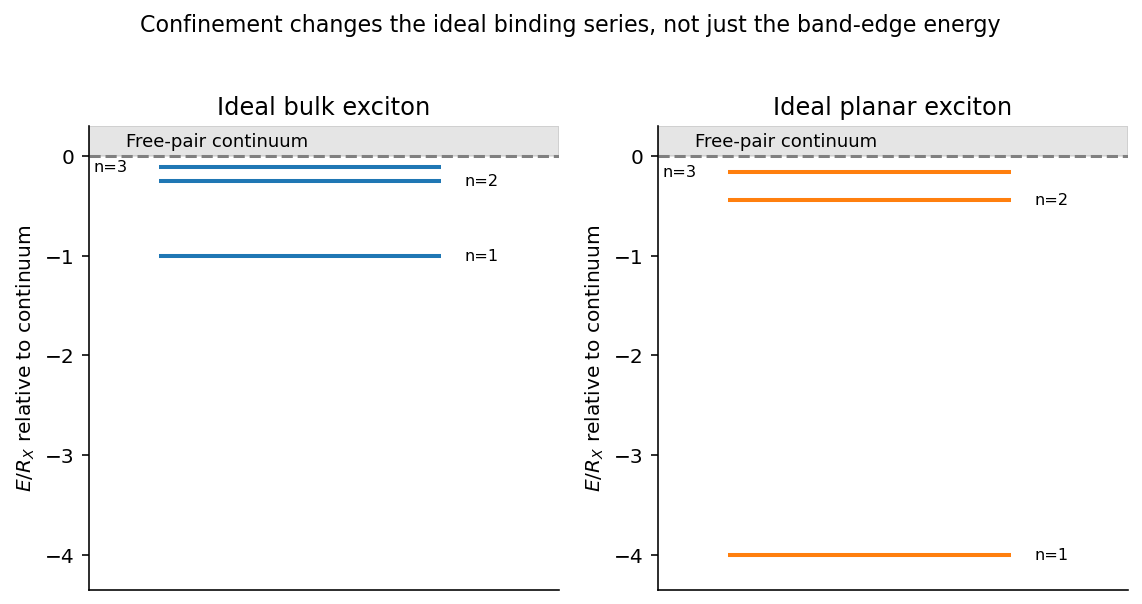


Quantum wells tune both the continuum threshold and the bound-state energy; an optical line shift is not automatically a change in binding alone. The hydrogenic envelope model requires a Wannier-sized state, rather than an exciton localized to one lattice cell.
Experimental tests of BCS theory compare several properties of the same superconducting state. In the conventional weak-coupling setting, phonon-mediated attraction pairs opposite momenta and spins, and the BCS quasiparticle spectrum is . Agreement with a single energy scale and its temperature dependence is more discriminating than observing zero resistance alone.
The superconducting isotope effect tests the lattice's role. Replacing one isotope by another changes ionic masses while leaving the chemical valence nearly unchanged. Phonon frequencies scale approximately as , so a weak-coupling phonon mechanism predicts with when other parameters stay fixed. The shift was measured in mercury before the microscopic pairing theory was developed.[ref]
Isotope Effect in the Superconductivity of Mercury by Emanuel Maxwell. 1950 primary report, transition-temperature comparison of mercury isotopes
Deviations from can result from Coulomb, anharmonic and strong-coupling effects; the isotope observation supports lattice-mediated pairing without uniquely proving every assumption of the simplest model.Thermodynamic measurements test the gapped excitations and condensation energy. An isotropic fully gapped superconductor has exponentially small low-temperature electronic heat capacity, rather than the normal linear law. At the transition the weak-coupling BCS thermodynamic ratios areHere means the electronic contribution after subtracting the lattice background. The gap closes at , and the same framework predicts the temperature dependence of penetration depth and thermodynamic critical field. These quantities were quantitative comparisons in the original theory.[ref]
Theory of Superconductivity by John Bardeen and others. Abstract and thermodynamic discussion: energy gap, specific heat and penetration depth
Electron tunnelling measures the excitation spectrum more directly. A normal-metal–insulator–superconductor junction has, at sufficiently low temperature and nearly constant tunnelling matrix element, proportional to the superconducting density of states at :The suppression below the gap and enhancement at its edges test the BCS electronic density of states. Giaever's thin oxide-barrier junction measurements established such energy-gap structure.[ref]
Energy Gap in Superconductors Measured by Electron Tunneling by Ivar Giaever. Physical Review Letters 5, 147–148; tunnel-current and differential-conductance measurements
For a junction between two superconductors the threshold involves the sum of their gaps, so it must not be read as a normal-metal single-gap spectrum without accounting for the two electrodes.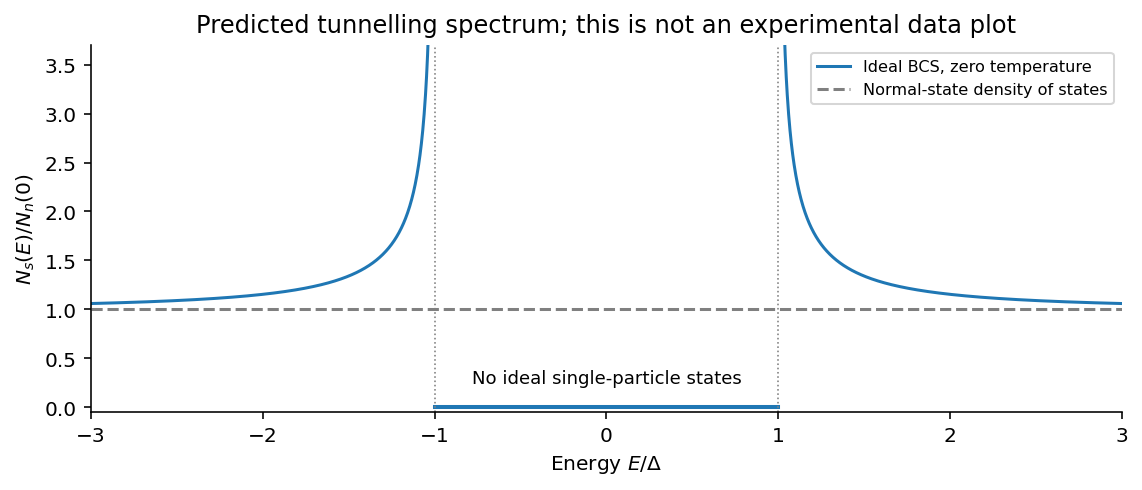
Ideal BCS density of states illustrating gap-edge spectroscopy; model prediction, not experimental measurements
. Details. 
Nuclear spin-lattice relaxation supplies a phase-coherence-sensitive test. In the conventional s-wave case, the Hebel-Slichter coherence peak just below is followed by a falling rate at lower temperature. Density of states alone is not enough: the BCS coherence factors enter the transition matrix elements. The contrast between nuclear relaxation and ultrasonic attenuation was explained using the paired state, unlike a simple two-fluid population model.[ref]
Nuclear Spin Relaxation in Normal and Superconducting Aluminum by L. C. Hebel and Charles Pence Slichter. Abstract: field-cycling method and comparison of nuclear relaxation with ultrasonic absorption
Finally, magnetic flux quantization in units and Josephson effects support a coherent charge- condensate. Those observations establish pairing and phase coherence more broadly; their existence alone does not specify a phonon mechanism or an isotropic weak-coupling gap. The converging isotope, spectroscopic, thermodynamic and coherence-factor tests support conventional BCS superconductivity, with explicit limits to its simplest universal ratios.
The first term assigns energy to occupying the localized orbital at site . The hopping term moves an electron between neighbouring sites, producing kinetic delocalization and band dispersion; Hermitian conjugate hops make the Hamiltonian Hermitian. The final term costs only when both spin states occupy the same local orbital. This is a Hubbard model with an on-site Coulomb penalty, not a classical interaction between magnetic dipoles.
At one electron per site and large , a real hop is energetically costly, but a virtual hop into a doubly occupied intermediate state is possible. Opposite-spin states can exploit these virtual processes and lower their energy, while parallel spins cannot occupy the same one-orbital site. The resulting singlet–triplet splitting produces antiferromagnetic Hubbard kinetic exchange.
There is a terminology qualification. The paper calls this overlap-mediated process “direct exchange” because the hopping is directly between neighbouring magnetic orbitals. In the stricter distinction between direct Coulomb exchange versus kinetic exchange, the displayed Hamiltonian omits an explicit intersite Coulomb exchange integral. The antiferromagnetic mechanism derived below is kinetic exchange; a genuine intersite direct exchange term is separate and can compete with it. This distinction also separates the model from ligand-mediated superexchange in part f.
Expand the field operator in orthonormal localized orbitals, . For a one-electron continuum Hamiltonian , projection givesThe coefficient in the displayed lattice Hamiltonian is . Thus the projected hopping matrix element and sign convention requireOrthogonality states ; it does not imply for a spatially varying potential. If the off-diagonal potential is assumed zero, for example when it is a constant, the hopping coefficient is . This is the kinetic integral requested by the paper, but it equals under the paper's own leading-minus convention. A convention writing the hopping term with a plus sign would instead call itself .
TODO: the printed positive equality for requires a missing assumption about and a consistent hopping-sign convention. It does not follow from orthogonality alone. The general projected relation above is the result supported by the supplied information. Rephasing an orbital changes both and the coefficient of the corresponding operator together; it does not remove this algebraic sign mismatch in a fixed convention. The spectrum in the remaining two-site calculation depends on , so the missing convention does not prevent solving those parts.
Fix canonical single-particle order and write the occupation ket as . The six states in the printed order are , , , , , . The last state is double occupancy on site 2.
For a fermionic raising and lowering operator acting on mode , the sign is , and annihilation requires that mode occupied while creation requires it empty. Starting from the second basis state, the hop that reaches the last state isIt therefore contributes . Starting from the third state instead,because the occupied mode precedes . The Hamiltonian's leading makes . Finally , so . No other displayed basis state reaches in one allowed hop. These signs verify the three nonzero entries without assigning distinguishable-particle hopping signs to fermions.
Use for the six printed basis vectors. The three singly occupied triplets areEach has energy zero: either Pauli exclusion prevents hopping to double occupancy or the two contributions cancel. DefineThe state has energy . In the subspace the Hamiltonian is , withFor , the fourth low-energy eigenstate is the normalized singletwhere . Its energy isThe four lowest energies are to leading order, with the singlet and triplets just given. The upper pair lie near and .
The low-energy Hamiltonian can be writtenusing dimensionless spin-half operators. It places the singlet below the triplet by , hence favors antiferromagnetic alignment. A lattice of such bonds can support antiferromagnetism, although its ordering pattern also depends on geometry and competing couplings. The physical energy gain comes from virtual charge fluctuations, not from a permanent double occupancy in the large- limit.
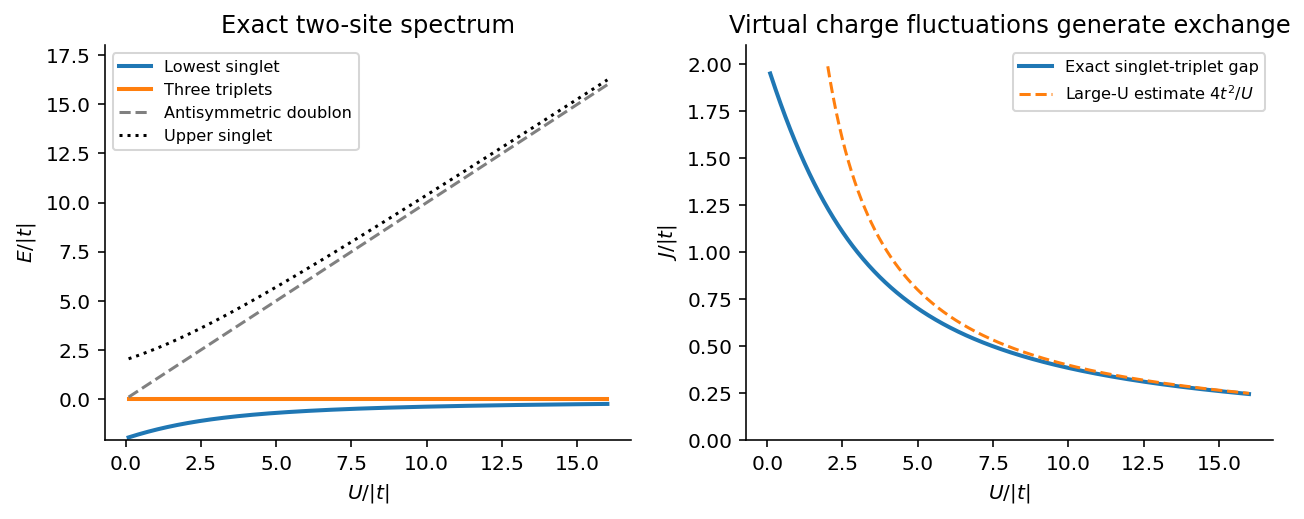
Exact singlet-triplet spectrum of the two-site repulsive Hubbard model and the large-U exchange scale
. Details. 
An overlap estimate must use nearest magnetic-ion separations. For the face-centered cubic lattice of Mn, ; for the body-centered cubic lattice of Fe, . The supplied radial functions have inverse decay lengths . Their intersite overlap therefore contains approximately , up to polynomial and angular factors. The decisive exponent difference isThe exponential orbital-tail estimate of exchange thus gives a hopping suppression approximately before polynomial corrections. Keeping the supplied radial prefactor in a midpoint overlap proxy givesThis proxy is not an evaluated hopping integral, but confirms that the polynomial factors do not undo the exponential loss. If comparable Coulomb denominators and nonexponential prefactors are assumed, a kinetic-exchange scale proportional to is suppressed by roughly –. Direct intersite Coulomb exchange likewise contains products of the small tails. Coordination-number differences cannot compensate for many orders of magnitude.
By contrast, the measured ordering-temperature ratio supplied in the question is , not an exponentially tiny number. Within this overlap model, direct Mn–Mn exchange cannot explain MnO's substantial magnetic ordering scale by extrapolating the Fe mechanism. Another exchange path is required.
This is an order-of-magnitude argument, not an exact relation between an itinerant Curie temperature and a localized-spin Néel temperature. The hydrogenic functions use the printed bare values; actual solid-state orbitals are screened and hybridized. Their literal absolute exchange scales should not be treated as quantitative predictions for Fe or MnO.
Use an oxygen-mediated superexchange path between two magnetic metal orbitals. A minimal one-active-orbital three-site charge-transfer superexchange Hamiltonian is clearest in a hole representation:Here describes a metal hole, a ligand hole, and is the energy needed to create the virtual ligand hole. The low-energy configuration has one hole on each metal orbital and no ligand hole, corresponding to a filled bridging ligand orbital in the electron picture. and penalize double hole occupancy on the corresponding sites.
Virtual metal–ligand hopping transfers charge through oxygen without producing a real mobile carrier. Eliminating the ligand gives an effective metal–metal hopping . Combining it with the large metal repulsion givesA ligand double-occupancy channel adds a contribution of the same sign for the simple half-filled straight-bond model, often organized as . The precise coefficients depend on the orbitals and hopping conventions; the essential mechanism is virtual charge transfer plus spin-selective access to intermediate states. The effective spin interaction favors antiparallel alignment while the material can remain insulating.
For MnO's rock salt structure, the strong approximately Mn–O–Mn path joins next-nearest Mn sites. It is not the nearest fcc Mn–Mn separation used in the direct-overlap estimate of part e. The oxygen-mediated path avoids relying on the tiny direct overlap of the two distant 3d tails. A realistic model includes several Mn 3d orbitals, Hund coupling and the high-spin Mn ion; the single-orbital Hamiltonian above isolates the antiferromagnetic exchange channel. Approximately paths and different orbital occupancies need not have the same sign.
Articles by others on the same topic
There are currently no matching articles.