The Hartree-Fock method minimizes the expectation of an interacting-electron Hamiltonian over normalized Slater determinants of orthonormal one-particle spin orbitals. It is a variational, self-consistent mean-field approximation. The determinant enforces fermionic antisymmetry exactly within that class, while each orbital responds to the mean charge density and a nonlocal exchange operator generated by the occupied orbitals.
For an electron gas, this accounts for kinetic pressure, the average electrostatic field, same-spin exchange and the associated exchange hole, and possible spin polarization. It does not account for general dynamical electron correlation, such as the correlated avoidance of opposite-spin electrons, and cannot capture all screening or collective fluctuations merely by optimizing one determinant. Uniform plane waves are an additional restriction, not the definition of Hartree-Fock itself.
In the energy functional, the one-body term is the sum of electron kinetic energy and ionic-potential energy. The direct two-body term is the Hartree energy: the classical interaction of the mean electron density with itself. Its factor avoids counting every pair twice. The negative Fock term comes from exchanging the two indistinguishable electron labels in the antisymmetric state. For a spin-independent interaction, spin orthogonality makes this exchange act only between equal spin components. For an orbital interacting with itself, direct and exchange contributions cancel exactly; the exchange term removes the spurious one-electron self-interaction. Ionic background terms and their prescribed cancellation must be included consistently with the direct term.
Use normalized plane-wave spin orbitals and fill a separate Fermi sphere for each spin species. Each spin state counts once, soIts kinetic energy per volume isThe spin-independent contact interaction has uncancelled direct energy , with . By the imposed background assumption this direct contribution cancels. For the Fock term the contact delta function sets the two spatial positions equal; its spin factors then select equal spins. The local one-body density matrix for each spin has diagonal value , givingCombining these results gives the contact-interaction Hartree-Fock spin energyHere has units of energy times volume. The result is the model with the stated background subtraction; an isolated contact-interacting gas without that subtraction retains its direct contribution.
For the unpolarized gas write . The positive direct Hartree energy before background cancellation and the kinetic energy areTheir ratio is thereforeThis compares the separate direct and kinetic terms. The net Hartree-plus-background contribution after the stipulated cancellation is zero, so it would be incorrect to interpret as that residual contribution divided by . The exchange-energy magnitude in the unpolarized state is , not .
At fixed total density, the unpolarized and fully polarized candidate energies arePolarization increases the kinetic energy because one spin species must occupy a larger Fermi sphere, but gains negative exchange energy. The fully polarized candidate wins this endpoint comparison ifUsing the defined givesThus the specified two-state comparison indeed predicts a polarized state below the unpolarized state's energy for .
The endpoint and continuous polarization thresholds of a contact electron gas are different. To check the actual onset within the same uniform Hartree-Fock model, allow to vary continuously. In units ,The unpolarized state loses local stability already at . Full polarization becomes the minimizing endpoint only when , or . Between those values the optimum is partly polarized. Consequently is the requested endpoint crossing, not the exact onset of spontaneous polarization after all spin populations are allowed.
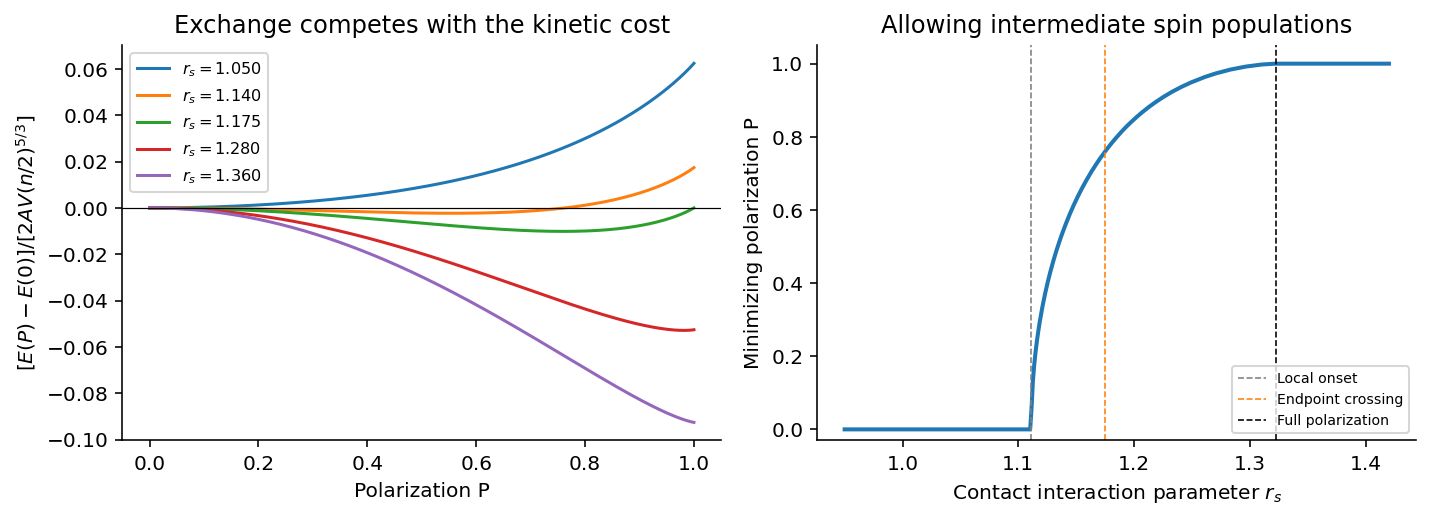
Contact-interaction spin energies showing partial polarization between the local onset and full saturation
. Details. 
The central limitation is that a Hartree-Fock electron gas includes exchange but omits the correlation energy that is not representable by one determinant. Opposite-spin electrons can lower their repulsion by avoiding one another in a correlated unpolarized state. Hartree-Fock misses that avoidance while retaining the exchange advantage of aligned spins, so it need not place a magnetic instability at a reliable interaction strength. The relevant energy differences between competing spin states can be much smaller than their total energies. Correlation calculations of the electron gas explicitly address this competition.[ref]
Ground State of the Electron Gas by a Stochastic Method by D. M. Ceperley and B. J. Alder. Author manuscript, physical PDF pages 4–8: competing phases, correlated trial functions and energy differences
There are further model restrictions. A constant contact coupling discards the momentum dependence of the Coulomb interaction and the resulting nontrivial screening. Real materials have a lattice, band structure and material-dependent effective interactions. Spatial magnetic textures or other competing states are excluded by a comparison restricted to uniform Fermi spheres. Even before those changes, part c's two endpoints do not find the continuous polarization onset.
The symbol also needs care. Here it is an energy ratio proportional to . The usual Dimensionless Wigner-Seitz radius of a three-dimensional Coulomb electron gas is , proportional to . They are not the same density parameter. A quoted experimental value of the latter cannot be compared numerically to without a model-specific mapping. The contact interaction, missing correlations, restricted variational class and parameter convention prevent the number from being a quantitative experimental prediction. The paper supplies no particular experimental threshold, so none is invented here.
Articles by others on the same topic
There are currently no matching articles.