The first term assigns energy to occupying the localized orbital at site . The hopping term moves an electron between neighbouring sites, producing kinetic delocalization and band dispersion; Hermitian conjugate hops make the Hamiltonian Hermitian. The final term costs only when both spin states occupy the same local orbital. This is a Hubbard model with an on-site Coulomb penalty, not a classical interaction between magnetic dipoles.
At one electron per site and large , a real hop is energetically costly, but a virtual hop into a doubly occupied intermediate state is possible. Opposite-spin states can exploit these virtual processes and lower their energy, while parallel spins cannot occupy the same one-orbital site. The resulting singlet–triplet splitting produces antiferromagnetic Hubbard kinetic exchange.
There is a terminology qualification. The paper calls this overlap-mediated process “direct exchange” because the hopping is directly between neighbouring magnetic orbitals. In the stricter distinction between direct Coulomb exchange versus kinetic exchange, the displayed Hamiltonian omits an explicit intersite Coulomb exchange integral. The antiferromagnetic mechanism derived below is kinetic exchange; a genuine intersite direct exchange term is separate and can compete with it. This distinction also separates the model from ligand-mediated superexchange in part f.
Expand the field operator in orthonormal localized orbitals, . For a one-electron continuum Hamiltonian , projection givesThe coefficient in the displayed lattice Hamiltonian is . Thus the projected hopping matrix element and sign convention requireOrthogonality states ; it does not imply for a spatially varying potential. If the off-diagonal potential is assumed zero, for example when it is a constant, the hopping coefficient is . This is the kinetic integral requested by the paper, but it equals under the paper's own leading-minus convention. A convention writing the hopping term with a plus sign would instead call itself .
TODO: the printed positive equality for requires a missing assumption about and a consistent hopping-sign convention. It does not follow from orthogonality alone. The general projected relation above is the result supported by the supplied information. Rephasing an orbital changes both and the coefficient of the corresponding operator together; it does not remove this algebraic sign mismatch in a fixed convention. The spectrum in the remaining two-site calculation depends on , so the missing convention does not prevent solving those parts.
Fix canonical single-particle order and write the occupation ket as . The six states in the printed order are , , , , , . The last state is double occupancy on site 2.
For a fermionic raising and lowering operator acting on mode , the sign is , and annihilation requires that mode occupied while creation requires it empty. Starting from the second basis state, the hop that reaches the last state isIt therefore contributes . Starting from the third state instead,because the occupied mode precedes . The Hamiltonian's leading makes . Finally , so . No other displayed basis state reaches in one allowed hop. These signs verify the three nonzero entries without assigning distinguishable-particle hopping signs to fermions.
Use for the six printed basis vectors. The three singly occupied triplets areEach has energy zero: either Pauli exclusion prevents hopping to double occupancy or the two contributions cancel. DefineThe state has energy . In the subspace the Hamiltonian is , withFor , the fourth low-energy eigenstate is the normalized singletwhere . Its energy isThe four lowest energies are to leading order, with the singlet and triplets just given. The upper pair lie near and .
The low-energy Hamiltonian can be writtenusing dimensionless spin-half operators. It places the singlet below the triplet by , hence favors antiferromagnetic alignment. A lattice of such bonds can support antiferromagnetism, although its ordering pattern also depends on geometry and competing couplings. The physical energy gain comes from virtual charge fluctuations, not from a permanent double occupancy in the large- limit.
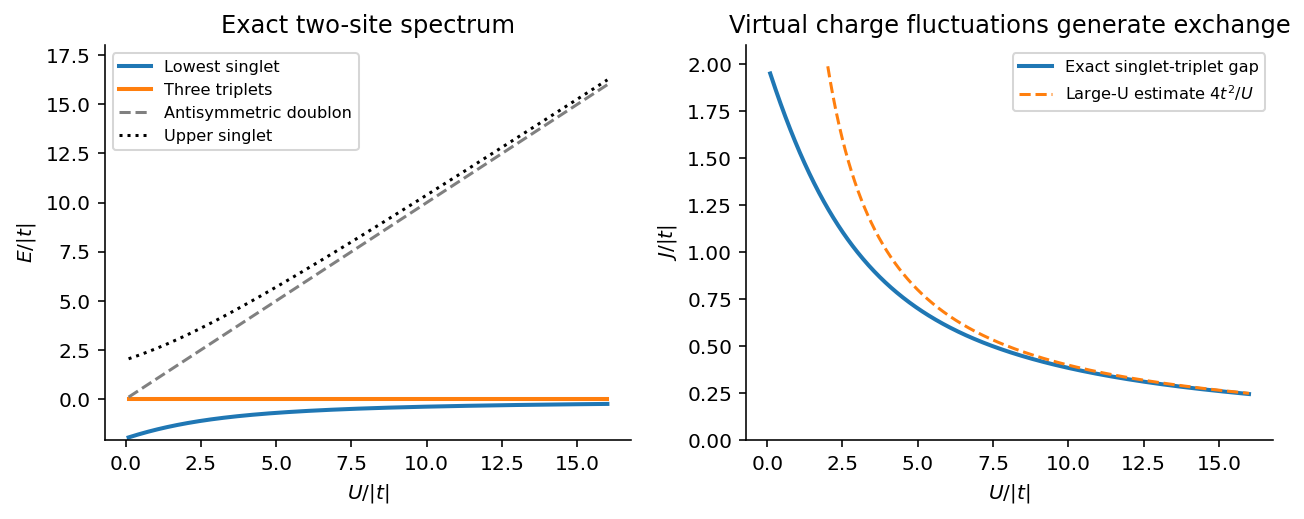
Exact singlet-triplet spectrum of the two-site repulsive Hubbard model and the large-U exchange scale
. Details. 
An overlap estimate must use nearest magnetic-ion separations. For the face-centered cubic lattice of Mn, ; for the body-centered cubic lattice of Fe, . The supplied radial functions have inverse decay lengths . Their intersite overlap therefore contains approximately , up to polynomial and angular factors. The decisive exponent difference isThe exponential orbital-tail estimate of exchange thus gives a hopping suppression approximately before polynomial corrections. Keeping the supplied radial prefactor in a midpoint overlap proxy givesThis proxy is not an evaluated hopping integral, but confirms that the polynomial factors do not undo the exponential loss. If comparable Coulomb denominators and nonexponential prefactors are assumed, a kinetic-exchange scale proportional to is suppressed by roughly –. Direct intersite Coulomb exchange likewise contains products of the small tails. Coordination-number differences cannot compensate for many orders of magnitude.
By contrast, the measured ordering-temperature ratio supplied in the question is , not an exponentially tiny number. Within this overlap model, direct Mn–Mn exchange cannot explain MnO's substantial magnetic ordering scale by extrapolating the Fe mechanism. Another exchange path is required.
This is an order-of-magnitude argument, not an exact relation between an itinerant Curie temperature and a localized-spin Néel temperature. The hydrogenic functions use the printed bare values; actual solid-state orbitals are screened and hybridized. Their literal absolute exchange scales should not be treated as quantitative predictions for Fe or MnO.
Use an oxygen-mediated superexchange path between two magnetic metal orbitals. A minimal one-active-orbital three-site charge-transfer superexchange Hamiltonian is clearest in a hole representation:Here describes a metal hole, a ligand hole, and is the energy needed to create the virtual ligand hole. The low-energy configuration has one hole on each metal orbital and no ligand hole, corresponding to a filled bridging ligand orbital in the electron picture. and penalize double hole occupancy on the corresponding sites.
Virtual metal–ligand hopping transfers charge through oxygen without producing a real mobile carrier. Eliminating the ligand gives an effective metal–metal hopping . Combining it with the large metal repulsion givesA ligand double-occupancy channel adds a contribution of the same sign for the simple half-filled straight-bond model, often organized as . The precise coefficients depend on the orbitals and hopping conventions; the essential mechanism is virtual charge transfer plus spin-selective access to intermediate states. The effective spin interaction favors antiparallel alignment while the material can remain insulating.
For MnO's rock salt structure, the strong approximately Mn–O–Mn path joins next-nearest Mn sites. It is not the nearest fcc Mn–Mn separation used in the direct-overlap estimate of part e. The oxygen-mediated path avoids relying on the tiny direct overlap of the two distant 3d tails. A realistic model includes several Mn 3d orbitals, Hund coupling and the high-spin Mn ion; the single-orbital Hamiltonian above isolates the antiferromagnetic exchange channel. Approximately paths and different orbital occupancies need not have the same sign.
Articles by others on the same topic
There are currently no matching articles.