The first panel is the one-particle-irreducible Feynman diagram for photon vacuum polarization. The two internal Dirac propagators carry and , and the external photons carry . The other panels fix the routings used in parts c and d.
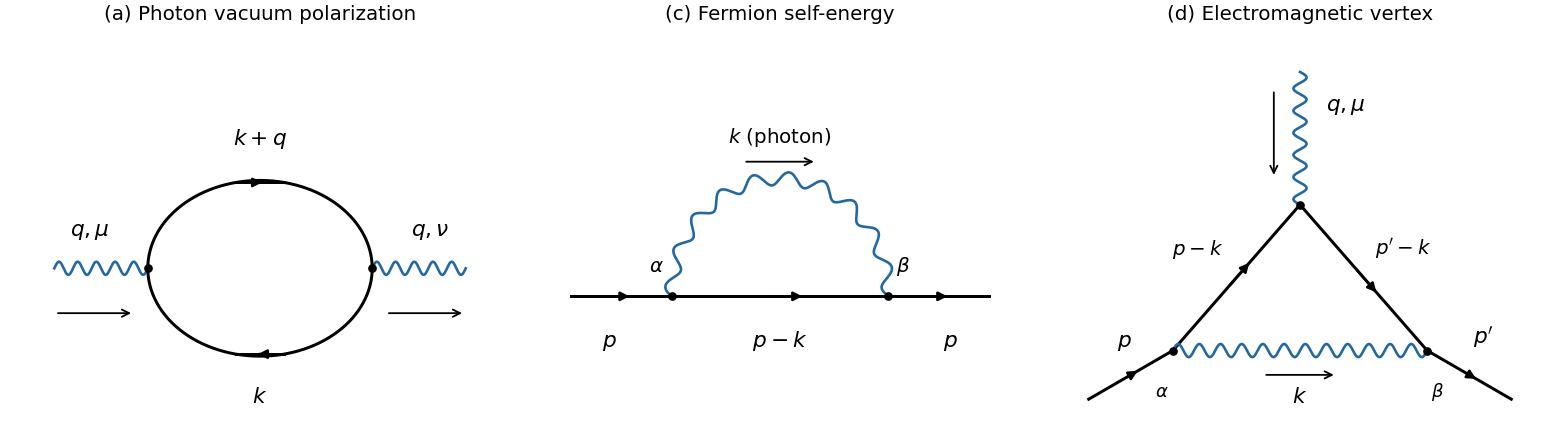
Original labelled one-loop QED Feynman diagrams: photon vacuum polarization, fermion self-energy, and the electromagnetic interaction vertex
. Details. 
The closed fermion loop sign contributes a minus sign; there is no extra symmetry factor. Applying the given Feynman rules, with the external propagators amputated,Equivalently, the required amplitude isThe Feynman slash notation is and in the chosen dimensional regularization convention.
The Ward identity implies . Lorentz invariance then gives , so . The gamma matrices satisfy . Odd traces vanish, and thereforeSubstituting gives the requested scalar coefficient:To extract the ultraviolet divergence without introducing a Feynman parameter, set , and useTranslation invariance of dimensional regularization gives . ConsequentlyIn the pole coefficient one may set : the bracket becomesThus the ultraviolet pole of QED vacuum polarization isThe cancellation of the apparent divergence is essential: gauge invariance forbids a photon mass counterterm. The scalar result at is understood by continuation after this cancellation.
The middle panel in part a has an internal photon of momentum joining two points on a fermion line; the internal fermion has momentum . It is a one-particle-irreducible Feynman diagram with no closed fermion loop sign. In Feynman gauge,orThe decomposition in the source gives . In particular,For a direct ultraviolet divergence extraction, use a Feynman parameter multiplying the massive denominator, shift , and define . Then andOdd terms integrate to zero. Taking the trace explicitly supplies the weight , whose integral tends to . HenceAs a check on the same fermion self-energy calculation,This is the ultraviolet pole of QED fermion self-energy. It is safe to extract it at generic external momentum; an on shell or massless limit must distinguish any infrared divergence from this ultraviolet divergence.
In the right panel of part a, enters the fermion line, leaves it, and a virtual photon of momentum bridges the external photon vertex. Write and . The one-loop amplitude isThis Feynman integral has a logarithmic superficial degree of divergence. Its ultraviolet pole is independent of the external momenta and , because every such numerator insertion or denominator correction lowers the large- degree. Preserve an auxiliary positive mass while extracting the ultraviolet pole; setting everything to zero would create a scaleless integral and conceal the cancellation of ultraviolet and infrared divergences.
The leading numerator is . Symmetric integration replaces by . Two contractions of gamma matrices then giveFor the auxiliary-mass extraction of ultraviolet poles,The second term is ultraviolet convergent. ThusThe ultraviolet pole of the QED vertex is therefore . The Pauli structure has zero trace against and no ultraviolet pole at this order.
Form-factor qualification. The two electron electromagnetic vertex form factors in the source describe matrix elements between external on shell Dirac spinors. A general off shell vertex has more structures, so the unprojected trace is not a projector for the complete finite on-shell . It does correctly isolate the divergent local coefficient, which is all that is required here.
In , the modified minimal subtraction scheme subtracts for each one-loop pole, with no further finite, kinematics-dependent subtraction. Equivalently, use a rescaled renormalization scale and subtract only in that convention. This differs from the minimal subtraction scheme by a fixed scale convention.
Let . With the source's counterterm insertion signs, cancellation proceeds as follows. The vertex has from the loop and from its counterterm, giving . The kinetic part of the fermion self-energy insertion is and its counterterm is , giving . Finally the photon vacuum polarization insertion is and its counterterm is , givingWriting therefore verifies the Ward identity for QED renormalization constants, , at one loop. The proper-vertex Ward-Takahashi identity in QED independently gives , whose divergent part reproduces the opposite signs of and found above. The equality holds in a common gauge fixing and subtraction prescription; the individual constants are gauge dependent.
Articles by others on the same topic
There are currently no matching articles.